
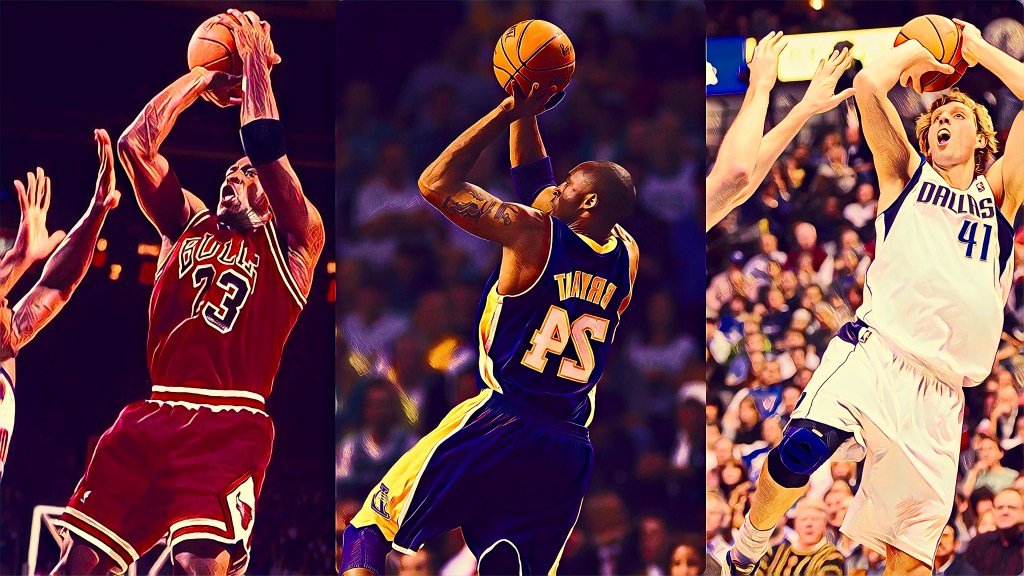
The fadeaway. Arguably one of the most iconic shots in all of basketball. I would say it’s the most iconic shot, but a man by the name of Kareem Abdul-Jabbar exists. It’s a move that’s become associated with some of the NBA’s greatest players, iconized by guys like Kobe Bryant, Michael Jordan, and Dirk Nowitzki. Even LeBron James has made it a part of his arsenal over the years, using it to surpass Mr. Abdul-Jabbar as the NBA’s all-time leading scorer. It’s a move that starts with your back to the basket, defender breathing down the back of your neck, ball in hand and pivot foot welded to the hardwood. A quick turn, a push off your back leg as you rise up and away from your defender, creating an ocean of space between the both of you, then a soft release that leads to you (hopefully) seeing the ball hit nothing but net. It’s a move that’s graceful to watch, frustrating to defend, and oh-so-satisfying to execute.
The fadeaway is my favourite shot in all of basketball. It’s my personal go-to move whenever I step onto the court and has been ever since high school; particularly the off-balance, Nowitzki-esque one-footer variant, to the chagrin of my coaches who much preferred that my 6’5” butt stay deep in the post. If only they knew that the move actually might have been created by one of the most dominant big men the game has ever seen. Now, due to the lack of video footage, no one knows for certain who invented the fadeaway jump shot. What we do know is that the game had evolved from the two-handed set shots of the 30s and 40s with players’ bodies leaning towards the basket, to jump shots in the 50s that added a level of verticality, to eventually a more fluid game around the 60s when more diversity in movement and in-air improvisation started taking place.
During this time, a man by the name of Wilt Chamberlain had been dominating the game alongside the legendary Bill Russell. Now, outside of basketball, I’m not a huge fan of Wilt. Between his politics and comments on black women, the man wouldn’t have been someone I’d cared to have a drink with, and why I gladly take Mr. Abdul-Jabbar’s side when looking back at the two giants’ historic beef. When it comes to basketball, however, “Wilt the Stilt” was an absolute beast. However, because he was so physically dominant, analysts, commentators, and even other players would attribute much of his success to his size and strength rather than skill. Leading Chamberlain to want to add more finesse to his move-set.
As Gary Pomerantz notes in his book, Wilt, 1962: The Night of 100 Points and the Dawn of a New Era, Wilt’s teammate Paul Arizin believed that Chamberlain did not want to be perceived as great simply by being tall, hence why he developed shots like the fadeaway. Now, even if “The Big Dipper” was one of the early pioneers of the fadeaway, he’s not the name we all think of when thinking of the shot. Most of us think of the three men that I named in the opening paragraph. Nowitzki, Jordan, and Kobe, in my opinion, not only popularized the shot, but mastered it. So let’s take a deeper look into each of their fadeaways and see what made each so unique.
Jordan
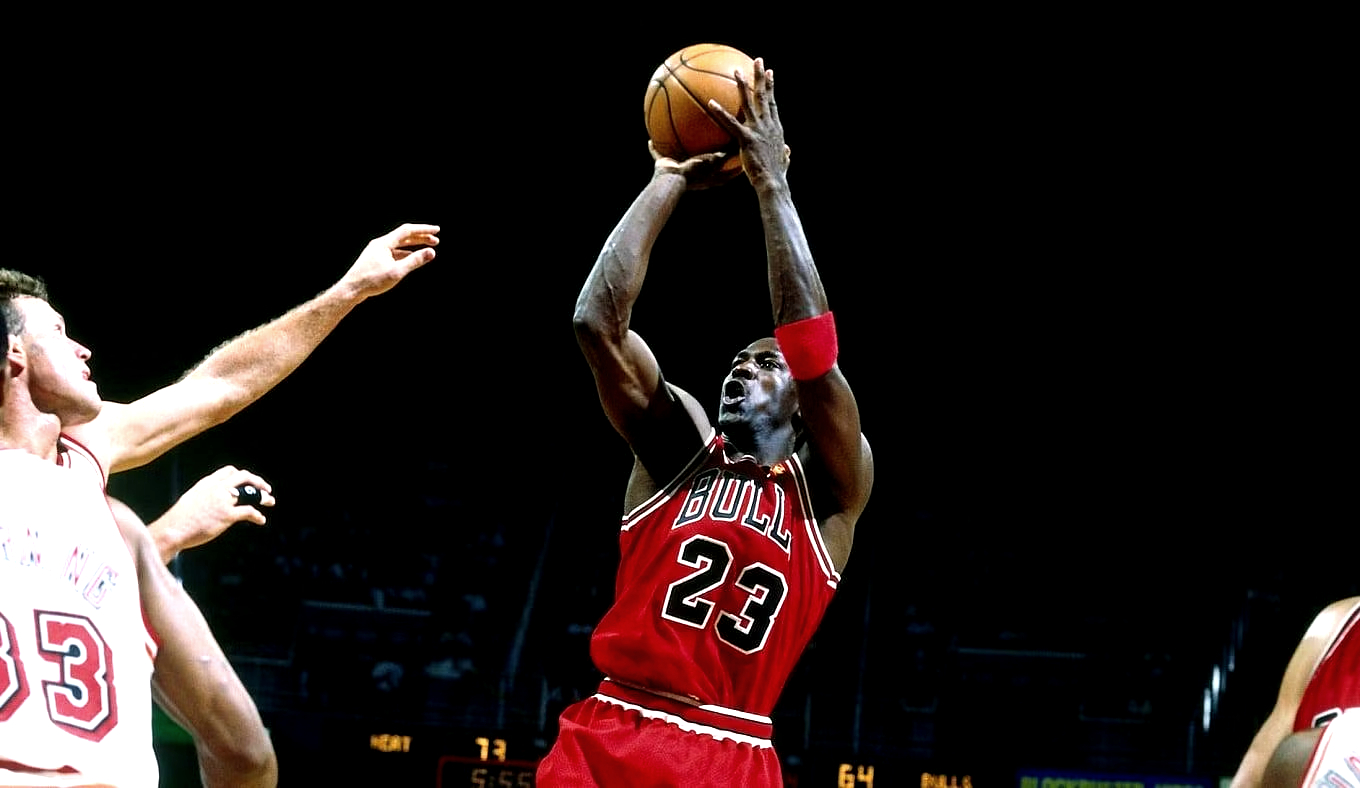
“His Airness.” The man many, if not most, consider the greatest player to ever touch a basketball. The Jumpman himself who’s made billions off of his shoe sales. Guess Republicans really do buy sneakers, too. Jordan could do a lot on the basketball court. But the thing he did most proficiently, and most consistently, was put the ball in the hoop; still standing as the NBA’s all-time leader in points per game. Though he might be remembered for his high-flying dunks by those loosely familiar with the NBA, most of us fans know him for being the player who truly popularized the fadeaway. Jordan was a mid-range maestro throughout all of the 90s. From his efficiency to his versatility, Jordan could have his way from the midrange.
When it comes to his fadeaway, there’s honestly nothing too fancy about it at first glance. However, it’s in the details where you see just how perfect it is. Jordan doesn’t waste a second. As soon as the ball’s in his hands, he gauges his defender’s position and makes his move. He’ll do his classic “windshield wiper,” where he’ll fake going over one shoulder if he sees his defender leaning on him a particular way to throw them off balance, then he’ll turn around the other shoulder and fall away for the shot. It’s the quintessential fadeaway. Succinct, effective, and looks incredibly graceful due to Jordan’s impressive body control and high vertical jump. It was still far from customary for players to shoot this shot in the 90s as it was treated more like a Hail Mary attempt to get a shot off. But Jordan’s efficiency with the shot and complete control of his movements to where the shot looked natural on him, made it not only a viable option but an essential one.
Kobe

Often called the “toughest shot-maker” of all time, the Black Mamba played with a tenacity unlike any other. His will to win and almost psychotic devotion to training and adding to his arsenal of moves is what made Kobe Bryant one of the greatest to ever lace up for the hardwood, and his fadeaway is possibly the most iconic out of this trio. Not necessarily for the shot itself, which elevated and looked uncannily like Jordans, but everything he did that led up to it. You see, where Jordan had his one “windshield wiper” fake and turn, Kobe had a flurry of other moves he would dish out to tire and pester his defender before taking the shot. Shoves, fakes, pump-fakes, step-backs, drop-steps, more pump-fakes; jab steps, rocker steps, jump-stops, spins, half-spins, twirls, up-and-unders, even more pump-fakes. Kobe’s footwork was second to none, and he often looked like he was dancing in the post.
As a somewhat undersized guard, Bryant had to find creative ways to get his shot off. And boy did he do just that, tirelessly working to better his game and become an unstoppable scoring force. Kobe would go on to surpass Jordan in the NBA’s all-time scoring list and his tough fadeaways live on today as being some of the most iconic shots in the game’s history. To the point where you can hear kids and adults alike all around the world shouting “Kobe!” every time they take a tough fadeaway. Rest in peace, Mamba.
Dirk
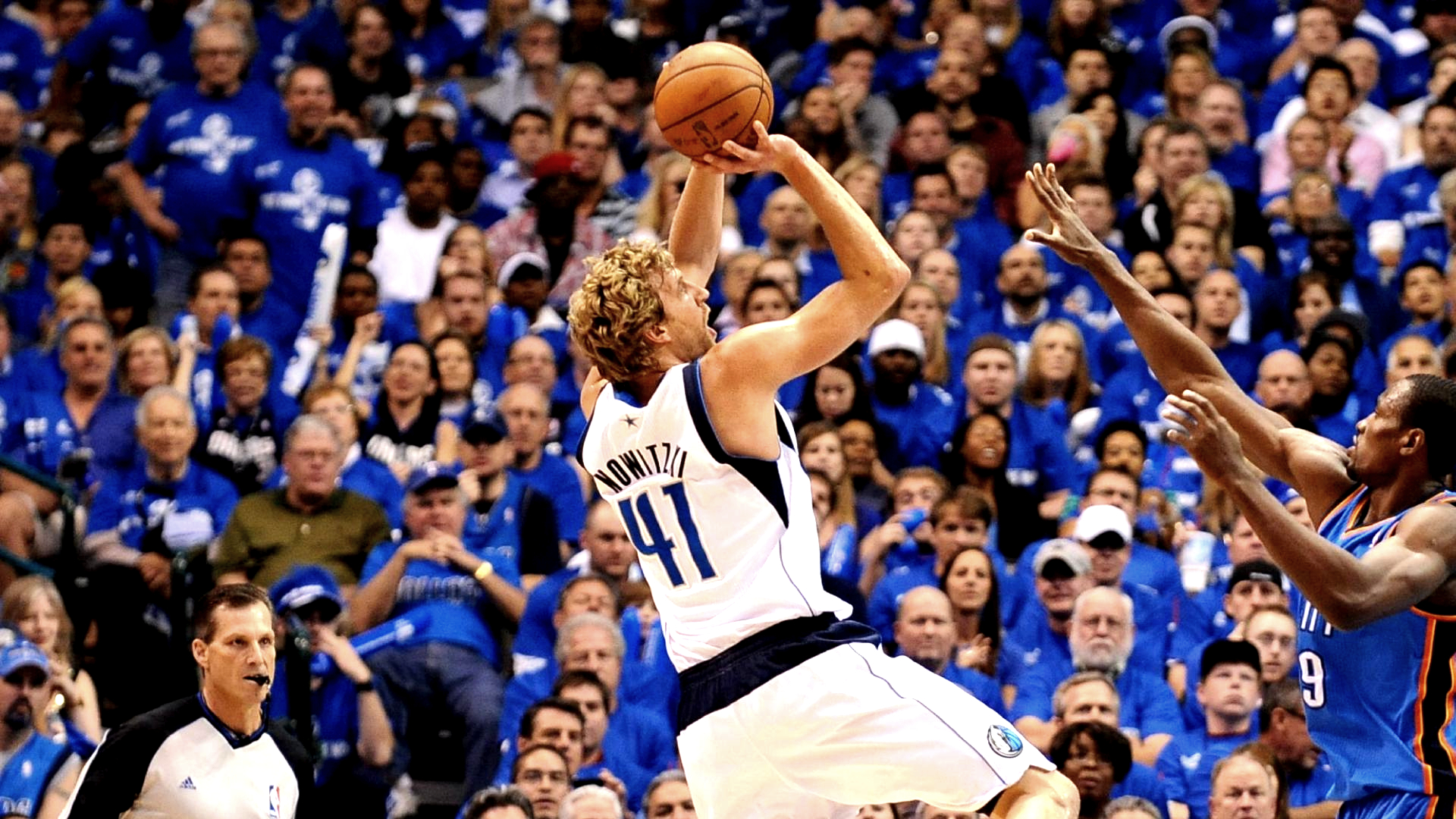
We started with a big man, so it’s only right that we end with a big man. While the fadeaway is already an off-balance shot that requires a ton of body control and for you to put more weight on your back leg, Nowitzki decided to make it even harder by ridding the front leg altogether and taking the shot off of just his back foot. Yet, for as crazy as the shot looks, he somehow made it effortlessly. Dirk’s fadeaway had his front leg jut out on the shot, acting somewhat like a pike that kept defenders at bay and unable to close the gap. Couple this with Dirk being a 7-footer, and you can imagine how much of a nightmare this shot must have been to guard on a nightly basis.
Nowitzki’s fadeaway may be the only shot that competes with Mr. Abdul-Jabbar’s sky-hook as being the most unguardable shot in NBA history. But it’s not just the fadeaway itself. Much like Bryant, Nowitzki was incredibly agile for a big man and had a bag full of tricks to get to his iconic one-legged shot. There was a finesse to his game that made him versatile. His fadeaway has been emulated by the greats – including Kobe, who often praised Nowitzki and even said how much of a fan of his game he was – and continues to be used by current stars like Luka Dončić.
Even though most fans love seeing high-flying dunks, and today’s NBA has evolved to being effectively a 3-point contest, the fadeaway will always be the shot that gets me excited. And I thank these three greats for making the shot a staple on the basketball court.
 Pixel Swish
Leave a comment