
Watch the video review here.
“It is worn and worthless. It is bent and broken. And it is beautiful in all of those things.”
The original Citizen Sleeper is one of my favourite video games of all time. A game that reminds me of why I hold this medium so dearly and of the powerful ways in which a narrative can be told through choice-driven interactivity. You can imagine what my excitement must have been when reading the news that publisher Fellow Traveler had given Gareth Damian Martin, the solo developer at Jump Over The Age, the green light to work on a sequel to this game I held in such high regard.
Fast-forward a few years, and Citizen Sleeper 2: Starward Vector is here. And it is very, very good. It expands and positively iterates upon the original in almost every way, from its gameplay mechanics to its story and lore. Yet, through this expanse, it never forgets to delicately tend to the one aspect that made the original so memorable: its characters. Although the game may not have hit the emotional highs of the first for me, which in fairness is an incredibly tough task to achieve, Citizen Sleeper 2 is a spectacular sequel worthy of sharing the pedestal with its original as an all-time great.
The Heart
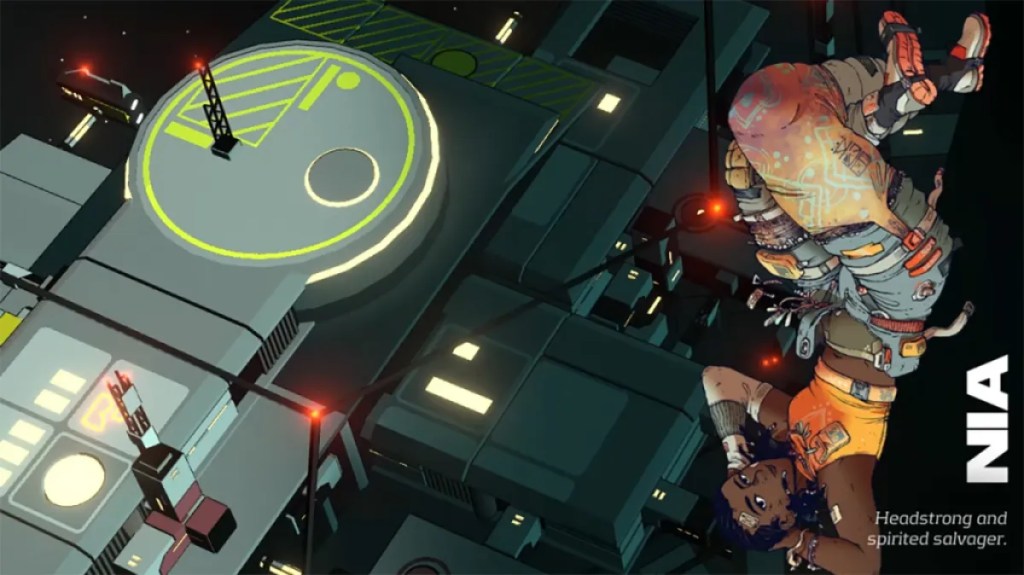
Much like the first game, Citizen Sleeper 2 has you take the role of a Sleeper, a being housed in an artificial body with the digitized mind of a human being who has long since passed and whose memories are wiped from your own. The purpose of a Sleeper is to serve a life of permanent servitude for one of the big corporations in this dystopian science-fiction universe. In Starward Vector, you wake with blurred memories and find yourself on the run from a man named Laine, whose short description underneath their menacing portrait reads, “Relentless, cruel, and on your trail.”
You and your companion, a man named Serafin with whom you supposedly have a long friendship but aren’t able to recall any memories of at the moment, quickly get on a raggedy ship and escape the clutches of Laine…for now. Why you don’t have any memories of your life as a Sleeper and who Laine is are questions that soon get answered and punctuate the necessity for you to stay on the run. It’s not long before you begin travelling across The Belt and finding new crewmates to add to your rag-tag team, getting involved with conspiracies, and helping instigate a mutiny.
Unlike the first game, the story this time around plays out a bit more like a space opera with greater stakes, a far larger world with more characters, and clear paths guiding you to the next major plot beat. Where the first game felt much more intimate, with the focus being on surviving each day and relishing the quiet moments between characters, with all the political strifes and chaos of the systems happening beyond you, Starward Vector puts you in the midst of that chaos with its story and far grander narrative scale. It’s a change that I wasn’t entirely sure of as I was playing, seeing as how much the first game’s heart was tied to its simpler moments and grounded characters. Thankfully, the sequel never loses sight of that heart, giving each member of its memorable cast of characters their satisfying arcs and genuine moments of vulnerability.
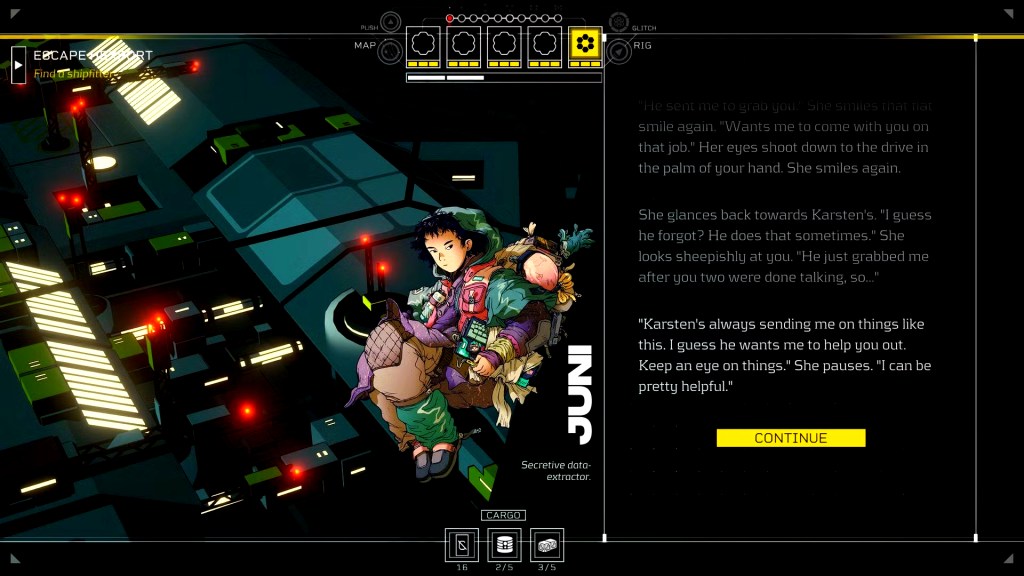
Citizen Sleeper 2 is a wonderfully wordy video game whose experience isn’t that far removed from reading a great science fiction novel. Gareth Damian Martin’s prowess as a writer is showcased in full force as his prose efficiently moves you across each narrative beat while ensuring you savour the moments of needed stillness and introspection. Martin has a way of beautifully illustrating character moments with simple descriptors, giving us as readers all that we need to know about them efficiently while never losing the moment’s emotional weight. His prose carries a warmth and sensitivity often not found in the sci-fi genre, and his love for using said genre as a vessel to explore poignant humanistic themes with vibrancy and nuance will always be something I admire.
That being said, there were a couple of irks I had that took me out of the otherwise captivating reading experience. The lack of contractions in dialogue, for instance, was one that I wasn’t particularly a fan of. Constantly reading “you are” instead of “you’re” when reading character dialogue gnawed at me for the duration of my playtime. It’s a simple thing, but it added to this feeling of not being able to “hear” these characters and how their speech differed from one another when reading their words. Nevertheless, that’s a tiny, somewhat pedantic ink-spot on an otherwise pristinely told narrative whose world and characters, much like the first, will stay with me for some time.
The Controller
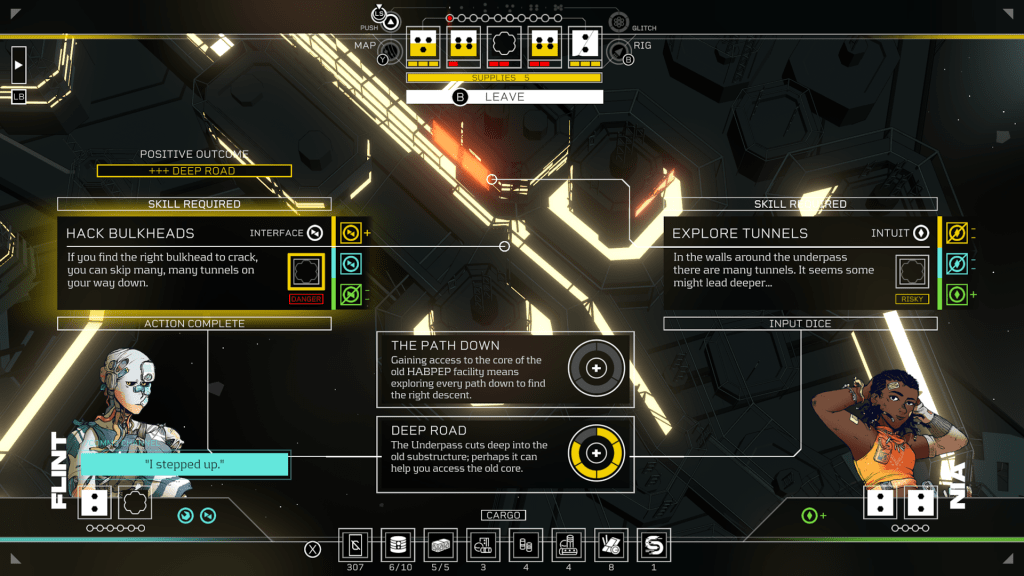
Starward Vector plays similarly to its original, albeit with some notable quirks and extensions to its core mechanics. These games are effectively an RPG with a chance-based dice mechanic driving the gameplay. The game works in “cycles,” with each time you wake up refreshing your roll of five dice you have at your disposal for that cycle. The higher the number of your die, the better your chances of a positive outcome on the multitude of tasks at hand. Each task also has a risk factor from “safe” to “dangerous.” Getting a negative outcome on a “dangerous” task leads to your character losing energy, which, if depleted, accrues “stress” – the biggest new addition to Starward Vector. Fill the stress meter enough, and it’ll damage your dice, which can lead to them getting broken and needing repair, which costs important supplies to do.
Also a big addition to Starward Vector are contracts. As the game has now expanded to be ostensibly an open world, each new location offers the chance to work with a character on a side mission. These missions play out the same way as the major missions in the game, that being a somewhat table-top version of Mass Effect. You’ll select two crew members before disembarking, with each of them having their character-specific advantages and disadvantages, then follow along with a narrative that requires you to complete various tasks. Like before, each of these has a risk factor, with their outcome reliant on dice rolls.
There are five major skill categories for the three different character classes in Starward Vector: Endure, Engineer, Intuit, Interface, and Engage. These skills affect your rolls and the success of every task you perform in the game. If you put in a lot of upgrade points towards your Engineer role and the task at hand requires the Engineer’s ability, then rolling a two can be upgraded two, maybe even threefold. The opposite is true for a task whose ability requires one that you aren’t adept at, for which you hope your crewmates can pick up the slack. Otherwise, they will also accrue stress. If your crewmates’ stress meters fill up, then they’ll be knocked out of the mission.
At first, the number of things the game has you keep track of can be slightly overwhelming. However, it isn’t long before all the jargon makes sense, and you’re flying through contracts, upgrading abilities, and managing your stress in a calm flow state. The medium difficulty, which the game describes as the intended experience, manages to never be frustrating while keeping you on your toes and being savvy with how you approach its balancing act. Whereas the original game’s experience was far more akin to that of a visual novel, Citizen Sleeper 2 feels much more robust in its gameplay and, in turn, has that ratio veer more towards the middle.
The Eyes
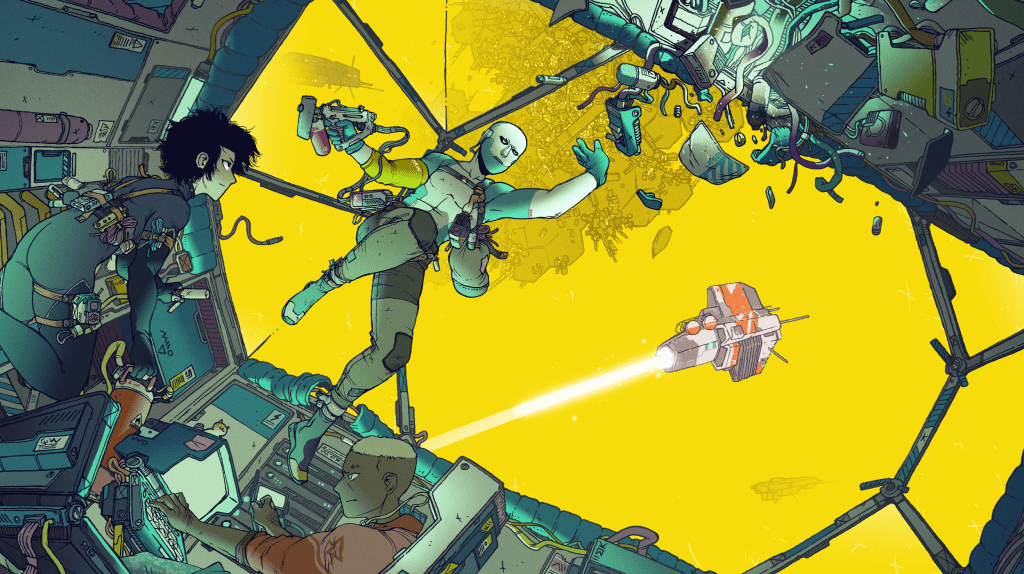
Visually, Citizen Sleeper 2 oozes with a slickness reminiscent of something like Cowboy Bebop. Guillaume Singelin’s artwork is evocative; his character portraits jump out of the screen with such a level of detail that you want to zoom in on each of them to see all of their intricacies. It’s not just about the detail but how he’s able to craft these portraits in such a way that brilliantly shows us everything we need to know about who these characters are. From the frayed cloth that poorly wraps around Juni’s keyboard to the random beads and wires that are daisy-chained around Nia’s belt, these portraits do so much in bringing these characters to life.
Unfortunately, I can’t say the same for the environmental artwork. None of the locations I visited during my time in The Belt were particularly memorable. I would read wonderfully vibrant descriptions of the places my crew had landed on, yet the artwork for these places didn’t come close to matching said descriptions. This didn’t affect my immersion all too much, as you’re constantly viewing these places from a top-down perspective that’s quite a bit zoomed out from the action, with your focus being on either the tasks at hand or the words flowing on the screen. Nevertheless, it’s something that I had hoped would have gotten a little more attention this time around, if only to feel even more connected to this interesting universe.
The Ears
Amos Roddy is the composer of possibly one of my all-time favourite tracks in all of video games: “Possible Futures.” A track that had made itself comfortable in my ears during my time with the original game. And one that would make a surprising appearance this time around as well, causing me to completely drench my controller in tears. Roddy’s compositions in Starward Vector continue to titillate and help evoke much of the same emotions as the first game did.
His ability to fuse ethereal soundscapes with slow synths that reverberate this wondrous feeling of longing, hope, and melancholy will forever be awe-inspiring. Though I wish there were more instances of tracks that jumped out and forced me to pause and listen, particularly during some of the more emotional beats of the narrative, Roddy’s work perfectly coalesces with Martin’s writing and Singelin’s artwork to create a beautifully harmonious audiovisual experience.
The X Factor
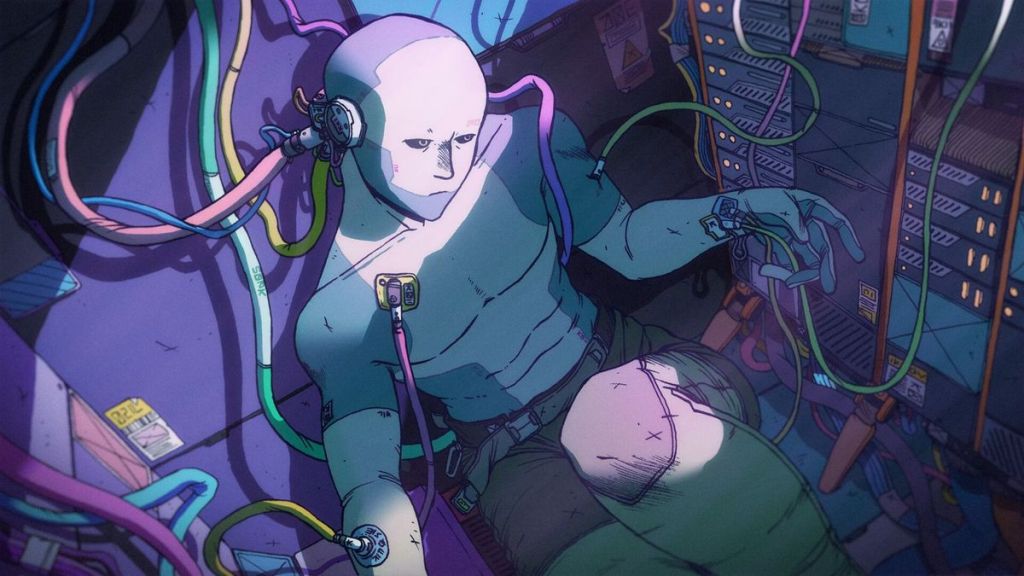
There’s something special about Citizen Sleeper 2. Something that connects on a deeper level. Through all of its new gameplay additions, its larger world and ambitious narrative, and even minor shortcomings, Starward Vector retains that special something which separates it from being just another great game. It’s not something one can describe in a review such as this because doing so is frankly impossible. It’s this kinetic connection one can only experience through playing the game. A connection that, at its core, is intrinsically human.
The Verdict: 9/10 – “It’s Essential”
Shaz played Citizen Sleeper 2: Starward Vector on Xbox Series S via Game Pass

 Pixel Swish
Leave a comment