
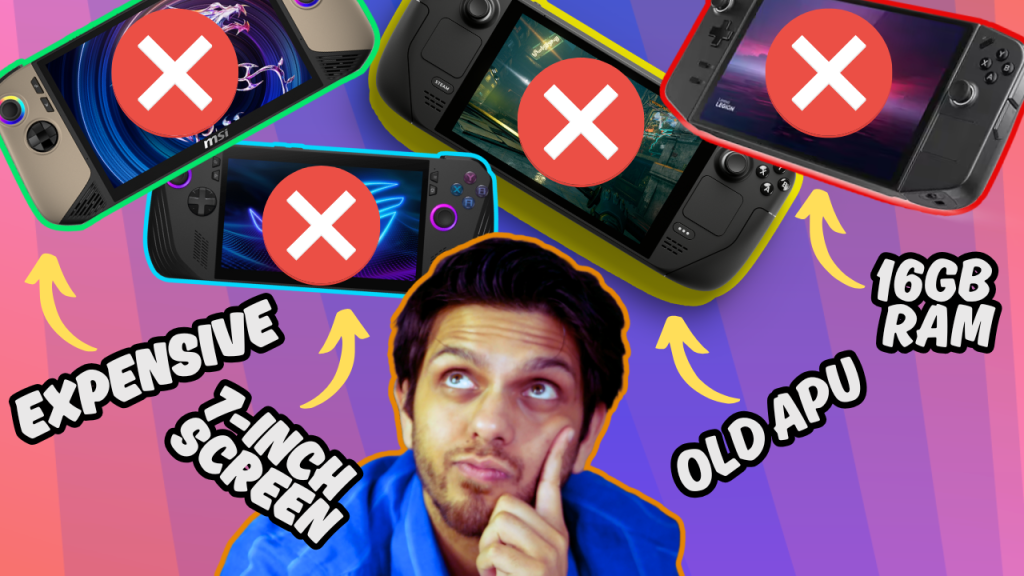
For the past few days, I’ve been obsessively reading articles and watching videos on the MSI Claw 8 AI+ (congrats, by the way, MSI, for having one of the stupidest names for a tech product. You’re right up there with The Chumby). Ridiculous naming schemes aside, MSI have, apparently, outdone themselves with this handheld, which is a vastly improved refresh to its original Claw from last year. Every YouTuber and tech reviewer have praised its screen, ergonomics, battery life, and most importantly: its performance. Reportedly, this beast outperforms competitors like the ROG Ally X by 5-10%, which, though it isn’t much, is still considerable considering how powerful the Ally X is. In basically every way, this device seems like something I’ve dreamt about for decades. However, one huge factor is making me reconsider pulling the trigger on it—actually, it’s more like 1,300 factors.
I was – and, admittedly, still somewhat am – excited about this device. That’s because for anyone who’s been following my work, you’ll know how much I love handheld gaming. The dream, for me, ever since I was a wee lad, was to be able to play my console games on the go. And though each generation has come closer to that dream coming to fruition – with Nintendo and Valve, in particular, helping to spur the current handheld renaissance we’re living in – the industry always seems to fall just a little short. The PC handhelds we’ve gotten from the likes of Asus, Lenovo, and others, though impressive and very exciting, still fall shy in one way or another from this dream of mine. However, the Claw 8 AI+ may very well close that gap, but at 1300 Canadian dollars, I may need to start dreaming about something else. Especially when considering that I’ve been able to, for the most part, satiate this desire of mine through another, far cheaper means: cloud gaming.
What I Want In A Handheld
So, what is the ideal handheld for me? Well, firstly, it needs to have a nice, big screen. Though I think a seven-inch screen is great, it’s still a little too small for triple-A titles. Eight inches is, in my opinion, the sweet spot. The screen needs to be a 1080p or 1200p 120Hz native landscape panel with VRR. I would love OLED, but will accept a very high-quality LCD with great black levels. Hall-effect joysticks and triggers are all the rage nowadays, and for good reason, so we need that. I also play a lot of 2D retro games and some fighting games, so a nice D-Pad is essential. Ergonomically, the Steam Deck has it figured out and feels incredible in the hands, so if we can emulate that while having a bit of a sleeker design with a better screen-to-body ratio, that would be great.
Now, let’s get to the three biggest factors: price, performance, and battery life. For performance, I’d like 32 gigs of fast RAM, which, when coupled with a beefy APU, should be powerful enough for me to play every newly released triple-A title for the next three to four years at native resolution and medium-high settings, all the while getting north of 40 frames per second, consistently. I don’t need the full 60, but something that, when coupled with that VRR display, gives me a very smooth experience. I’m fine using some upscaling to achieve those results, but I shouldn’t have to put FSR to “Ultra Performance,” which destroys the image quality, to do so.
I would then like to be able to play these titles at those settings for at least two play sessions before having to charge the device. A play session for me is roughly an hour and a half to two hours. Which means that this hypothetical device needs to give me about three to four hours of playtime for triple-A titles, while being very battery efficient when in idle. I’d assume, then, we’re looking at an 80-90 Wh battery. If this kind of battery life isn’t possible at high TDPs, then I’d need to be able to achieve all these graphical settings and framerates at a sub-20 TDP.
Finally, I need to be able to do all of this for no more than 700 USD, which roughly converts to a little under 1,000 CAD.
The Perfect Handheld Doesn’t Exist…Yet
Every handheld currently available falls short in one way or another from this dream device of mine. The Steam Deck, though sporting an amazing – albeit 720p – OLED panel with the best ergonomics, has an aging chipset that struggles to run the latest triple-A titles at anything above low settings—and even then, it struggles to go beyond 30fps. The Lenovo Legion Go has an amazing 8.8” screen and the AMD Z1 Extreme chip, which, though a couple of years old at this point, can manage medium-ish settings and 30+ frames per second on a lot of current-gen titles. But its meagre 16 gigs of RAM throttles it and can make for pretty choppy experiences on modern games. Not to mention its less-than-ideal 49 Whr battery means you’ll be searching for an outlet pretty quickly.
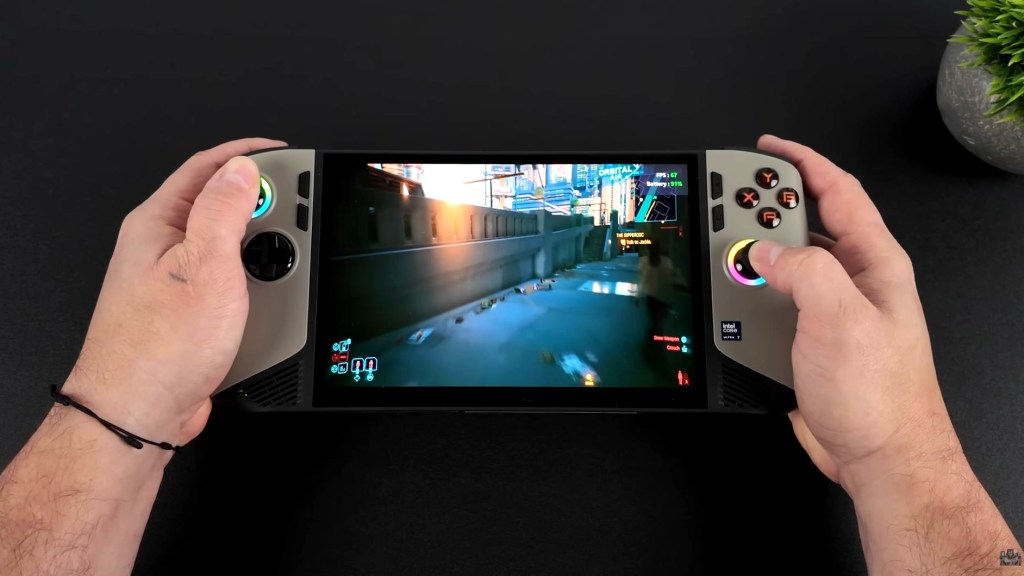
Then you have the Asus ROG Ally X, which many reviewers call the benchmark within the PC handheld space, and for good reason. It has a great 1080p VRR LCD, a big battery, decent ergonomics, and 24 gigs of RAM to fight alongside the Z1 Extreme chip. Unfortunately, at 7-inches, the screen is a little on the small side for me and that aging Z1 Extreme chip is just a bit shy of achieving the fidelity and frames I’m looking for in modern triple-A titles. Furthermore, it retails for 800 USD and 1100 CAD.
Now let’s enter the MSI Claw 8 AI+. In every way, this is my dream handheld. Big beautiful screen with a high refresh rate and VRR? Check. Lots of fast RAM? Check. Big battery? Check. Good ergonomics? Check. Hall-effect sticks and triggers? Check. A new-generation APU that surpasses the Z1 Extreme in performance and can play modern triple-A titles at medium-high settings and decent frame rates? For the most part, check. A relatively affordable price? Oh God! No! Not check; not check at all!
Cloud Gaming Is Still King…For Now
It’s because of this that I’ve stuck with my Logitech G Cloud and services like GeForce NOW. I’m able to play so many modern titles at the highest settings and very high frame rates while still getting hours upon hours of playtime because of the G Cloud’s incredible battery and not needing to rely on its internal hardware. Now, of course, there are a ton of caveats here. Firstly, though I’m lucky enough to live near one of Nvidia’s data centres and have gigabit internet at home, which provides for a mostly excellent cloud gaming experience, the moment I step out of the house, that experience is very difficult to replicate, given the inconsistencies of public Wi-Fi. I also don’t have access to a lot of my Steam library and must rely on the libraries of the cloud gaming service I’m using. I could get a subscription to a cloud PC using services like Shadow PC and MaximumSettings.com, which would give me such access, but those require a lot more tinkering and finagling that I don’t want to do every time I want to play a game.
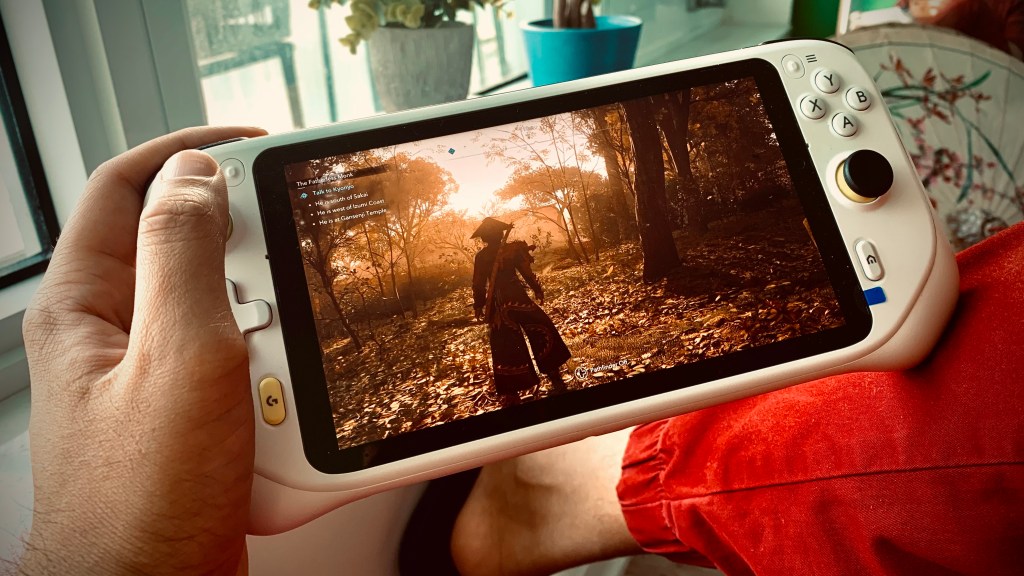
Even so, as it stands, until a handheld PC like the MSI Claw 8 comes out at two or three hundred dollars cheaper, or innovations in APUs get to the point where even midrange chips can offer far better performance, cloud gaming is where I’m going to be. And with how the leader of my neighbours to the south is currently going in regards to his wonderful tariffs and the rising component costs for manufacturers of tech around the world, I may end up sticking around here for much, much longer—or at least until the Claw 8 goes on sale.

 Pixel Swish
Leave a comment