
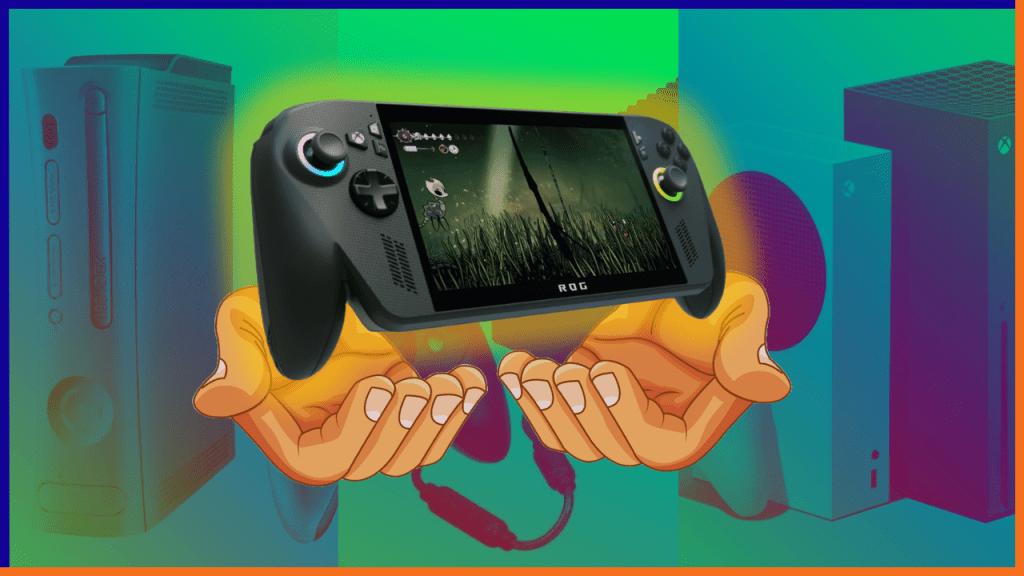
Earlier this week, we got a livestream of an Xbox Games Showcase presenting what’s new and upcoming in the world of Team Green. In it, we got a smattering of world premieres, including a cinematic trailer for A Plague Tale: Resonance, as well as a dazzling new trailer for Clockwork Revolution (my game of the show). We also got shown an exciting piece of hardware—the Asus ROG Xbox Ally (try saying that ten times in a row).
For a few years now, we’ve gotten leaks and rumours that Xbox were working on a handheld device, with Phil Spencer even mentioning in an IGN livestream last year that Xbox needed a portable device that didn’t need to rely on streaming. Fast-forward a few months, and articles began to circulate that Xbox were going to partner with an established OEM like Lenovo or Asus to make an Xbox-branded handheld.
Jez Corden from Windows Central originally reported in an exclusive that this partnership would serve as a “research experience” for Microsoft before they dove fully into their next generation of consoles with the “Series X 2”—or whatever they’ll call it because for all the things Xbox can do, product naming isn’t one of them—and a handheld of their own making. Well, fast-forward a couple of more weeks, and Corden returned with an update, writing that, “Xbox’s first-party handheld has been sidelined (for now), as Microsoft doubles down on ‘Kennan’ and Windows 11 PC gaming optimization.” “Kennan” is the codename for what we now know as the ROG Xbox Ally. And I don’t think people realize just how smart this move was by Phil Spencer, Sarah Bond, and the rest of their team. A smart move that perfectly aligns with what the future of Xbox looks like.
What Xbox Was, and What It’s Become
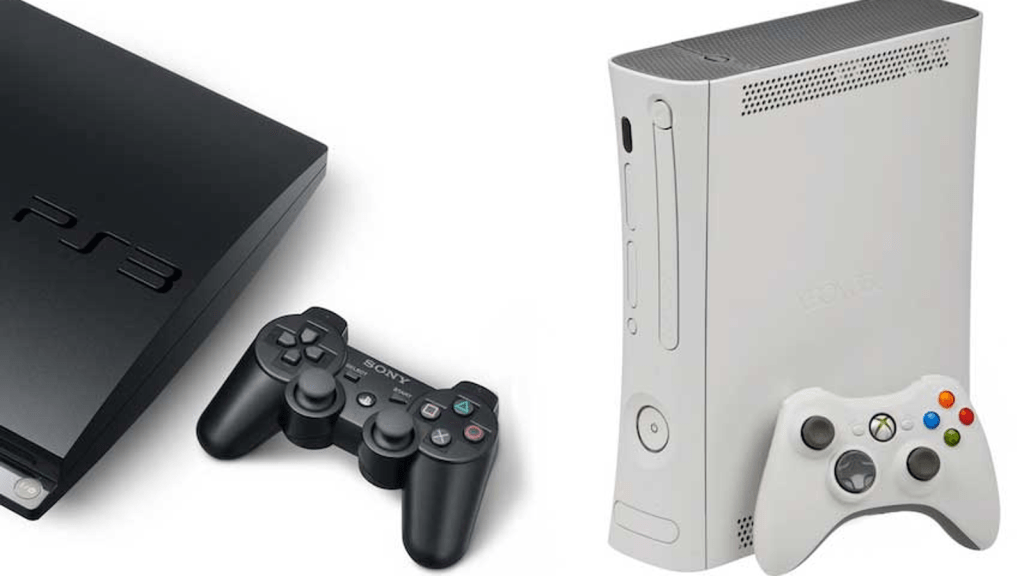
We’re all familiar with the history of Xbox. Microsoft came out swinging in the early 2000s with the original Xbox, giving the world Halo: Combat Evolved and the “Duke” controller. They instantly became a competitor to the “Big 2” in Sony and Nintendo, and it was clear that they were here to stay. One generation later, Team Green dominated with the Xbox 360. Even with all its hardware flaws (looking at you, “red rings of death”), the 360 is still widely considered to be the console that “won” that generation of gaming, even though the PlayStation 3 did eventually outpace it in worldwide sales by the generation’s end thanks to a slew of incredible exclusives and Xbox’s shift to whatever the heck the Kinect was.
However, things would take a turn for the worse a generation later. I don’t need to tell you that the Xbox One was a massive failure for Microsoft. Phil Spencer can tell you that. As he ostensibly did during an episode of the Kinda Funny Xcast a couple of years ago, saying, “We lost the worst generation to lose, in the Xbox One generation, when everybody built their digital library of games.” And it’s true, and Team Xbox have been fighting for their lives ever since. So, how does a flailing console manufacturer keep itself in the game? Well, if people aren’t coming to your console, then you just have to bring your console experience to them.
“Xbox Game Pass;” “Play Anywhere.” These are the two phrases we’ve heard incessantly over the past few years coming out of the mouths of Xbox executives like Phil Spencer and Sarah Bond. A strategy that began when the team started putting their first party games, day and date, on their subscription service, Game Pass, and culminated most recently via an admittedly brilliant advertising campaign that stated “This Is An Xbox.” Xbox aren’t, like many have been saying, becoming a third-party publisher like SEGA. Rather, they’re becoming what Microsoft has always been: A software services company. They want you on Game Pass, they want me on Game Pass, they want everyone on Game Pass. And credit to them, Game Pass, is very good. As an on-again, off-again subscriber since late 2019, I admit that I’ve gotten more out of the service than I have any other subscription service I’ve ever subscribed to. It is, as games journalists will keep telling you, the best deal in gaming.
Now, it’s come to the point where if you want to play Xbox, you can most likely go to any screen in your home and play Xbox. There are certain caveats, of course. To play on a phone, you need fairly fast internet and need to subscribe to the highest tier of Game Pass in order to access cloud gaming, and even then, not all of the Game Pass library is on Xbox Cloud. But the idea of it, of Xbox Play Anywhere, is what’s powerful. And this idea perfectly aligns with their newest product, the ROG Xbox Ally.
The State of PC Handheld Gaming
We’ve been in a handheld renaissance, of sorts, over the past few years. And for someone who’s loved handheld gaming ever since the Gameboy Colour, it’s been very exciting to see how fast this niche market, and the technologies surrounding it, have grown. However, we’ve hit somewhat of a wall over the past year or so regarding performance, efficiency, and cost. You see, the first generation of these handhelds post the Steam Deck, which is to say the original ROG Ally and Lenovo Legion GO, were powered by AMD’s Z1 Extreme chip. A chip that has been very impressive in modern triple-A gaming performance, outpacing the Steam Deck in practically every way, even with the bloat of Windows.
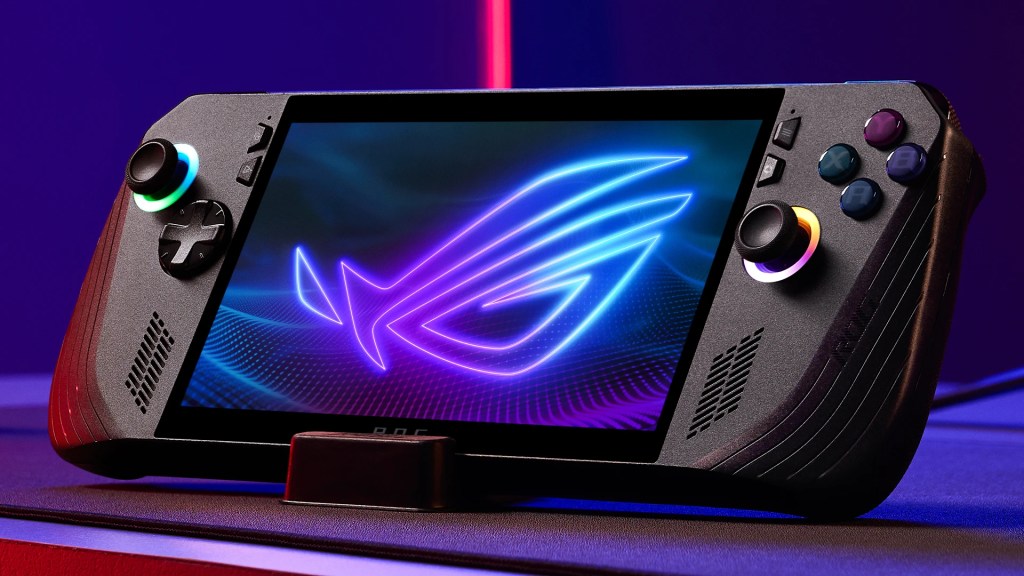
The Z1 Extreme chip would go on to power the successor to the ROG Ally with the Ally X, and is continuing to be supported by Lenovo’s latest handheld, the Legion GO S Steam Edition, which provides a considerable bump in performance due to the efficiency of Steam OS compared to the bloat of Windows. But this is still a two-year-old chip. One that, though still more than capable of handling practically all triple-A titles, you see start struggling to keep up high framerates at quality graphics settings with newer titles like Clair Obscur: Expedition 33.
As such, we’ve been due for a new chip to hit the market. And like clockwork, AMD has delivered, with their newest Z2 lineup of chips, with the highest end being the Z2 Extreme. Well, actually, as of writing, they just announced an even higher variant named the Z2 Extreme AI—because, of course. They can’t be a respected corporation without shoving AI into everything. But that higher variant doesn’t add anything aside from some AI cores, which God knows what they do. The base Z2 Extreme chip, which the ROG Xbox Ally is powered by, is a decent boost in performance compared to the Z1 Extreme, with reports suggesting about a 15% increase overall. The problem, however, is that it’s an expensive chip. An employee at GPD, a manufacturer that makes tiny gaming laptops, shared on Discord that the AMD HX 370, which is what the Z2 Extreme is based on, is almost two times more expensive than the generation prior.
Couple that with rising prices of metals and other components needed for building consumer tech, and tariffs (because that’s a thing in 2025), and analysts predict that these upcoming handhelds are going to be very expensive. Which is why Xbox partnering with Asus is such a clever move by Microsoft in a number of ways.
The ROG Xbox Ally and the Future of Xbox
Firstly, Xbox have never made a handheld. And making one from scratch, I’d assume, isn’t easy. So, partnering with an established OEM that’s arguably made the best PC handheld in the space so far with the Ally X, to make a device that still looks like an Xbox product, with Xbox software, is a brilliant move. No need for extensive and expensive R&D on a product line you have no experience with. Work with people who know what they’re doing and just slap a trapezoid Xbox button and bam, Xbox handheld.
Secondly—and I by no means know if this is the case, but I’d assume a variation of it might be—Microsoft and Asus can share much of the manufacturing costs of the device, in turn making it so that the burden can be shared amongst these two tech giants and hopefully (though capitalism is going to capitalism and you can never trust a trillion dollar company) make the final price of this device more consumer friendly. Now, don’t get that twisted, this is going to be an expensive device. And I mean north of $800 expensive for the higher-end “X” variant, which is the version with that Z2 Extreme chip (and the one I’d personally recommend everyone get, as the cheaper model is going to be far less performant).

But even if the “X” variant comes in at 799 USD, that’s less than the price of the current ROG Ally X (it used to be $799, but the Orange Man did a little thing called tariffs). With devices like the upcoming MSI A8, which also has the Z2 Extreme chip, reportedly going to cost north of 1000 USD, Xbox and Asus have an opportunity here to make every other PC handheld obsolete. Then again, this is Microsoft, and they love their money, so we’ll have to wait and see what the price of the Xbox Ally actually ends up being.
Still, this partnership perfectly embodies Xbox as a brand today. This idea that everything is an Xbox, and even when we release a new product, it’s not even fully our product. Now, Phil Spencer and Co. have said that they don’t want to stop making hardware, mainly because of their avid player base. So expect to see another Series X in the next couple of years. But what does Xbox look like ten years from now? Who knows. But I wouldn’t be surprised if they dip out of the hardware-making business altogether come 2035. As for the Xbox Ally, I think it’s going to be a solid device so as long Xbox and Microsoft don’t screw up the software experience. The “X” variant, in particular, is going to be very capable. Even though I’m not a huge fan of how it looks, those grips are going to make for a very comfortable experience. It also only has a 7-inch screen, which is a little small for my tastes, but it’s still a high-quality panel. For me, I’m more than set on the MSI Claw 8 AI+ for the years to come, but am excited to see how well the Xbox Ally does.
 Pixel Swish
Leave a comment