

I consider the original Final Fantasy VII to be one of my favourite video games of all time. I say that without a tinge of nostalgia, by the way, as I’d played the game for the first time only a few years ago on the PS Vita. Actually, my playthrough of the original was an interesting one, as I’d decided to finally jump into the boots of Cloud Strife right when his remake was afoot.
Not having the patience to wait until after I’d finished my journey with the classic 1997 polygonal crew to jump into Final Fantasy VII Remake, I decided that I would play through the entire Midgar section of the original, then jump into Remake as that game only covered the story up until the end of the Midgar section, then jump back into the original and finish off the journey. It was a very interesting experience, to say the least, and it allowed me to compare and contrast the changes Square Enix had made to this world and story with an immediacy that was quite illuminating. With that said, it only took a few hours into my playthrough of Remake to realize just how different this game was from its original. Some of these changes were refreshing and new, some curious and questionable, and others just flat-out jarring and unnecessary.
These changes in gameplay, structure, and overall tonal sensibilities would carry over tenfold into Final Fantasy VII Rebirth—a game that I finally started playing a couple of weeks ago. And, even though I am highly critical of some of these changes and additions—thinking some to be frustratingly superfluous and others laughably cringeworthy—I cannot deny that they have charmed their way into me in a Kingdom Hearts-like fashion that I was not expecting. So, I would like to take today to talk about how, despite its many flaws and follies, Final Fantasy VII Rebirth carries with it a charm and sense of wonder that’s unlike anything else.
The Slow and The Bloated
For anyone who’s played the original Final Fantasy VII, you’ll know that the opening Midgar section takes roughly five to seven hours to complete. As such, when it was announced that Remake would only cover the Midgar section of the game, many a brows were understandably furrowed. Because, how long could a modern remake of just the opening of this game take? 10 hours? Maybe 15 if Square Enix luxuriates in the cinematics and overall presentation? Oh, sweet child, no. Try forty hours. Double that if, God help you, you’re a completionist. Now, if only the first few hours of the original game could be expanded to a near full-sized JRPG, one shudders to think about the number of hours the masterminds at Square could shove into their following entry, given that we’re now delving into the open world proper. 300 hours? 500?
Well, thankfully, it’s not quite as egregious. According to howlongtobeat.com, Final Fantasy VII Rebirth can take a little under a hundred hours for a playthrough that sees players stray off the beaten path and dabble in some of the side content, with a completionist run taking upwards of 150 hours. This would be “fine” if Rebirth covered the remainder of VII’s story. But, as we all know, that’s not the case. Frankly, I’m not even sure if Rebirth reaches 50% of the remaining story. So, combining Remake and Rebirth’s playtimes, we’re looking at a game that’s not twice, but thrice longer than the original game—multiple times more if you’re a completionist—yet still barely reaches the halfway point of the original’s story. The question that everyone should be emphatically asking, then, is “why?” What on Earth are you doing or seeing in these games that’s stretching their runtime to ungodly lengths? Well, the answer…is bloat. And a lot of it.
Firstly, there’s a ton of side content in both of these games. Rebirth, specifically, has so much going on in its open world. From Assassin’s Creed-like towers, combat encounters with special enemies, treasure outposts, sanctuaries to unlock lore, a string of missions to find something called a protorelic, and a lot more. Not to mention, each region has about half a dozen NPC side quests, most of which take a not insignificant amount of time. Then, of course, there are the mini-games. Good Lord, the mini-games. Frankly, at times it feels like Rebirth is more a string of mini-games than actual game game.
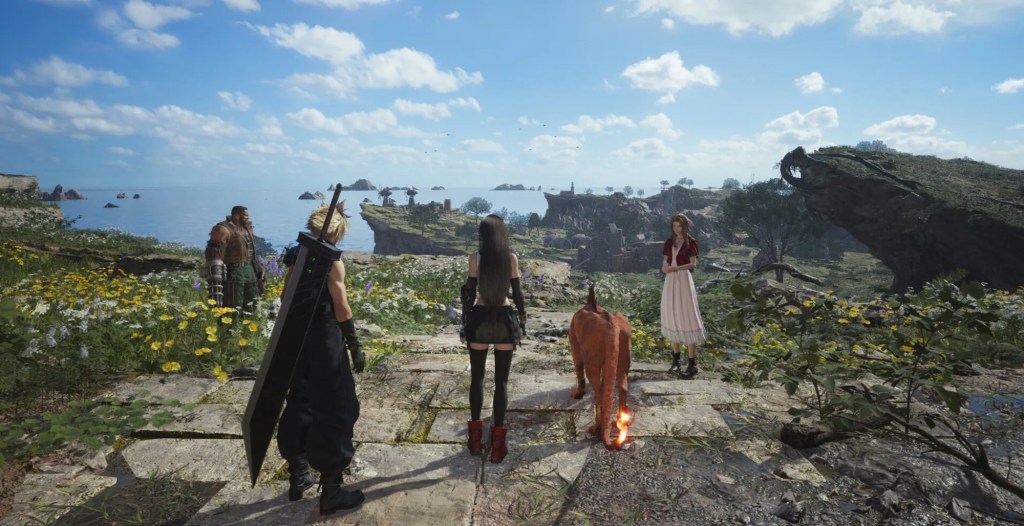
But you know what? All of that would be fine. Because this all sounds like your standard open-world RPG or JRPG affair. And on paper, it is. The problem is, it all feels like padding for padding’s sake. And this sentiment of mine is not simply because of all these extracurricular activities. No, it’s because the moment-to-moment experience of playing Final Fantasy VII Rebirth, and how you’re meant to interact with all of these extracurricular activities, feels padded and frustratingly slow.
The animations for when Cloud scales a wall or rappels down a cliff feel a few seconds too long. The pace at which your chocobo climbs a cliff face feels far slower than it should be, and pressing the “dash” button during this climb is laughably negligible from your chocobo’s regular animation. Pushing or dragging a cart to complete a dungeon puzzle feels slow, as does shimmying across a ledge—a motion you’ll be doing quite often in your playthrough. As such, going from tower to tower, having to wait for Cloud to slowly climb each of their ladders, or doing the same little mini-game that’s not even challenging for every sanctuary, gets boring fairly quickly. And their rewards are oftentimes not even that worthwhile, leading me to quickly forgo doing these activities altogether the further I got in the game, as neither their perks nor the narrative surrounding their completion is of any value.
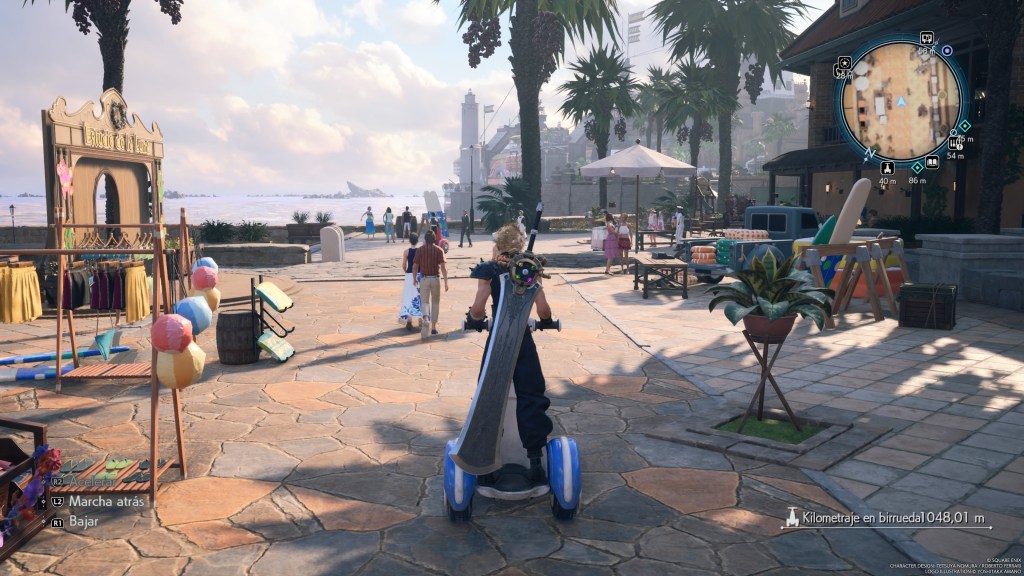
Then there are the many times you’re tasked to perform a scripted slow-crawl towards an objective and all you can do is simply gawk at Cloud’s ripped body as you push up on the left control stick and ponder how such a fit lad can move his limbs at such a pace it makes retirees look like Usain Bolt. And, of course, I can’t forget about the number of conversations you’ll have with characters and NPCs, all of which are littered with “anime-isms” like unnecessary grunts, sighs, and giggles, making for a fatiguing pace and a frankly cringeworthy narrative tone. But more on that later.
Mini-Games Galore
To circle back to the mini-games, on one hand, the sheer number of mini-games Square Enix has shoved into Rebirth is pretty impressive. On the other hand, there were certain moments where I felt their inclusion was completely unnecessary. Take Costa del Sol, for instance, one of the earlier locations in the game. Narratively, this sunny resort acts as a reprieve for our heroes. Mechanically, however, it’s a test of patience as the game forces you to go through a series of mini-games to progress the story. A couple of these games are somewhat decent, like Red XIII’s Rocket League knock-off and Tifa’s piano recital. But others, like scurrying around the map trying to take pictures of cactuars or having to find all the different coloured wheelies, were just boring.
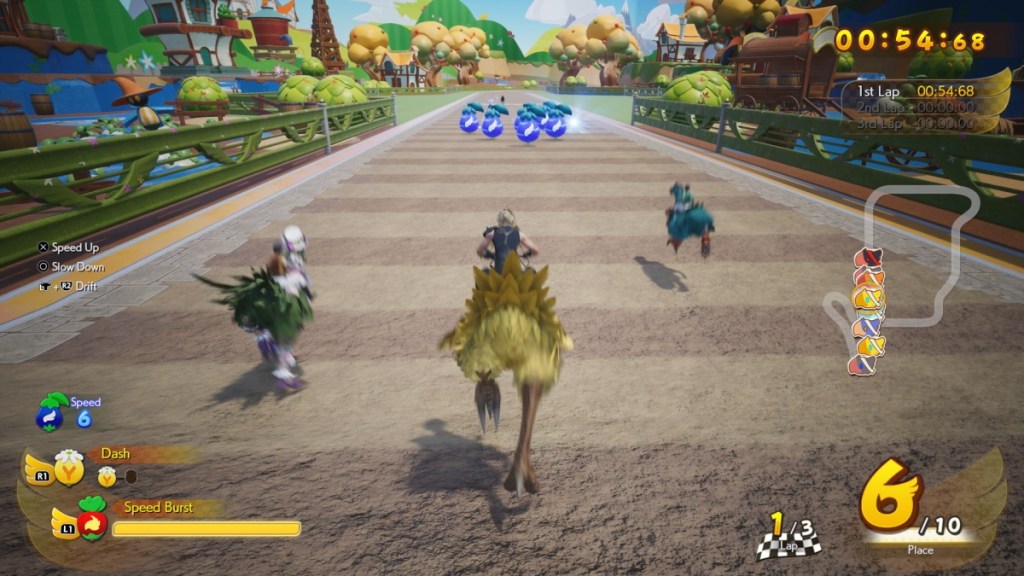
The slow animations, forced pace-stoppers like crawling through corridors, and incessant mini-games all add up quickly to make for a playing experience that feels like Square Enix is simply trying to hit their word count. There are a couple of genuinely great mini-games, don’t get me wrong. Queen’s Blood, for one, may overtake Gwent as the best in-game card game of all time. But those couple get lost amidst the sea of goofy and half-baked mini-games that feel at odds with the otherwise incredibly high production quality of this game. Speaking of goofy, though:
The Silliness
I remember Final Fantasy VII Remake having some awkward voice acting with characters often doing their best Kingdom Hearts impression with random sighs and giggles. But I’d forgotten to what level in the years since I’d played the game, and was starkly reminded of just how goofy these cutscenes could get with Rebirth. Especially seeing that the last Final Fantasy game I played was XVI, whose story I adored and was pleasantly taken aback by as its wonderfully grounded and gritty voice acting and narrative sensibilities brought a depth and nuance I hadn’t seen in a Final Fantasy game in a long time (if ever). Going from that to Rebirth was jarring, to say the least.
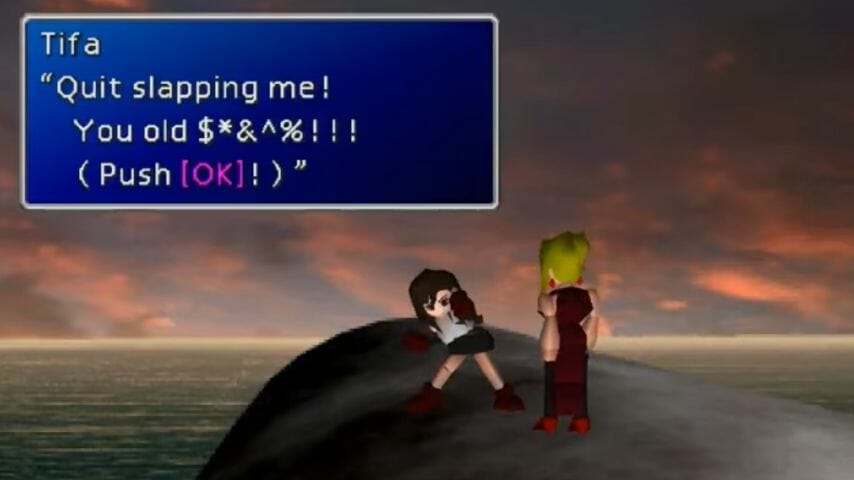
Now, I understand that VII and XVI are different games, with VII having some purposeful lighthearted silliness. That’s not the issue. The issue is that I remember those silly moments quite vividly in the original game, and they were incredibly charming and brought a needed levity to a pretty grim narrative and world. In these remakes, especially Rebirth, however, those moments, in addition to all the other silly cutscenes Square Enix have added, are executed with an awkwardness akin to Kingdom Hearts through oddly directed voice acting and poor scene pacing, which, in turn, dilute the impact of the more serious themes and overall narrative.
The Love
I’ve spent nearly 1700 words thus far being critical of Final Fantasy VII Rebirth. Yet, what I’ve yet to reveal is that I still really like this game. I may even go as far as to say that I love it. I didn’t, at first, or even after the first dozen or so hours, but eventually I came to truly enjoy this game for what it was. Maybe this is called Stockholm syndrome, but I cannot deny that Square Enix, for all their flaws and missteps, have put a lot of love into Rebirth. Maybe too much, leading to a lot of unnecessary padding. But once I dissociated this game from the original and accepted it for what it was instead of what I thought it should be as a fan of the PS1 classic, it began to click. This world is gorgeous, these characters ooze charm, and the combat system is one of the greatest amongst any action-RPG.
I mentioned Kingdom Hearts a couple of times during this article in a way that would make it seem I wasn’t a fan of that series. Truth be told, I’ve played through most of the mainline Kingdom Hearts games and genuinely love them for what they are. They’re nonsensical and ridiculous, with some of the cringiest storytelling and voice acting to ever exist. Yet, the creativity, heart, and wonder injected into each entry are undeniable. And that’s why I made the comparison. Because Final Fantasy VII Rebirth has a heart that’s filled with splendour. It’s annoying and awkward, bloated and silly, yet I can’t sit here and tell you that I didn’t have a stupid smile on my face throughout the entirety of the Gold Saucer chapter.
 Pixel Swish
Leave a comment