

1350; 1000; 900. No, these aren’t numbers representing the cost for half a month’s rent for a one-bedroom apartment in a place like New York City or Toronto (by the way, 1350 being just half a month’s rent for a one-bedroom is already some late-stage capitalism BS, but that’s a different topic). Nor are they some listed prices for a one-way, premium economy ticket to London from L.A. Nope, these are the U.S prices for some of the current, top-of-the-line handheld gaming PCs available on the market. More specifically, the Lenovo Legion GO 2, the ROG Xbox Ally X, and the rumoured price for the upcoming MSI Claw A8, respectively.
A thousand or more dollars for a handheld gaming device. And this is only for a few of the more mainstream devices. Niche products, like the recently released GPD Win 5, are flirting with the $2000 price tag. Meanwhile, Valve, as of the writing of this article, just slashed the price of their LCD Steam Deck to a little over $300. And this, dear reader, is why we need Lord Gaben to save us.
Exponential Costs for Fractional Gains
Benchmarks between AMD’s latest chip, the Z2 Extreme, which powers these top-end handhelds, and the one in the Steam Deck show that the performance difference between them isn’t a generational leap. It’s considerable, sure, but definitely not enough to warrant the hefty price increase. Videos like this and this showcase that, at 800p, on the Steam Deck preset, and at 15-17 watts, the LCD Steam Deck only trails by 10-15 frames per second behind the MSI Claw A8; oftentimes less depending on the area of the game. Now, yes, the A8 is a little bottlenecked here, running at only a 17Watt TDP; ETA Prime later pushes the device to higher TDPs (something the Steam Deck is incapable of), which obviously yields higher frames.
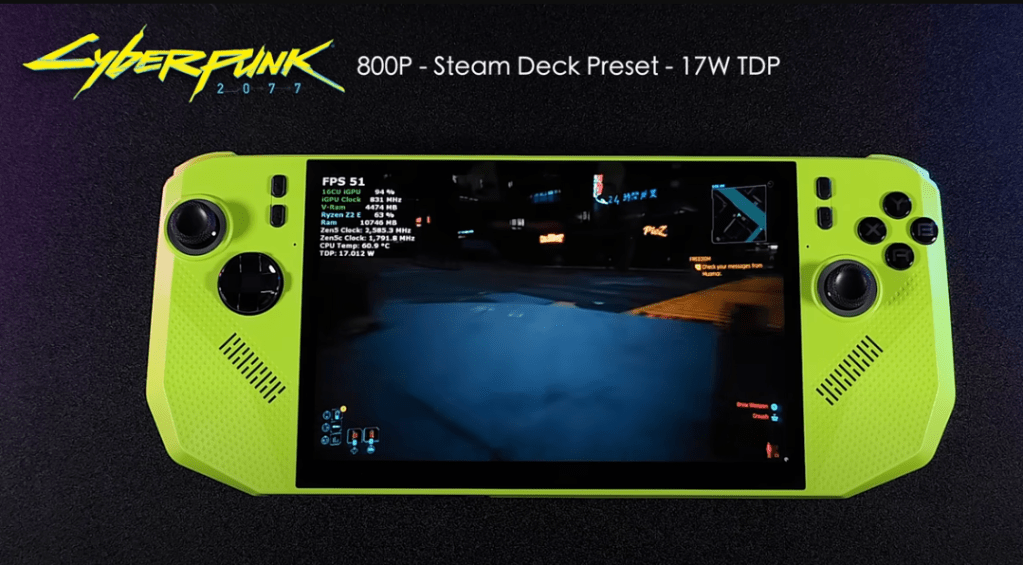
Still, for a newer device with the latest and greatest hardware, that costs nearly triple that of Valve’s handheld, I would expect to be able to play a five-year-old triple-A game like Cyberpunk at a higher resolution, with better graphical settings, and at a lower TDP like 17 Watts to save battery life, all the while getting much better framerates than that of the Deck. But that is simply not the reality for these newer handhelds.
Everything Is Expensive
Now, with all of that said, I understand that we’re living in precarious times. PC component costs are skyrocketing due to the Orange Man’s tariffs, and things don’t look to be getting any better any time soon. Heck, it’s because of this that, for the first time in gaming history, console prices have increased rather than decreased five years into a generation. As such, when considering the economic state of the world and how it’s been affecting pricing within the PC gaming industry, these prices for these top-end handhelds make sense. They’re overpriced, don’t get me wrong, but I can somewhat understand why they’re overpriced. Especially when considering that most of these manufacturers, unlike Valve, need to profit from their hardware sales. They cannot rely on taking a loss on each unit because they don’t have a platform where they can recoup their losses and make a profit in the long run. Unlike Valve, who have Steam.
And even so, Gabe Newell, in an interview with IGN in 2021 — a time before tariffs — described hitting the Steam Deck’s original price point of $399 as “painful.” They had to be “very aggressive” with the price because they knew it was “critical.” So if a company like Valve, who have the luxury of taking a loss on hardware, during a time before tariffs and rising component costs, still found it incredibly difficult to get the price of a handheld — one that had a seven-inch, 60Hz LCD, 16 gigs of RAM, and 64 gigs of storage — to $400, how can Lenovo, who don’t have that same luxury, during a time of tariffs and rising costs, have their handheld — which has a nine-inch, 144Hz OLED with VRR, detachable controllers, 32 gigs of RAM, a terabyte of storage, and a more powerful chip — do the same? ($1350 is still absolutely wild, but you get my point).
Can Lord Gaben Save Us?
So, considering our current economic state and Gabe Newell’s previous statements on Valve’s struggle to meet their pre-tariff pricing for the original Steam Deck, would it even be possible for them to make a successor to the Steam Deck that’s more powerful than current Z2E-powered devices but priced roughly akin to something like the Switch 2? Well, if any company could do it, it would be Valve. But it may still be a while before we even see a successor to the Steam Deck.

Last year, in an interview with Australian outlet Reviews.org, Steam Deck designers Lawrence Yang and Yazan Aldehayyat were very clear in saying that Valve weren’t interested in yearly refreshes to their handheld, saying that, “…we really do want to wait for a generational leap in compute without sacrificing battery life before we ship the real second generation of Steam Deck.” The AMD Z2 Extreme, as evident from the benchmarks, is not a generational leap.
But, AMD’s upcoming Zen 6 APU, codenamed “Magnus,” has been rumoured by notable leaker and YouTuber Moore’s Law Is Dead to power both the next generation of consoles, as well as the Steam Deck 2, and should provide that generational leap in performance. Now, whether this APU will be affordable enough for Valve to price the handheld at sub-$600, we’ll have to wait and see. But if they want to compete within the console space and go up against the likes of Sony and Nintendo (because, at this point, Xbox has clearly left the chat and are doing their own thing), pricing is, once again, going to be critical.
Some rumours also suggest that this APU could power a SteamOS home console, which would be more cost-effective for Valve, seeing as it would just be a box instead of a full-fledged handheld with a screen and controller. Competition within the home console space wouldn’t be a bad thing, but I would still love to see Valve focus on a Steam Deck 2 that rivals next-gen performance while not costing me half a month’s mortgage payment.
Looking Ahead & What’s Important
The Steam Deck ostensibly spurred the current renaissance of PC handhelds, but I feel like, in so doing, companies have been getting ahead of themselves without considering the player base. This race to be the first to release the latest and greatest handheld with the best tech currently available, regardless of their manufacturing costs, made them forget who the Steam Deck was initially targeted towards: console players. And console players aren’t used to spending PC player money, which is what these handhelds have been progressively skewing towards. Console players also don’t want to deal with a heavy and bloated OS like Windows.
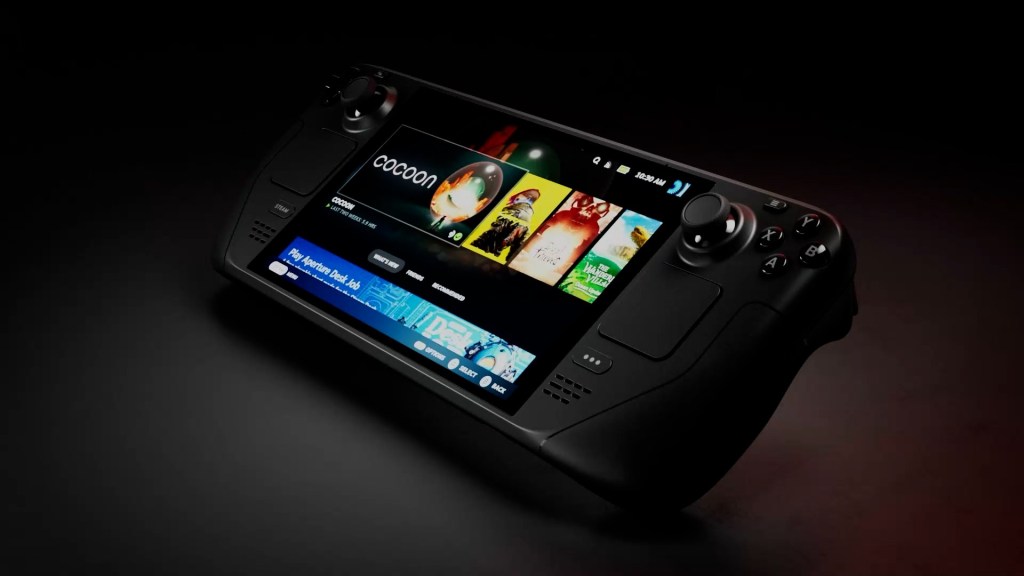
I want power, don’t get me wrong. I love my MSI Claw 8 AI+ and the fact that I can play pretty much every triple-A game at 1200p, medium to high settings, while still getting north of 40fps. But I didn’t love spending 1300 Canadian dollars, and I certainly don’t love Windows. Comparing this device to the OLED Steam Deck and its beautiful screen and still decent performance, I sometimes wonder if my experience with the Claw is worth nearly double the price of the OLED Deck. It’s actually why I’ve started to use my Claw as a make-shift desktop replacement, just to feel like I’m getting my money’s worth.
Spending more time in R&D, figuring out the best and most efficient combination of specs to provide the most consistent experience, while working with a streamlined OS like SteamOS, all in an effort to get the best price-to-performance ratio, is what every company should be aiming for. Here’s hoping Valve can remind other manufacturers of that with their next handheld.
 Pixel Swish
Leave a comment