
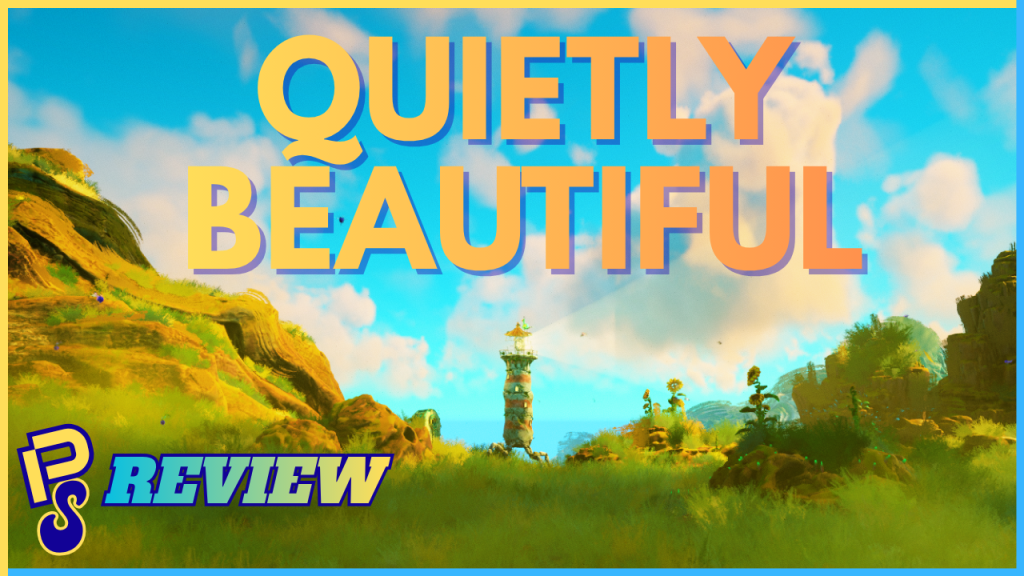
There’s a moment in the early hours of Keeper when you, as the animated lighthouse that dawns the game’s cover, come across a precipice looking out towards a vista. A vista that’s as gorgeous as it is somewhat melancholic. Melancholic because you see, maybe even feel, this vista in front of you that shows a world long forgotten, lit by the bright and pristine blue sky hovering above you as the chirps and creeks of odd, crab-like creatures buzz from the lands behind you; lands which are just as awe-inspiringly beautiful and melancholic as the horizon before you. It’s moments like these in video games that I remember for years; moments that bring you, the player, to a standstill as you take a second to breathe and question the virtual world around you.
Keeper is Double Fine at their most refined. While games like Psychonauts are a whirlwind of wacky ideas, executed with a flair and pizzazz that consistently keep you guessing, Keeper, while still having some terrific fun in the game’s final act (Double Fine clearly couldn’t help themselves, and I love ‘em for it), is far more subdued and introspective. It’s a story about time and decay, interwoven with themes of nature versus technology. A story that’s told without any spoken dialogue or even a line of text. A story that’s told through one of the most gorgeous visual experiences I’ve had all year. Though some gameplay elements, performance issues, and a somewhat abrupt ending keep it from an arbitrary “perfect” score, it’s a game that deserves to be given a chance.
The Heart
Keeper has you play as a lighthouse. Yes, a lighthouse. Of all the things I’ve played as in video games, this was definitely a first. The game begins with a green bird named Twig flying away from a swarm of dark matter. Twig eventually lands on a decrepit lighthouse standing atop a cliff. Right as this dark matter is about to approach Twig, the lighthouse awakens and shines its beam of light at the matter, causing it to scurry away. And thus begins this unlikely friendship between a lighthouse and a bird.
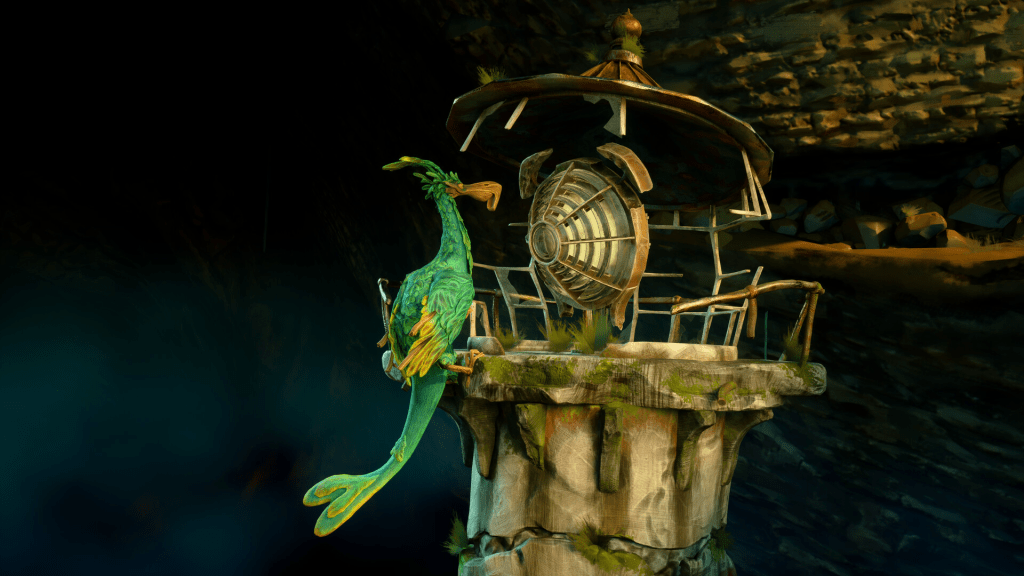
As I continued my journey, taking my first baby steps as this lighthouse, slowly but surely getting my bearings and figuring out how to move and use my lamplight, what I found remarkable was how connected I was getting to this nameless lighthouse and Twig. This is one of those moments that exemplifies how video games can create this attachment with a protagonist in a way no other medium can. Actually taking control of this lighthouse, struggling through those opening first steps, and interacting with Twig as you both act as one another’s guide throughout this post-apocalyptic world, makes for this wonderful semiotic relationship between player and protagonist.
Much of this is helped by the 3D modellers and animators over at Double Fine, who did a phenomenal job of bringing the lighthouse to life and adding actual character traits to the lighthouse’s movements and body. When the lighthouse is sad, its tower will slightly slump; when it’s scared, the little metal wires on top of its lamp will act as “eyebrows” and jolt up. It’s details like this that bring the narrative experience to the character-level, which is something I wasn’t expecting, given that I’m playing as a piece of architecture.
Thematically, a lot is going on in Keeper. In essence, it’s a story about what our world looks like post-humanity—post-humans, more specifically. Director Lee Petty wrote in a note a few days before the game’s launch day on Xbox Wire that much of the inspiration for this game came during the COVID-19 pandemic, writing:
“Like most, I thought a lot about isolation and connection with others…During the pandemic, it became even more important to me. I wondered if the wildlife around me would be all that is left in the future. Would it continue to develop, to evolve? I thought of the mycelium, the vast underground networks that connect fungi, and how they are also used by trees to share nutrients and communicate with each other. I imagined an isolated island in a far-flung future without humans. What sorts of life would evolve there? Would this life still be possessed with a need to connect with others and to have a purpose?”

This idea of nature’s way of connecting life, any life, with one another can be seen not only in Keeper’s visual design, but also on a ludonarrative level. Every step of the way, you and Twig are helping to connect the beings across these lands; whether that be through environmental puzzles, or simply by shining a light to rid a piece of flora of the dark matter that had covered it so that it may reconnect with its roots. Speaking of dark matter, this entity is a continuous nuisance throughout your playthrough. To me, it acts as a metaphor of the last remnants of humanity. The thing that had plagued the natural world and continues to endure even after humanity’s downfall, an entity which the natural world is still trying to fend off.
All of these narrative elements work together effectively to tell an intriguing tale about time, decay, and connection. However, for as moved as I was by the narrative experience, I do think the ending was a little too abrupt. On a thematic level, it mostly worked, but I felt as though a little more time was needed for me to truly feel as though I had an understanding of this world and my story and purpose within it. Nevertheless, it’s one of the most mature stories I’ve seen from Double Fine. And for a studio who are known for their sharp dialogue and exposition, making a game with neither yet still being narratively poignant is quite the feat.
The Eyes & Ears
This section is going to be quick. Without question, Keeper is one of, if not the, most visually stunning games I’ve played all year. Matching, if not surpassing, other visual treats like South of Midnight and Clair Obscur: Expedition 33. Double Fine were always known for their striking art style, meshing the surreal with vibrant colours and wacky character models. You can see some of those visual cues continue here in Keeper; however, things – once again – are far more refined. It still has some fun moments of fantastic whimsy and psychedelia, but there’s a polish here that looks a bit more elevated, more mature, more consistent, maybe even a little subdued compared to Double Fine’s prior works. Some of that may be due to their use of Unreal Engine 5, which has given ostensibly every damn game this generation a “same-y” look I’m not particularly a fan of.
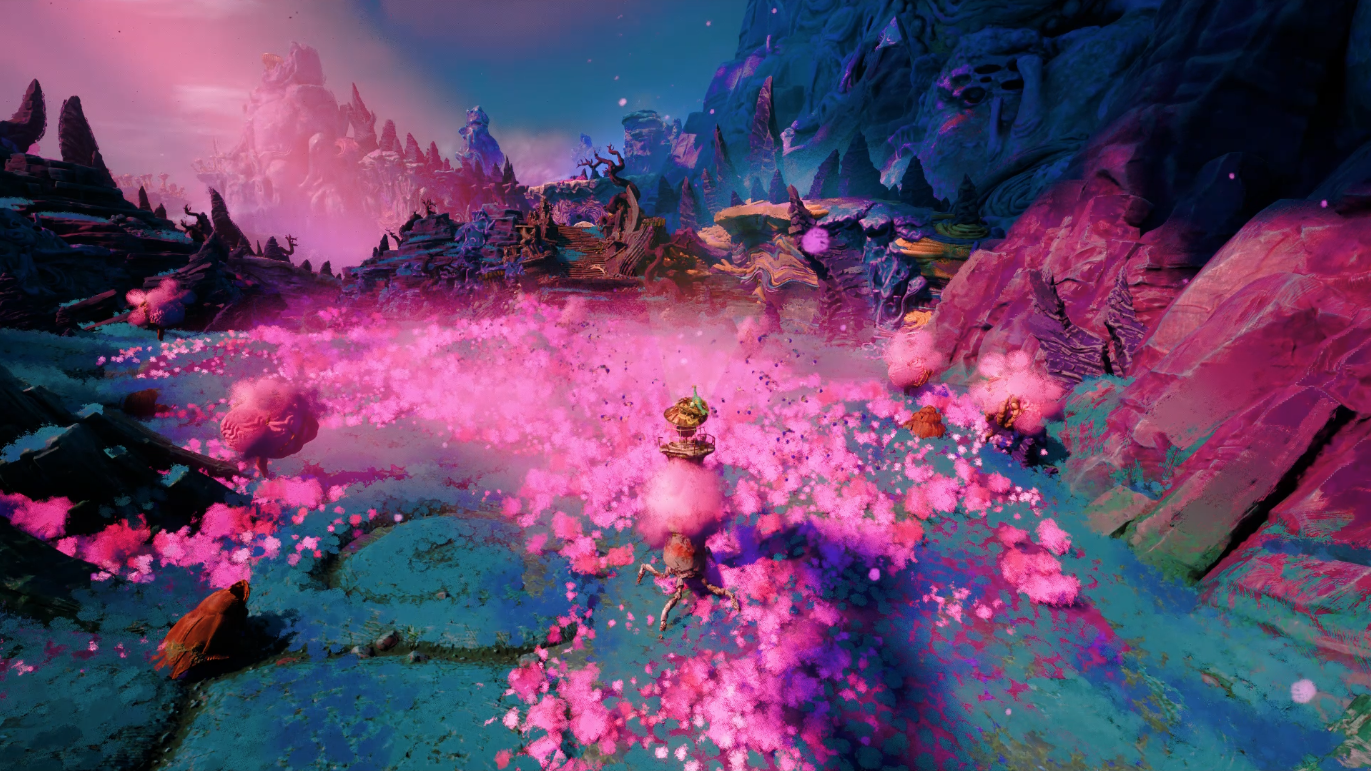
Nevertheless, to the engine’s credit, it does bring forth a crispness to the visuals. Every asset and texture looks incredibly high quality, which when combined with the marvellous art style, makes for a true feast for the eyes. However, such a feast comes at a tremendous cost to performance. Playing on the MSI Claw 8 AI+, arguably the most powerful handheld PC currently available that can play most triple-A games at 1200p and medium settings, I struggled to maintain a consistent 30fps while playing the game at those settings, even with resolution scaling set to 50%. Most of my playthrough required the use of a third-party frame generation app called Lossless Scaling, which allowed me to break into the 50-60fps range without sacrificing the visual quality. Unreal Engine 5 strikes again.
In terms of the audio experience, I can’t say things are as memorable compared to the visual one. The game doesn’t sound bad, by any means. The sounds of nature, hums of old technology, and the chirps of creatures make for an immersive playing experience, but nothing about the sound design or music particularly stood out. That latter part was especially disappointing. A game like this almost necessitates a banger soundtrack; one that accentuates the themes of its narrative to make for a more emotional and captivating experience. Unfortunately, such a soundtrack does not exist in Keeper.
The Controller
Gameplay-wise, Keeper plays it quite safe, save for one particular act, which I won’t spoil as it’s arguably the best part of the game. For the most part, you trek along these wondrous lands as the lighthouse with Twig sitting comfortably on your “head,” occasionally coming across the odd puzzle, which usually involves either shining your lamp light at a piece of dark matter or sending Twig out to crank a gizmo or press a doo-dad.
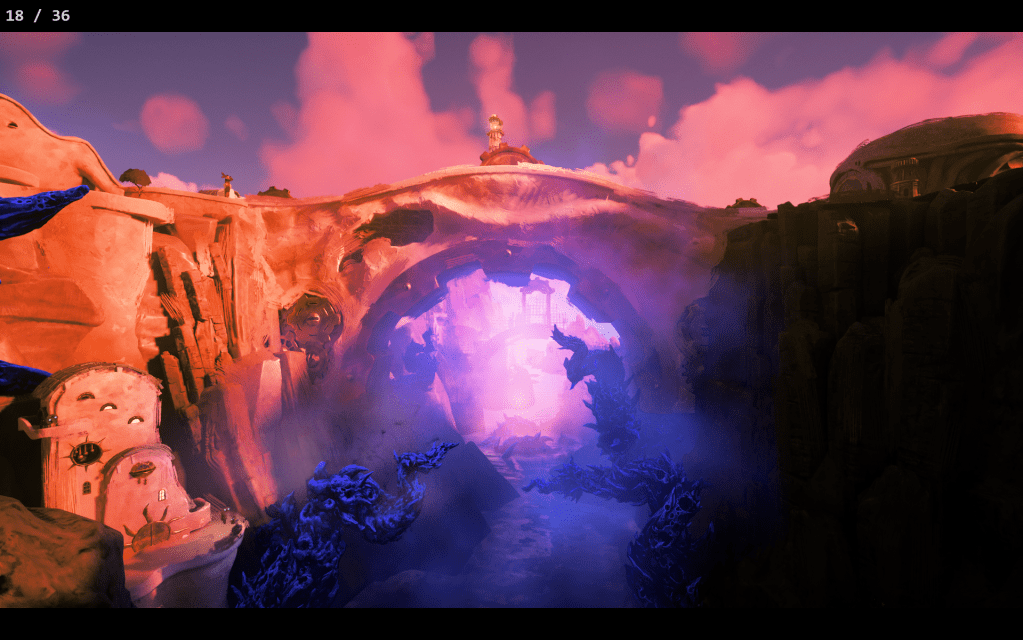
A couple of times throughout your playthrough, you’ll come across a hub that’ll have one primary objective, with branching paths splintering off, leading to bigger puzzle “rooms” that you’ll need to complete to collect a series of McGuffins that progress you through the main objective within that hub. Each of these hubs usually has a main gameplay quirk that requires you to think about the puzzles with that quirk in mind. There’s also a narrative and thematic component that ties this quirk to the world and story, which is interesting.
Overall, though, the gameplay experience is fairly linear, and none of the puzzles are particularly difficult or mechanically robust. Aside from that one part towards the end I keep mentioning, there’s nothing especially memorable about Keeper from a gameplay perspective. Oh, and some of the traversal and platforming can be a bit floaty and cumbersome, too.
The Verdict – 8/10: “It’s Superb”
Keeper is easily in contention for being the most visually stunning game of 2025. Double Fine’s use of Unreal Engine 5, combined with a more refined version of their classic artistic sensibilities, makes for a spectacular treat for the eyes, even if it comes at severe performance costs. Narratively, there’s a beautiful story here about time and what our natural world would look like if we weren’t in it; a story told effectively without the utterance of a word. Though mechanically things may be a little shallow, Keeper is one of those titles I’ll be thinking about for some time.
 Pixel Swish
Leave a comment