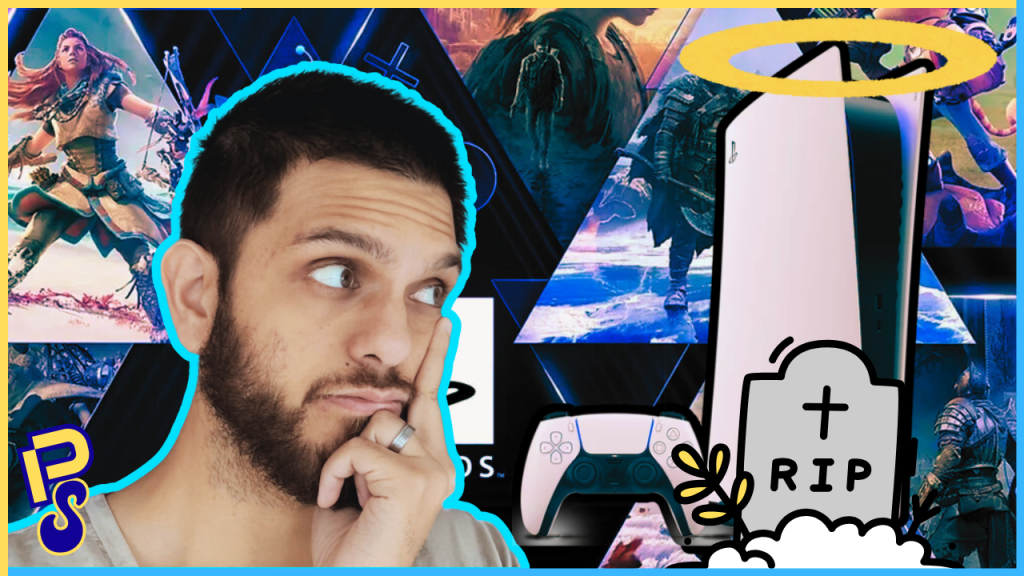
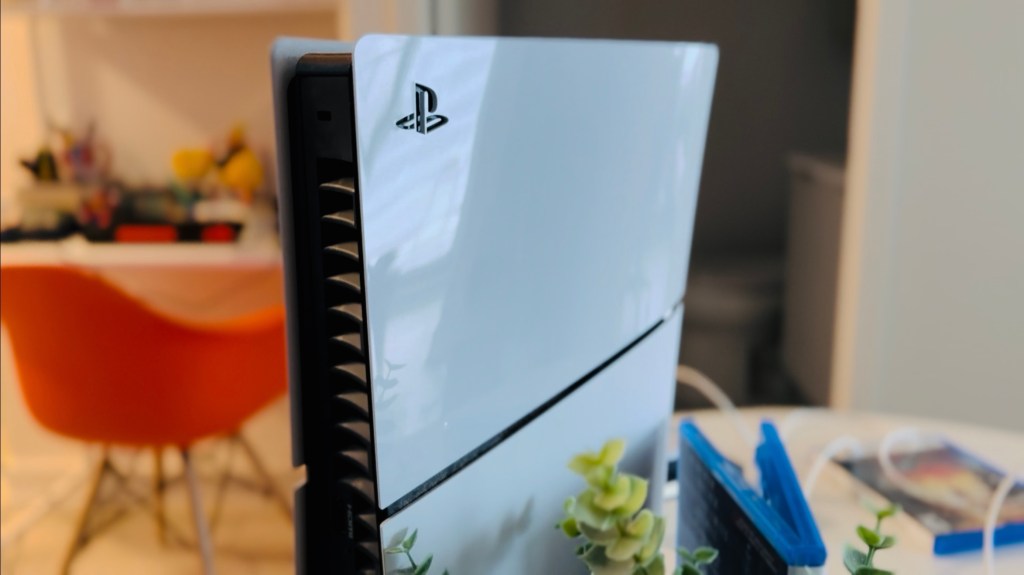
The PlayStation 5. Sony’s fifth-generation gaming console. You know that because it has a “5” at the end of its name. You hear that, Xbox? A number that correlates with the console’s generation—what a fascinating concept! The PS5 was released at the tail-end of 2020. A time when most people were stuck at home, many of them sick, and many more without a job. Ah, the memories. I had a lot of hype for the PS5. I loved its bold design, the new DualSense looked awesome, and the marketing hype of it being fitted with 10 teraFLOPS, nearly six times more than that of the PS4, had me very excited (even though I still, to this day, couldn’t tell you what a teraFLOP actually is).
Yet, despite all the hype, I decided not to jump on Sony’s latest generation upon release, mainly because the PS5’s launch titles—like most of Sony’s past console launches—weren’t particularly spectacular. For as great as Demon’s Souls looked, I wasn’t about to spend hundreds of dollars just to get my ass handed to me by one of FromSoftware’s demonic creations in 4K as my first foray into the generation. And so, I chose to be a patient gamer and wait until the PS5 had a decent catalogue of exclusive games. I thought that wait, much like prior generations, would be a year or so. That, as we all know, wasn’t really the case.
The Series S and Cloud Gaming
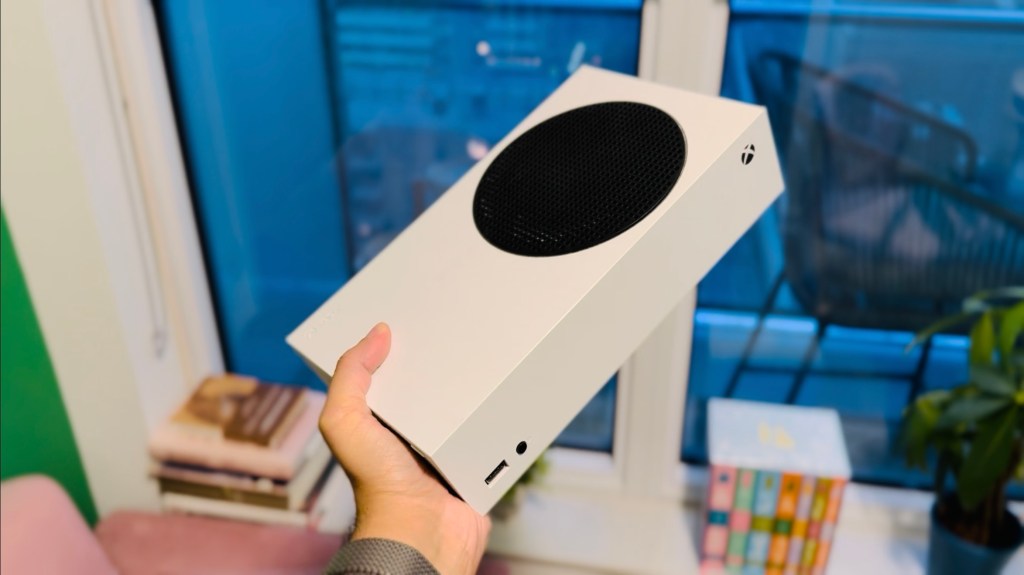
By the end of 2022, there were really only two Sony console exclusives I was interested in playing: Horizon Forbidden West and God of War Ragnarok. However, for as great as they looked, they were cross-generation titles with the PS4, and I didn’t feel like they alone justified an upgrade to the PS5. Not to mention, by this time, I had already jumped on the new generation through the Xbox Series S. I thought I’d get in on a budget, play some of the newest titles (even if they were at a lower visual fidelity), and try out Game Pass; all the while waiting for Sony to figure out their first-party lineup. It was a decent time, honestly, and I still consider the Series S to be an amazing entry-level console, which, when paired with Game Pass, is a solid bang-for-your-buck experience (although, Xbox’s recent price hikes make that “bang” a little less exciting—thanks, Phil).
It wasn’t until the middle of 2023 that a game came out that made me go, “Oh, damn, yeah, I need a PS5.” That game was Baldur’s Gate 3. A title that received universal acclaim upon release, and one that my poor Xbox Series S couldn’t run at the time. This was because Larian Studios couldn’t get full feature parity between the Xbox Series X and S, something that Microsoft required for all developers, but then later made an exception for BG3 (smart move, Phil). At the time, however, it was looking bad for the Series S, and I was worried I wouldn’t be able to play this game unless I upgraded to the PS5. But I was hesitant, because Sony’s first-party output was still pretty dire at the time, and I simply couldn’t justify spending the 600+ Canadian dollars. But I needed to play Baldur’s Gate 3, so what could I do? And it was at this time that I discovered a little thing called cloud gaming.
Baldur’s Gate 3 was available on launch day on Nvidia GeForce NOW. For those that don’t know, GFN is a service that allows you to play your purchased PC games via the cloud using Nvidia’s data centres. On the “Ultimate” subscription tier, you get access to a cloud PC rig that has the latest and greatest graphics cards from Nvidia, allowing you to play your games with ray-tracing and all of Nvidia’s other fun trinkets and baubles that you wouldn’t get on a budget PC or console.
I’d always been a believer in cloud gaming. I was one of the early beta testers for Xbox Cloud Gaming back in 2019. However, I’d always thought of the technology as a convenient albeit inferior alternative to local gaming. And for the most part, that was, especially at the time, true. As such, I was cautious to buy a game, at full price, without having a system to play that game on—solely relying on the cloud. But I had heard great things about GFN, so I thought to risk it for the biscuit (…did I really just write that?).
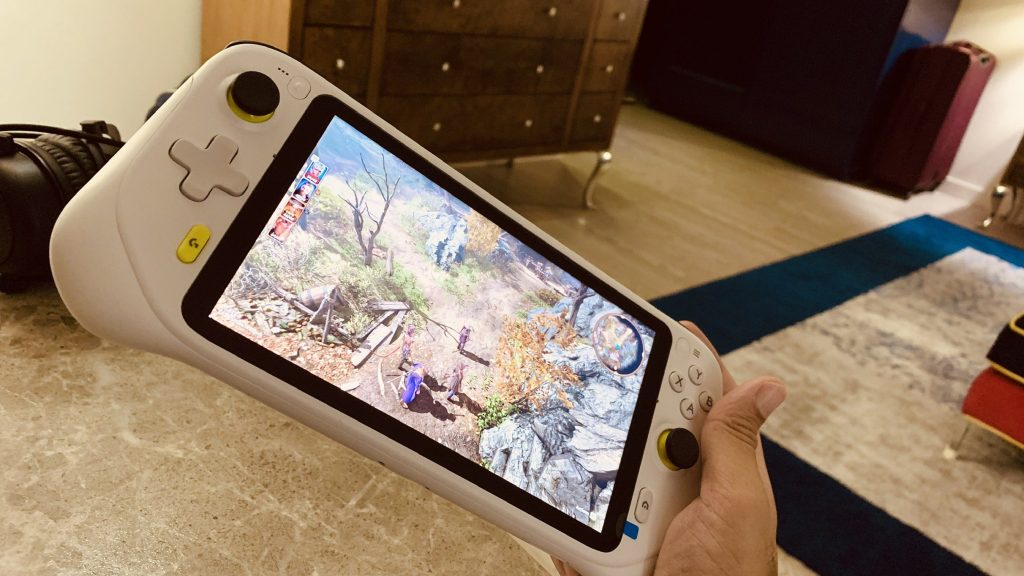
I went for what was at the time called the “Priority” tier, which gave me access to the RTX 2080 via the cloud. As soon as I booted up Baldur’s Gate 3, playing on my Logitech G Cloud, I was frankly in genuine awe at what I was experiencing. Playing a triple-A, modern release, on a handheld, at ultra settings, at a fairly consistent 60fps, was unreal. Not to mention being able to crank up the bitrate meant there was little to no artifacting and looked as if I was playing locally off the console. It took just a couple of hours of me roaming around the Nautiloid ship for me to be a full believer in GeForce NOW and cloud gaming in general. As such, my desires for the PS5 quickly dissipated.
Sony Exclusives On PC (via the Cloud)
For the remainder of 2023 and ostensibly the entirety of 2024, I spent all of my gaming on the cloud. Playing games like Black Myth Wukong, Alan Wake 2, and Cyberpunk 2077: Phantom Liberty all at their highest graphical settings with path-tracing turned on are still, to this day, some of the most gorgeous gaming experiences I’ve ever had—and I have GFN to thank for that. The problem, however, was that I was still very much itching to play both Horizon Forbidden West and God of War Ragnarok. Though both of those games had, by the end of 2023, come to PC, Sony does not play nice with Nvidia, and as such does not bring their first-party games to GFN. But Nvidia aren’t the only one in the cloud gaming space, and there is one competitor of theirs that does have pretty much all of Sony’s first-party games on their service, available to play via the cloud—Boosteroid.
Boosteroid does this thing where they have their “ready to play” games that are officially supported by their service, but then a ton of other titles that are on their “install and play” section. Nvidia has started doing something like this recently, too. Basically, once you click on one of these “install and play” games, instead of booting up right away, you have to wait for the game to install on your cloud gaming rig first. It takes a few extra minutes, but once installed, it plays pretty much the same. Why the separation? Not sure, but if I were to guess, it’s likely a legal loophole that allows the companies to get a bunch more games on their service without having to go through the traditional onboarding methods. At least, this seems to be the case for Boosteroid.

Playing both God of War Ragnarok and Horizon Forbidden West at 4K, ultra settings, via the cloud was a tremendous experience. Sure, Boosteroid was and still isn’t as consistently amazing as GFN, but it offered me a way to experience both of these games, plus Miles Morales, at fidelities and framerates higher than that of the base PS5. Being able to do that while also having the flexibility of taking these games anywhere with my G Cloud was an amazing bonus. I was beyond happy, and thought I wouldn’t need to get a PS5. But there was a game that wasn’t on either service. A game I knew I couldn’t wait a year and a half for it to be released on PC—Final Fantasy VII Rebirth.
From Excitement to Disappointment
I bought my PS5 with the optical drive and two games—Rebirth and Spider-Man 2—in October of 2024. I got home, excitedly unboxed the console and made room for the chunky fella in my media station. At this point, I’d cancelled both my subscriptions to GFN and Boosteroid, expecting to go all in on my new PS5. I started up Spider-Man 2 that very evening, and from the moment I took control of Peter, my eyebrows furrowed. Something looked a little…off. “Wait, what’s going on?” I asked myself. You see, I remembered Miles Morales looking incredible on Boosteroid, but now, Spider-Man 2 looked noticeably less sharp. Something about it looked “flat,” in comparison. Not to mention, being capped at 30fps in the “Fidelity” mode was a jarring switch. And the “Performance” mode was considerably less pretty, to my eyes.
The ray-tracing, ambient lighting, resolution, textures, and performance I was getting while playing on a high-end PC via Boosteroid were clearly a notch above what my newly purchased base PS5 was capable of. And that’s to be expected, obviously. Comparing a $500 console to a PC that costs thousands of dollars is silly. The thing is, I didn’t pay thousands of dollars to get that experience. I spent the price of a fast-food meal every month to get that experience. And I still owned the game, so it’s not like my library was taken away from me if I stopped my subscription. Still, not having to worry about latency, connection issues, and the many other minor quirks of cloud gaming and instead having a streamlined console experience was something to appreciate. And so, I continued being a PS5-only gamer for the next few months.
I played through Spider-Man 2, which was a solid 8/10 experience. Played through Final Fantasy VII Rebirth, which was…Well, you can watch/read my piece here to get my full thoughts on it (Spoiler: I hated it, but also kinda loved it, but also really hated it). Played through Ratchet and Clank: Rift Apart, which was a pretty good 7/10. Got my ass handed to me in both Returnal and Remnant II with a friend, and thoroughly enjoyed my time with it. Played through Jedi: Survivor, which was pretty “meh,” and rolled credits on a handful of indies like A Space for the Unbound, which was excellent.
And that, my friends, is honestly it. Maybe I’m missing a couple of titles, but between October 2024 and April 2025, those were the only games I played on my PS5. By the time spring came along, my PS5 had basically become a Blu-ray player. The platform simply didn’t have exclusives that got me excited. Nor did it have the crazy sales, the vast library of indies, or the flexibility of PC gaming in general. And every time a big, triple-A title came out, I knew I would have to make concessions between visual fidelity and performance.
Not to mention, I missed the convenience of taking my games anywhere, playing on either my G Cloud or laptop with a controller. Yes, Remote Play was there, but its connection to my hardwired console was incredibly finicky when out of the house and not on my local network. Also, the artifacting on Remote Play was quite noticeable. On GFN, in addition to its stellar visual quality, as long as I had a stable 40ish Mbps connection, I could turn down the bitrate and play my games without fuss, wherever I was.

Simply put, I missed PC gaming, which is why it was around this time that I bit the $1300 bullet and bought the MSI Claw 8AI+. A handheld that has become my primary way of gaming over the past six months. Even though it’s technically not quite as powerful as a PS5, because it’s a PC, I can utilize frame-gen tech like Lossless Scaling or Intel’s XESS to match PS5-like visuals while also getting north of 60fps. I’m able to play games like Control at max settings, with full ray-tracing, then use Lossless Scaling to get 60+fps—and it works pretty flawlessly. Being able to now play all of these games at those settings, locally and on the go, while still having the option to re-up one of my cloud gaming subscriptions for those super high-demanding games and play them on this handheld as well, makes for a gaming experience that feels tailored to a variety of my needs and wants.
An Underwhelming Generation & The Rise of PC Gaming
Now that Sony is playing nice with PC gamers and has been bringing all of their exclusives to the platform, I honestly can’t imagine ever turning on my PS5 again. Save for the infrequent Blu-ray, this great white beast has ostensibly become a piece of decor for my media station. Or an eye-sore if you’re asking my wife. The reason for this, I feel, is twofold. For one, this has been an incredibly underwhelming generation for the Japanese tech giant. Coming off the heels of one of their best generations in the PS4, which had dozens of incredible, medium-defining titles, the PS5 started on the wrong foot and has yet to find its footing—even after five years.
The first-party output has been poor, to say the least. And the games we have gotten, though good, are mostly iterative sequels that don’t necessarily feel “next-gen.” Forbidden West, Ragnarok, Spider-Man 2, Rift Apart, Death Stranding 2, and Ghost of Yotei are all good games, but nothing about them feels outwardly unique. The jump from God of War 3 to God of War (2018) felt substantial—a generational leap. Same for Uncharted 3 and A Thief’s End, and The Last of Us 1 & 2. Whether you like those games or not is not the point; I’m talking about a leap in mechanics, scope, storytelling, and visuals. All of these PS5 sequels may have done one or more of those things to a certain extent, but not to the extent that prior generations have done.
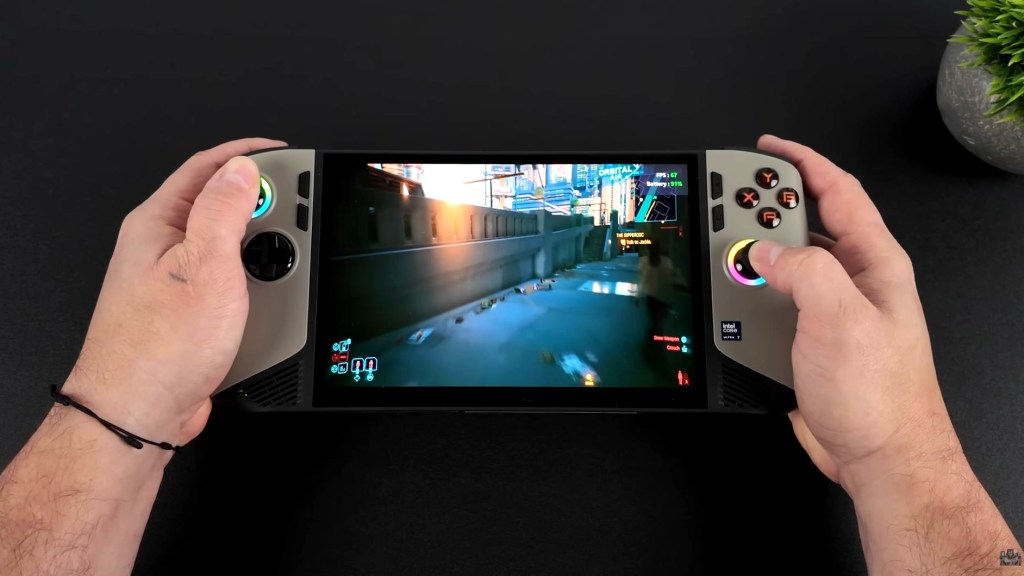
Then, you have the rise in PC gaming. Valve changed the game with the Steam Deck. Now, everyone and their momma are making handheld PCs. Steam sales and PC player counts are higher than ever, and more and more people are seeing the same things I, as a lifelong console player, am seeing. With Xbox ostensibly calling it quits and bringing all of its first-party lineup day and date to PC, and Sony slowly but surely loosening the locks on their walled garden too, it’s become harder to justify the need for a traditional console. Heck, even all of the DualSense’s features are now compatible on a PC via a wired connection.
It’ll be interesting to see what the next generation of gaming looks like for Sony and Xbox. Though I still predict both will release hardware, it’s going to be a very different landscape with how rapidly PC gaming is growing. I, for one, am planning to stay on Gabe Newell’s side of the war, and maybe toss a few coins to Nintendo for a Switch 2 Lite. Because we all know Mario is never coming to PC.
 Pixel Swish
Leave a comment