
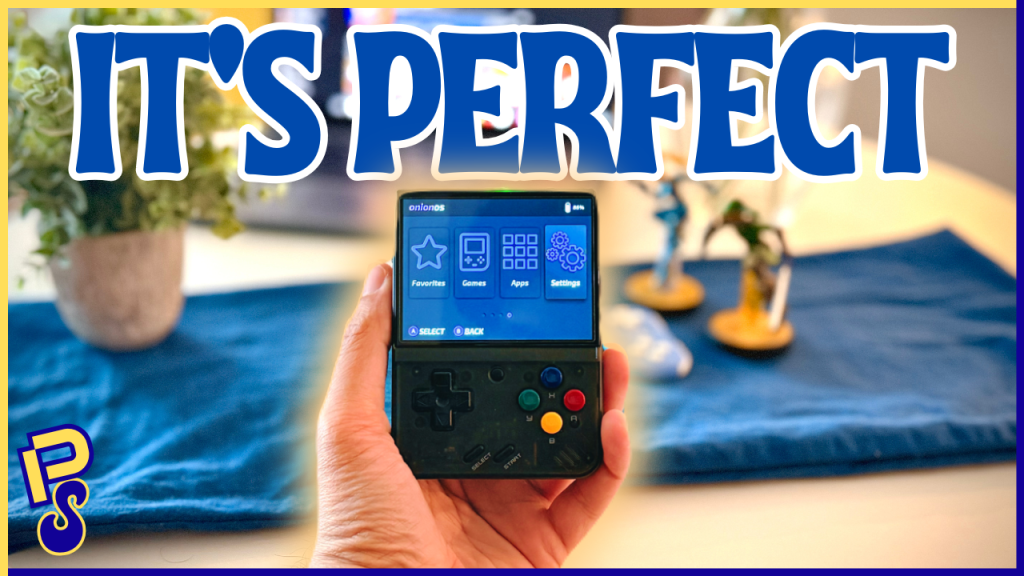
If you’re anything like me, you’ve spent years watching guys like Russ from RetroGameCorps, Bob from Wulff Den, and TechDweeb review an assortment of gadgets and doodads—namely, retro gaming handhelds. You’ve most likely seen devices from companies like Ayaneo, Retroid, and especially Anbernic—who seemingly release a new handheld every other hour.
Now, even though I’ve always loved handheld gaming, I’ve never actually jumped into the world of these retro handheld consoles. Mostly because I knew that if I did, my bank account would be in a world of pain, because there’d be no way my dumba*s would stop at just one. Furthermore, ever since getting my Logitech G Cloud a few years ago and especially my MSI Claw 8 last year, I didn’t think I needed another device solely for retro emulation. Both of these handhelds were more than capable of running emulators up to and including the PS2 and Gamecube. The Claw 8 can even do PS3 if I need it to.
However, there was one device that I kept seeing pop up on my feeds over and over again. A device that every creator, every person on Reddit, and every niche gaming outlet sang praises of, even years after its release. A little device that I didn’t think was necessary in my gaming EDC until my wife got it for me recently for my birthday. And though I absolutely love her for it, the sweet summer child doesn’t know the can of worms she’s just opened, because I am absolutely in love with this thing—the Miyoo Mini Plus, and finally understand why everyone has been obsessed with it since its launch in 2023 and why this niche product category has such an ardent fan base. So, allow me to jump on the bandwagon and tell you what makes the Miyoo Mini Plus so special, even in 2026.
The Outside
The first thing I said when picking up my Mini Plus was, “Oh my God, it’s so cute!” Even though this is the bigger brother of the original Miyoo Mini, it’s still a wonderfully pocketable, palm-sized device standing at just four inches tall and three inches wide. The second thing that came out of my mouth while tossing the device around in my hands for the first time was, “Wow, this thing is built really well.” Seriously, if you’d told me that Nintendo themselves manufactured this handheld, I would’ve believed you. There’s a sturdiness to its chassis without any creaks or rattling; the buttons all have a solid finish and feel very nice to press, and the screen, though only 480p in resolution, looks more than sharp on the 3.5-inch IPS display.
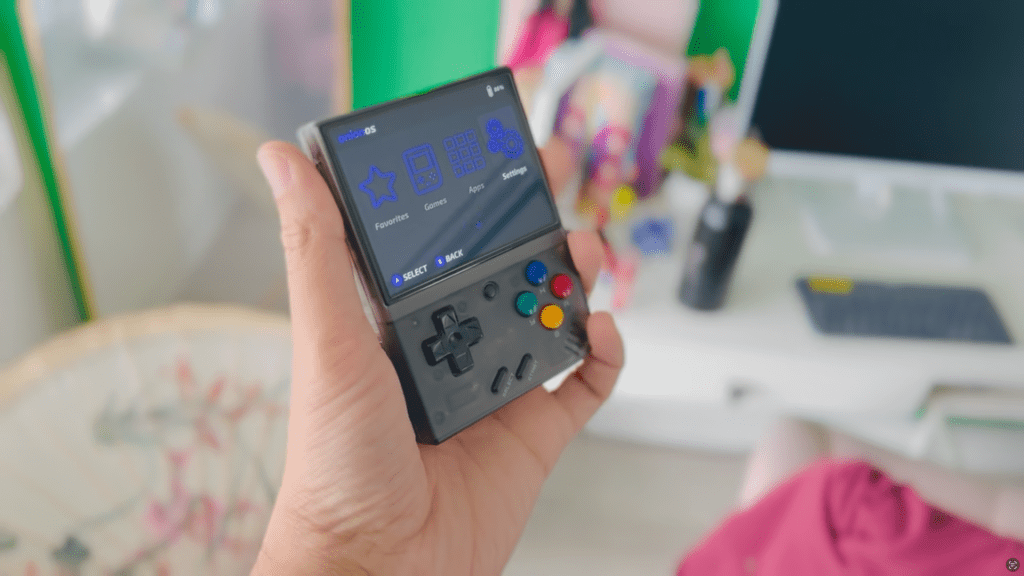
Let’s talk about these buttons. On the front, you have one of the better D-Pads I’ve used in recent years; I had no issues hitting diagonals in games like Minish Cap and Tekken 3. There’s a decent amount of travel, and as someone who can’t stand clicky buttons, I’m glad Miyoo went for a soft-press D-Pad for times when I’m trying to be inconspicuous while playing on the train and don’t want to drive the person next to me mad as I struggle to pull off a Hadouken. We have four face buttons with a glossy finish that are also soft-press with decent travel. A start and select button, and a function button. On the back, there are four shoulder buttons, which have very little travel but still feel nice to press—they are somewhat sensitive to trigger, though, making for a few accidental presses during my play sessions.
In terms of durability, I can’t say for certain how much of a beating this little guy will be able to take. What I will say is that I don’t feel nearly as comfortable being rough with it as I do, say, my old Game Boy Advance SP or even something like my PS Vita. That being said, I have, unfortunately, accidentally dropped my Mini Plus from my desk a couple of days ago, which is about three feet from our hardwood floor. And aside from the tiniest of scratches on the top corner, the device is still perfectly fine. Still, I do think there’s a premium-feeling brittleness that the device has, and would advise a carrying case, which you’ll most likely get when purchasing the Mini Plus.
Ergonomically, things are, as you might imagine, a bit of a mixed bag. Obviously, with such a small device, wrapping your hands around it isn’t going to be the most comfortable of experiences for long play sessions. However, because it’s such a lightweight little guy at only 160 grams, I found using just the tips of my fingers to hold it—kind of like how you might imagine holding a little sandwich—an adequately comfortable experience; one that I could do for a moderately long time before feeling any kind of finger fatigue.
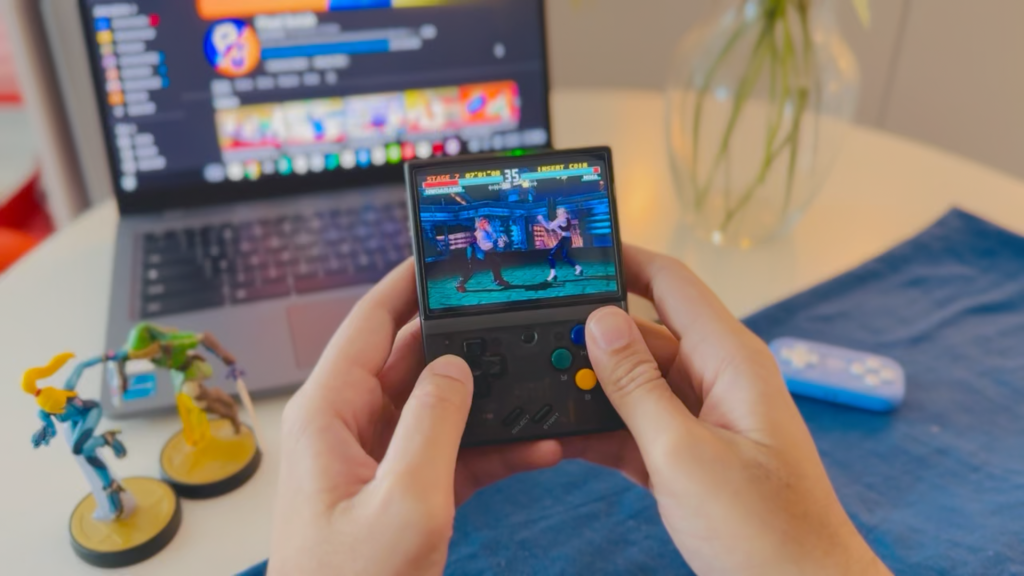
All in all, the whole package comes together to make a genuinely great-feeling handheld—one that makes me smile each time I pick it up.
The Inside
The Miyoo Mini Plus is powered by the SigmaStar SSD202D and comes equipped with a whopping 128 megabytes of RAM. That’s right, megabytes. This means its emulation capabilities are fairly limited. 8-16-bit games from the NES, SNES, and GBA are perfectly fine, as are more demanding titles from the likes of the PlayStation 1. I’ve played a decent amount of Tekken 3 and Brave Fencer Musashi without much hiccup. However, don’t expect to be able to run any N64 or Dreamcast titles. Which, I guess, is for the best considering the Mini Plus doesn’t have an analogue stick.
At its price-point, there are better options out there now if you’re looking to do a wider-range of emulation—specifically, the TrimUI Brick, which comes equipped with a gigabyte of RAM and a much faster processor. However, from everything I’ve read and watched, the Mini Plus still reigns supreme when it comes to button feel and software—speaking of which.
The Experience
The thing that separates the Miyoo Mini Plus from its competitors at its price point, even years after its release, is software. Namely, OnionOS. Created by a group of pals on the RGH Discord server, OnionOS is an operating system made specifically for the Miyoo line of retro handhelds—and it’s absolutely incredible.
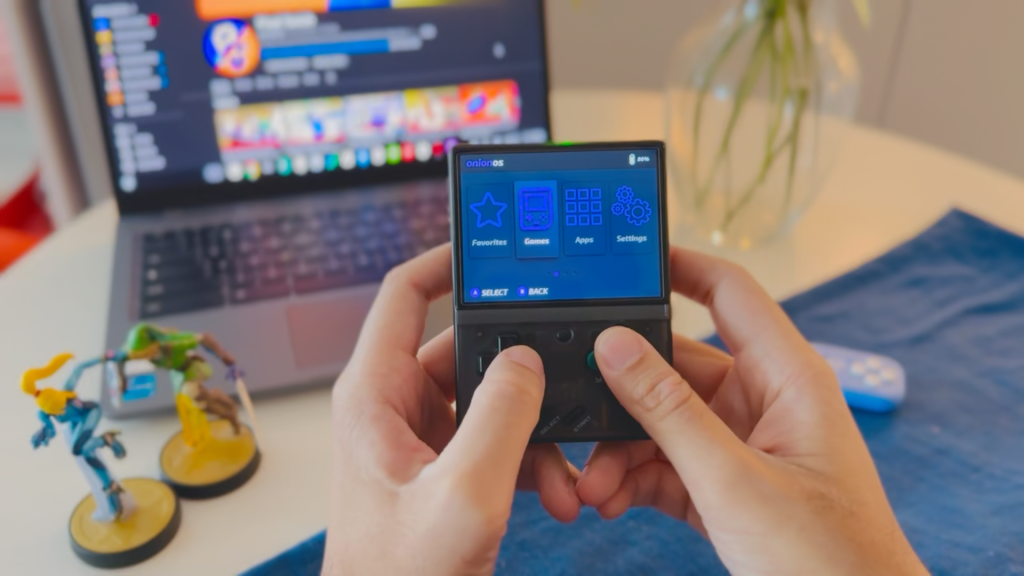
Now, aside from Logitech’s custom software on the G Cloud, which is an Android-based handheld, I have zero experience with other retro gaming handheld operating systems, so take my opinion with a grain of salt when it comes to this aspect of the device. All I can say is that OnionOS is incredibly fast, has a ton of awesome features like instantly switching between games and the ability to save/resume with a press of a button. I talked about the Nintendo-ness of the Mini Plus in terms of hardware, and that same sentiment can be applied to OnionOS in terms of the efficiency, speed, and overall cleanliness of its user experience. It also has some fun little apps, like an MP3 player, which turns your Mini Plus into a full-fledged retro MP3 player. I made a separate short video about this feature and how it’s brought me back to loving music again, which you can watch here.
When it comes to battery life, things are just okay. When playing classic GBA titles at 50% brightness, I can get around four to five hours of playtime; more than enough for a few sessions. When playing more demanding PS1 games at higher brightness levels, that number goes down to the two-to-three-hour range. Also, not too bad. What isn’t great is the fact that the Mini Plus doesn’t have a proper sleep mode. A quick press of the power button (and a change in the settings menu) will put the device into a “light” sleep state. However, the battery drain during this state is quite abysmal, making the state practically useless unless you plan to return to your play session within 30 minutes or less.
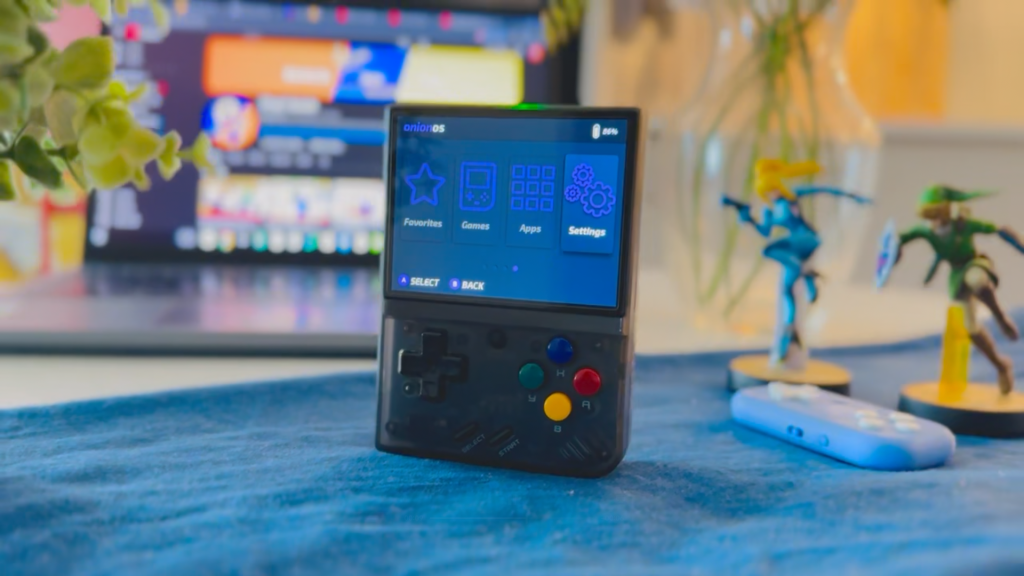
One aspect that I’d like to highlight before ending this review is how the Miyoo Mini Plus has helped me disconnect. I’ll likely do a whole separate article/video about how, in 2026, one of my goals is to use technology in a way that’s beneficial for my well-being, instead of having my brain rot away by doomscrolling through social media for hours on end. The Mini Plus has genuinely been a positive contributor towards that goal over these past few weeks. A device that’s just about playing my favourite games (or listening to my favourite albums), in a small, beautifully constructed package.
The Verdict – 9.5/10
I don’t doubt that the Miyoo Mini Plus will go down as one of my favourite devices of all time. It’s a slickly built device with great buttons that, when paired with OnionOS, is a remarkably polished product that rivals the quality of some of the biggest players in the gaming hardware manufacturing game. Although I wish it had a bit more power to play N64 and Dreamcast titles, and a proper sleep mode for me to come back to my play sessions throughout the day instead of having to fully restart the device each time (though that only takes a few seconds, so it isn’t all bad), it’s still become (and no doubt will continue to be) my go-to gaming device…
…until I inevitably end up buying seventeen more of these things. Sorry, honey.
 Pixel Swish
Leave a comment