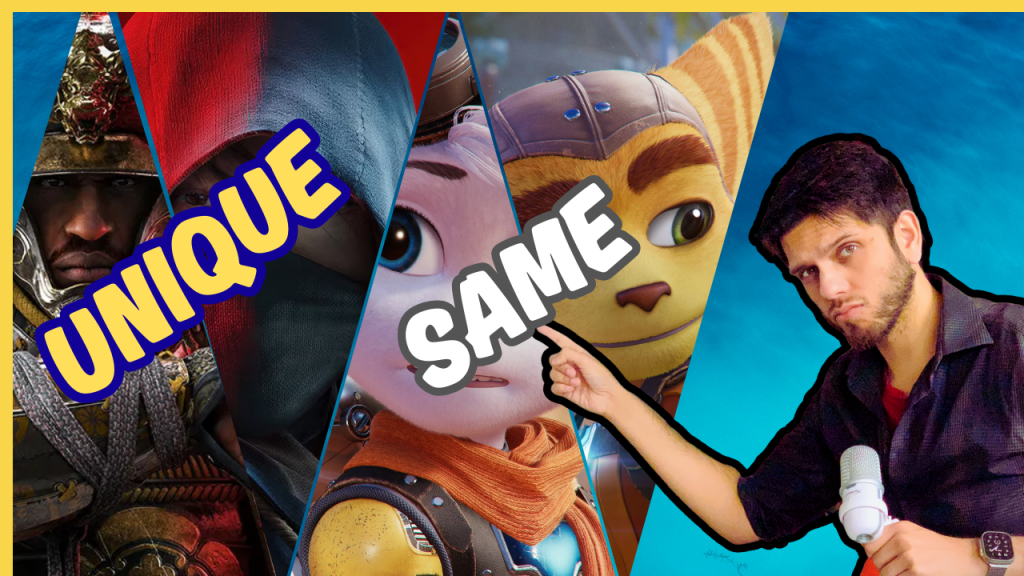
Ubisoft have been toying with dual protagonists in their Assassin’s Creed games for a while now. They were reportedly planning on giving players the choice between playing as Bayek or Aya in Origins before sexist executives budded their smooth-brained heads in and nixed the idea, thinking it too drastic a change for the franchise. Oh no, a female as a playable protagonist? Bury the thought, Pierre! Nevertheless, Ubisoft would eventually give us the option in Odyssey and Valhalla; to much success, if I may add, as Kassandra in Odyssey remains a fan favourite. Ubisoft have now taken it a step further in Shadows, having both a female and male lead and making them distinct, mechanically and narratively.
This distinction between the two characters has been a highlight thus far for me in my 30+ hours of play. A distinction that has encouraged me to flip-flop between the two characters during assassination missions. Whether that’s to gain a tactical advantage given each of their abilities, to see how each would react to an NPC interaction, or simply to change up my style of play. It’s this very distinction in a dual-protagonist setup that I was desperately missing in Insomniac’s Ratchet & Clank: Rift Apart.
Don’t get me wrong, I really enjoyed my time with Rift Apart. It was an adrenaline-filled, beautifully bombastic time that felt like I was playing through a Pixar movie. Its story, though fairly by-the-books and without much depth, did enough to keep me engaged. However, for as fun as the core gameplay was, I couldn’t help but be disappointed every time I’d switch between Ratchet and Rivet. I was excited when I saw that Insomniac was going to introduce another Lombax into the game. Not only because of the potential stories the premise could tell, but also the variety it could introduce to the game’s mechanics. Imagine my surprise, then, when I saw that the first time I switched characters, the game played pretty much exactly the same.
Playing through Shadows now and impressed with how distinct Naoe and Yasuke feel, it inspired me to get my thoughts down on paper and give praise to Ubisoft (which, believe me is not a frequent occurrence) outlining the ways they’ve succeeded with this dual-protagonist setup compared to Insomniac, who unfortunately missed the mark.
Movement
As soon as you take control of Yasuke in Assassin’s Creed Shadows, after a handful of hours playing as Naoe during the game’s opening, you feel an instant difference. Yasuke has a heft and sturdiness to his movements compared to Naoe’s more light-footed agility. This makes sense, of course, as Yasuke is a formidable samurai with pounds and pounds of armour, whereas Naoe is a shinobi who’s required to stay silent as she moves.
But it doesn’t stop there. I was surprised when trying to climb a building as Yasuke to see his burly body struggle to grab onto a low-hanging awning; something Naoe wouldn’t have any issue with. He also struggles to keep balanced while walking across a beam on a roof and isn’t nearly as graceful with his steps when compared to Naoe. Naoe is also able to scuttle across a tightrope with a fluttering ease, whereas one step on such a rope as Yasuke makes the rope snap and has Yasuke fall to his demise. And I almost burst out laughing the first time I tried to do a Leap of Faith as Yasuke, seeing him flail in the air and let out a scream as he tumbled and completely demolished a pile of hay.

Now, compare this with Ratchet & Clank: Rift Apart. Both Ratchet and Rivet feel exactly the same. There’s nothing about how they handle or traverse the world that feels distinct; nothing that makes their movements significant to them as characters or their personalities. They both jump the same, run the same, and interact with all the little doodads around the world the same. I was fully expecting Rivet to have some cool movesets or access to specific traversal mechanics around the world, but that expectation was never met.
In fairness, there is one cool traversal-related element she gets access to on a planet her missions are on, but that section plays more like a mount than a Rivet-specific movement mechanic. Nevertheless, I brushed off my disappointment with the hope that maybe a few hours down the road I’d be able to get access to some cool abilities that were specific to each character. Alas, that, too, was a disappointment.
Abilites
When it comes to playstyle, playing as Yasuke or Naoe honestly feels like playing two different games. From their weapons and special abilities, to their adeptness at stealth and spongey-ness when taking on direct combat, they are vastly different from one another. This makes for some interesting decisions as you play. Do you want to infiltrate an enemy base through the shadows and pick off each baddie one by one as Naoe, or would you rather storm the front gates as Yasuke and pummel your way through the horde? Or, if you’re a little more tactical, you can start as Naoe, take out the archers and sabotage the alarm bells, then switch to Yasuke and take care of the rest. This makes for such interesting set-pieces and incredibly satisfying sequences.
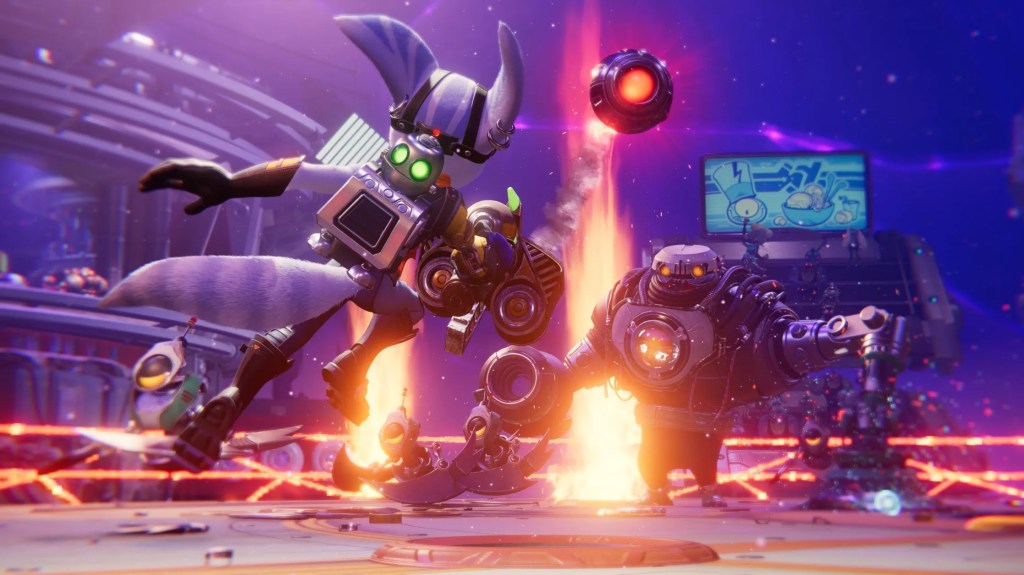
Rift Apart does no such thing with Ratchet and Rivet. Your loadout is the same for both characters, and each newly bought weapon or upgrade carries over each time you switch to the other character. You could say this was a quality-of-life decision as having to re-buy all weapons and upgrades for each character would be a nuisance, which, sure, but not having a single character-specific weapon or ability is, frankly, a little bewildering. There’s not a single gameplay element that makes Ratchet different from Rivet. Even their respective companions are of no help during combat. Neither Clank for Ratchet nor Kit for Rivet have any abilities or gameplay elements that shine during combat. Clank is relegated to tedious puzzle sequences, and Kit is completely MIA.
World Interaction
Just like the millions of Assassin’s Creed games before it, Shadow has a bunch of activities you can do around the map. A lot of these activities, if I’m honest, aren’t incredibly riveting or fun, but they are a good excuse to see some more of the beautiful world Ubisoft Quebec has recreated. One interesting twist this time, however, is that some of these activities are character-specific. You can only do the Kuji-Kiri meditations as Naoe and the Kata exercises as Yasuke, for instance. It’s not much, but it adds to this feeling of playing as two distinct characters. This feeling is further felt when you see how they interact with NPCs. Granted, most NPC interactions throughout Shadow’s world aren’t incredibly riveting; nevertheless, seeing the minor differences in how Yasuke and Naoe interact during such moments is interesting.
Once again, and I feel like I’m beating a dead horse here, but Rachet and Rivet interact with their worlds the same way. In fairness, you don’t cover the same planets as both characters, as each of them has their separate missions on different planets. Yet, I was still hopeful that these planets would have specific activities or side content that would showcase who both these characters were. Though each planet does have one or two side missions, they each play very similarly, irrespective of who you’re playing as.
Personalities
Lastly, I wanted to touch on the personalities of these characters. Yasuke and Naoe’s backstories are very compelling, and their distinct personalities shine through the more I play this game. (Side note: Please play Assassin’s Creed Shadows on “Immersion Mode” as the Japanese dub is leaps and bounds better than the English and does a far better job of bringing these two characters to life). Naoe is a fierce and somewhat stubborn woman who is relentless in her pursuit of revenge. Yasuke, on the other hand, is more reserved and has a deep sense of honour about him–though don’t take his reserved nature for weakness as this dude won’t think twice about bashing your head in with a Kanabo.
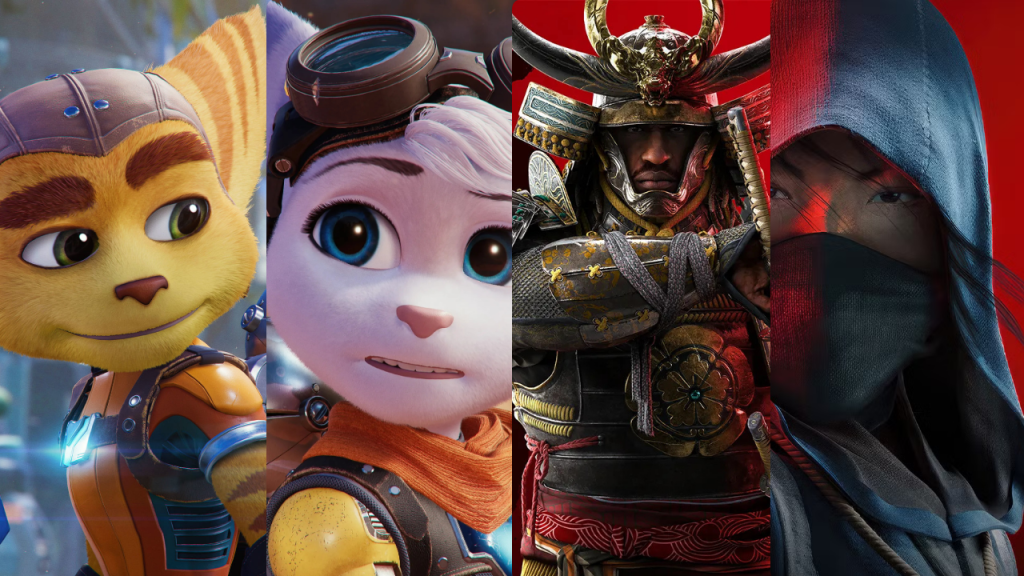
I won’t say that Ratchet and Rivet don’t have distinct personalities; they do. Rivet is a bit more spunky and reckless, whereas Ratchet can be a little more lighthearted and goofy. I only wished that these personalities had more opportunities to shine, both narratively and especially through the gameplay. Because by the end, they both kind of melded together, and I never fully felt like I got to know either of them.
Assassin’s Creed Shadows and Ratchet & Clank: Rift Apart are obviously very different games; as such, making certain comparisons may be unfair. Nevertheless, they both have the same setup of allowing players to play as two different protagonists. One of them, however, simply understood the assignment far better than the other, and in so doing, has delivered an experience that makes you connect with each of their protagonists in a more tactile and robust way that goes beyond just the narrative.


Leave a comment