
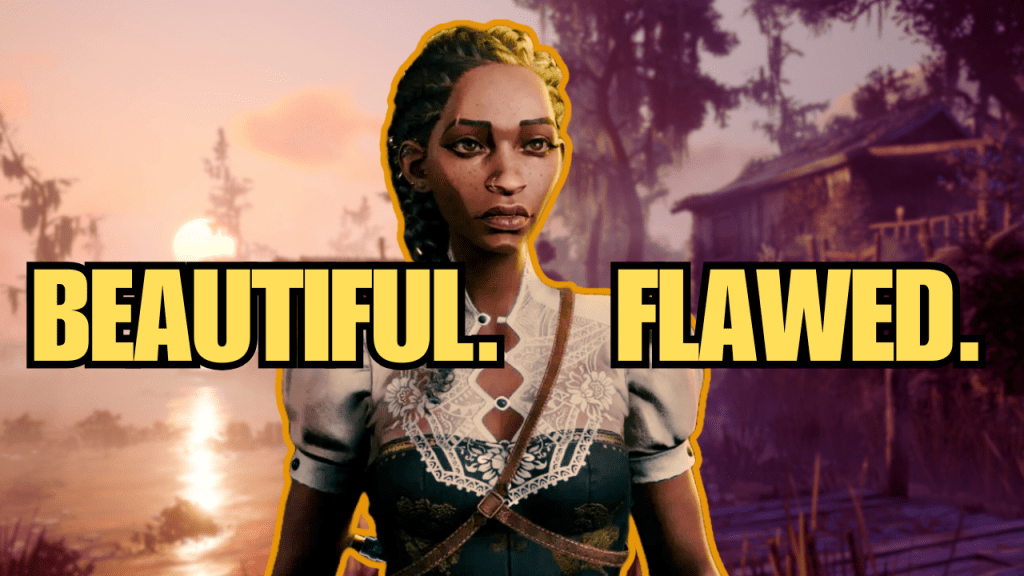
South of Midnight instills this sense of nostalgia, evoking memories of a time when a video game could sweep me off my feet with a fantastical world realized with wondrous art direction and a clear vision of its tone, characters, and overall vibe. Even if the game was bereft of complex gameplay mechanics or a sprawling map with endless activities, it hooked me by simply being unabashedly its quirky self, flaws and all.
It’s this very idiosyncratic nature that South of Midnight carries itself with that gives me confidence in telling you that this game is incredibly special, albeit far from perfect. It’s an empathetic journey through stories of trauma and community across vivid landscapes inspired by the Deep American South, the likes of which I’ve never seen before in a video game, with characters that pop out of the screen. Though it falls short on some key gameplay and narrative elements, this is a game that’s going to stick with me for some time, and I hope Microsoft allow Compulsion Games to keep exploring this impressive world that they’ve crafted.
The Heart
You play as Hazel, who, after a hurricane leaves her hometown of Prospero devastated, with a flash flood uprooting her house with her mother still inside it, must travel across Prospero in search of her mother and find answers to the many mysteries that surround her hometown. Soon enough, Hazel unlocks special powers and begins to see strange strands and creatures around her, which she eventually learns are a part of her being a Weaver—a magical mender of broken bonds and spirits.
On your journey, you’ll find that much of the otherworldly plane of Prospero, which only you, as a Weaver, can see, is covered in what the game calls Stigma. A dark ooze that originates from tears in the Grand Tapestry. As a Weaver, you have the power to rid the Stigma with your special magical abilities and reweave the Grand Tapestry, all the while learning about the histories, horrors, and traumas of those in your community.
Be forewarned, though, these stories are not for the faint of heart, as some of them deal with some truly devastating themes. Rightfully so, in my opinion, as Prospero’s dark history of enslaving black people and its mistreatment of those in poverty doesn’t just exist in the past, but those traumas have crossed generations in different ways, which Hazel now must work to mend. The writing and presentation around this history is delicately done, and done so in a way that doesn’t exploit these horrors for cheap shock, but in a way that feels empathetic and beautiful.
Something positive must also be said about the writing around not just Southern American culture, but Southern American Black culture. Being that Compulsion Games is a French-Canadian studio comprised of mostly white folk, and South of Midnight’s writer and director is a whiter-than-white man, you can imagine the skepticism I (and, I’m sure, black folk around the industry) had before booting up this game, and the pleasant surprise at seeing how much love they’ve poured into creating an authentically black experience. To quote VICE writer Anthony Franklin II’s review, “Not only is this a great game, but it’s also authentic in its representation of Southern and Black culture. And that’s what stood out. Yes, there are white characters, but this experience feels Black from top to bottom. And it isn’t forced — it’s real. And it’s beautiful.”
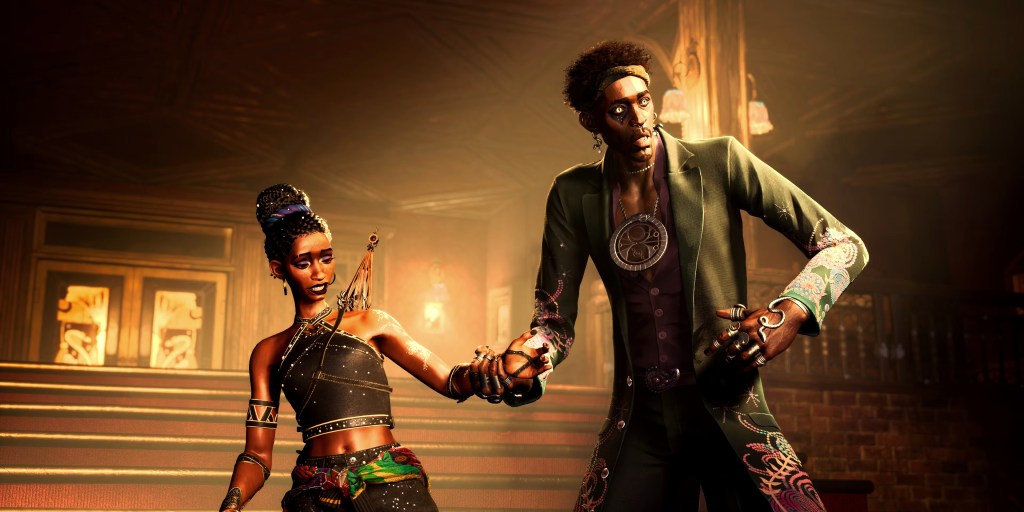
And I agree. From the impeccable fashion to the hair, to the delicately told stories of Mahalia fighting for freedom (which creatively act as the game’s tutorial), to the themes of identity and perseverance, David Sears and Compulsion Games have shown a lot of love for not just the Gothic fantasies and mythos of the Deep American South, but the influence of Black culture within the sub-genre. It’s captivating to learn about a mythology so embedded within Southern American culture through the kinetic experience of a video game; it brings me closer to the sights, sounds, and emotions of a people and community I otherwise wouldn’t have ever gotten an opportunity to experience.
All that said, there are a couple of narrative aspects wherein I must toss some criticism. For one, I’m unsure how I feel about the game’s handling of certain narrative beats. For example, there’s a story about two brothers early on in the game whose ending was quite horrific. Thematically, it was poignant and well-written, however, the gravity of its ending was somewhat lost as the game just skirted past it with Hazel giving a one-line response. This would be a frequent occurrence throughout the game, and each time, undercut the emotion of significant moments. I didn’t need the game to do what some others did and bask in its luridity (looking at you, The Last of Us Part II), but an extra character moment or cutscene where Hazel reflects on the story she’d just witnessed would’ve gone far in lessening this jarring feeling that didn’t feel tonally appropriate.
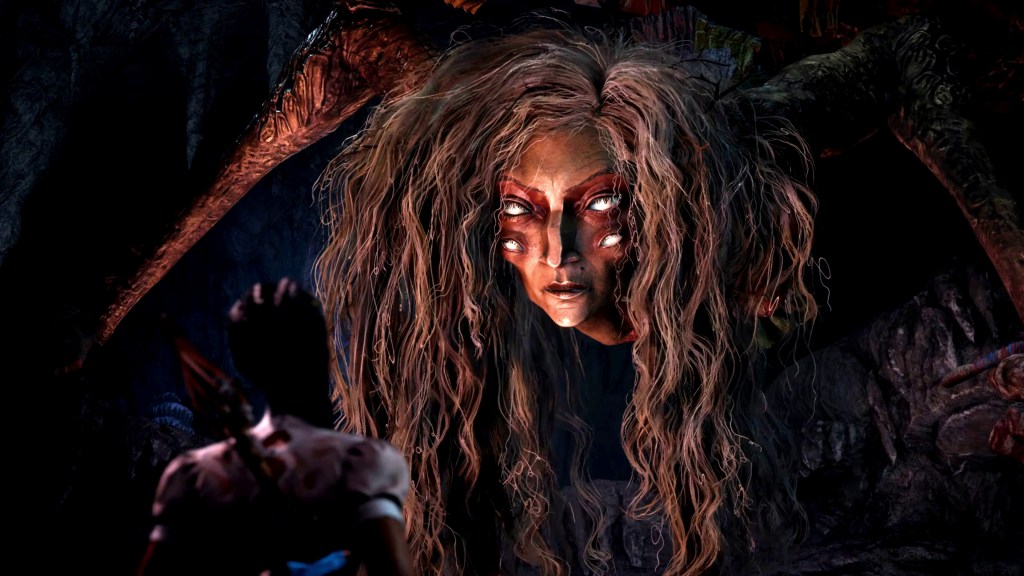
Lastly, the ending of South of Midnight was severely underwhelming. The game was clearly setting up an encounter with a certain character, and everything pointed towards them being the final boss, but when that chapter finally came, it all came to a close in a manner that felt far too cute and anticlimactic. I didn’t necessarily mind the ending on a narrative level, but it didn’t feel earned, either from a gameplay perspective or a character-writing perspective. It felt as if Compulsion Games had run out of development time and had to rush things out the door, leaving the ending to lack any sense of catharsis or proper thematic resolution.
The Eyes & Ears
To put it simply, South of Midnight is one of the best-looking and sounding video games I’ve played in recent years. From the beautifully rendered character models to the hums, chirps, and drones of the vibrant landscapes, Compulsion Games has done a tremendous job of bringing this world to life with an audiovisual flair unlike any other.
Playing on PC with all the settings set to “Ultra,” I lost count of the number of times I did the classic slow-pan to take in the environments. Compulsion Games’ use of Unreal Engine 4 to mix high-quality lighting, fog, and shadow effects to bring about a grounded realism that juxtaposes against their fantastical art design goes so far in giving South of Midnight a truly unique look. The most unique aspect of this style, of course, is the animations. To add to this storybook-esque visual identity, Compulsion Games chose to have certain animations run at lower frames. More specifically, all of Hazel’s body movements run at 30fps, while all her and the rest of the cast’s facial animations run at 15fps, all the while the game itself runs at 60fps. This creates this very interesting, somewhat jarring, presentation that feels as though you’re watching a stop-motion animated film—and boy, is it just gorgeous.
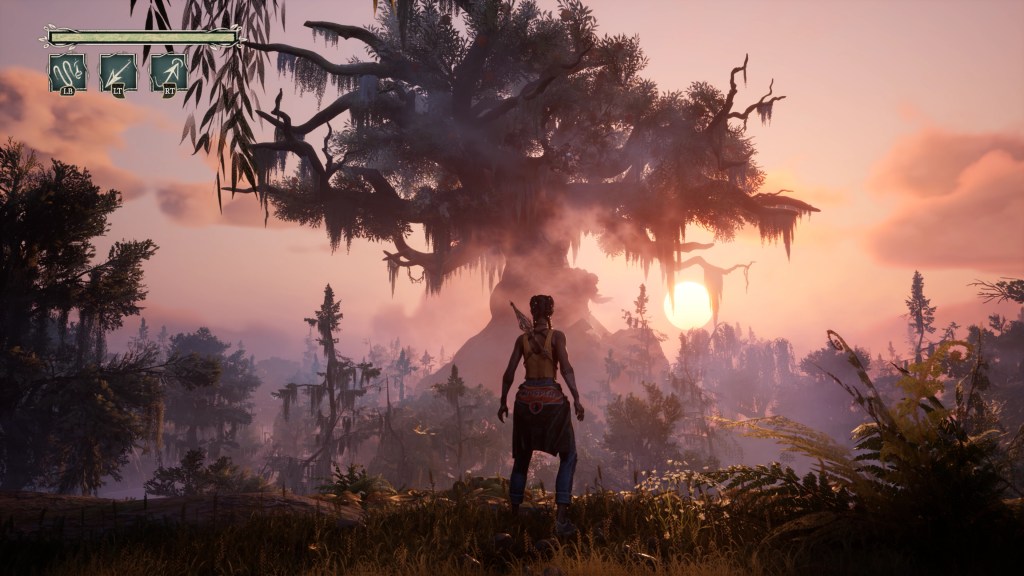
If you’ve watched the documentary, Weaving Hazel’s Story, that Xbox put out late last year, documenting the making of this game, you’ll remember the creators talking about how they travelled to the Deep South with microphones in hand to record hours upon hours of natural sounds. The work paid off, as simply slow-walking through these lands was a treat not only for the eyes but also the ears. From the rustles of dried shrubbery, to the croaks of toads, to the chirps of birds and twangs of other swamp creatures, it all comes together to make for a genuinely authentic and vivid auditory experience.
A lot of praise must also be given to the game’s composer, Olivier Deriviere, who clearly did a ton of research to ensure his melodies brought the appropriate feelings to enliven both the narrative and gameplay experience, all the while giving a tremendous amount of love to Southern sounds and Black culture. His work ebbs and flows between flavours of Blues, Bluegrass, and Country, while still retaining an identity that feels idiosyncratic to the game itself.
The Controller
If I can only use two words to describe South of Midnight’s gameplay, it would be, “it’s fine.” Because it is. In fact, it’s so incredibly “fine” that I’m not entirely sure how to even write about it, as much of it is quite forgettable. This is your standard – and I mean standard – third-person action-adventure affair. Each chapter has you traverse along a new area, wherein you’ll take in the lovely environment as you hop, skip, and skedaddle across an array of platforming sections, read some interesting lore tidbits via notes, stray off the beaten path to collect some upgrade materials, and enter some combat zones to fight some baddies called Haints.
Of all these gameplay elements, my favourite by far was simply traversing each stage. The platforming in South of Midnight works decently well, with Hazel having a couple of Weaver abilities to keep things interesting. These include an air dash, a mystical grapple hook of sorts, and the ability to wall run, though the latter two can only be used in specific sections instead of willy-nilly. Exploring the gorgeous stages, finding upgrade materials, and reading notes were much more exciting for me during my playthrough than the combat itself.
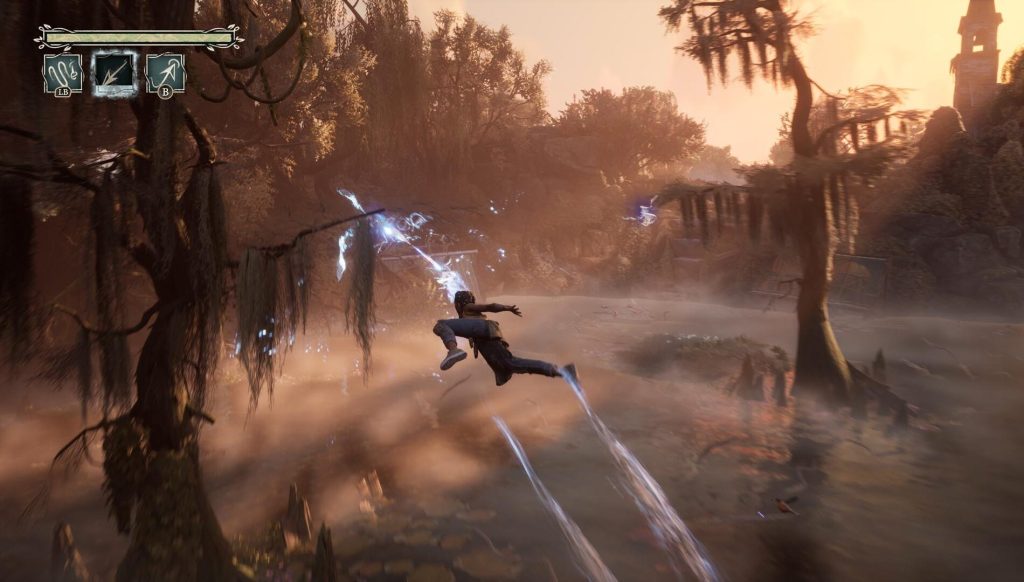
Combat exists in an Okami-like fashion, where once you enter it, you have to stay until you rid the zone of all Haints and fix the tear. At your disposal, you have a standard attack and four Weaver abilities, all of which can be upgraded through a simple but effective skill tree. There’s not much in terms of combos, but as you progress through the skill tree, some abilities can be used effectively in tandem. Though there’s some strategy involved, the combat is easily this game’s weakest aspect. It’s not bad, by any means, just not as robust or as polished as I would have liked. The abilities work as you’d expect – even though I wish there were more to them – and you eventually find a satisfying flow-state that makes you feel pretty powerful. That being said, every encounter was something for me to simply get through to return to the exploration rather than something I was actively engaged in. Enemy variety is decent, with some interesting twists added in during later stages, but once again, it all seems fairly by-the-book—a stark contrast to everything else this game does.
Verdict: 8/10 – “It’s Superb”
South of Midnight is a tremendous achievement in audiovisual design whose narrative explores poignant themes of generational trauma and perseverance. Compulsion Games has done a remarkable job of showing love to the mythos of the Deep American South and the Black culture that influences it. Though its combat falls short of memorable, the sights, sounds, and stories of this world will stick with me for years to come, even if the ending lacked the satisfying “oomph” I was looking for. This is a special game that has that special something—a special something that I hope Xbox continue to invest in.

 Pixel Swish
Leave a reply to ‘Clair Obscur: Expedition 33’ Is A Love Letter To Gaming Greatness | The Pixel Swish Review – Pixel Swish Cancel reply