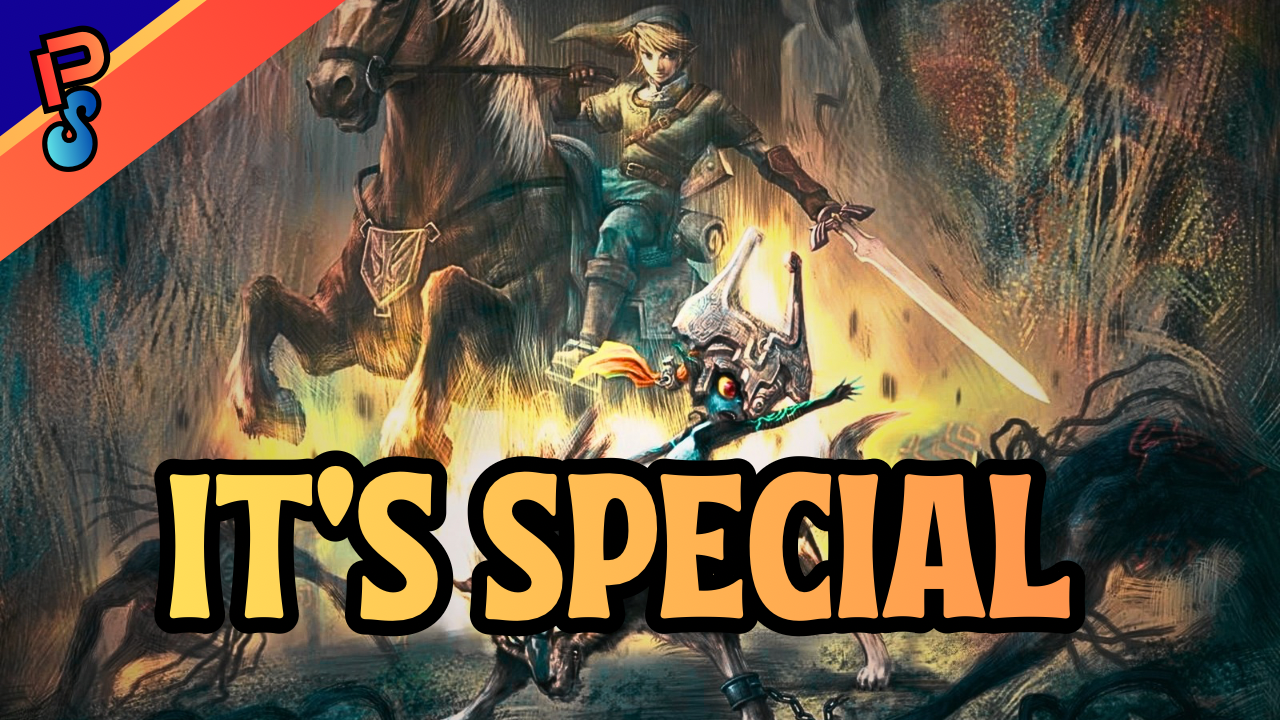
November 1st, 2026 will go down as the date on which I finally completed The Legend of Zelda: Twilight Princess. A game that I’d played originally back in 2006 on the Nintendo Wii, but unfortunately abandoned after a few hours because I was a dumb middle-schooler who couldn’t appreciate how good this game actually was. It’s something I’d always regretted as the years went on, and decided that it was finally time to rectify such a shame in my backlog. Now, considering my history with Zelda, I wasn’t expecting this game to resonate with me, because, well, Zelda games rarely did. But, something in me throughout the years kept telling me that this was going to be different. That this Zelda was going to be different. Well, friends, having, at last, rolled credits on Link and Midna’s journey, I can say that little part of me was right—Twilight Princess is different. Not just different, but special. So special, in fact, that it may just crack my top 3 favourite games of all-time.
Before I get to why this game is so special, I want to explain how I got here; to share my history with Twilight Princess and the Zelda franchise as a whole. Because doing so will give you a better understanding of what I look for in video games and why Zelda had, for the longest time, failed to connect with me. So, grab a snack and enjoy the ramblings of a random guy on the internet as he tells you about his journey with Zelda, and his love for Twilight Princess.
Your Support Means the World
If you enjoy our work and would like to support Pixel Swish, consider becoming a monthly supporter.
A Little History
The Legend of Zelda: Twilight Princess released on November 19th, 2006—nearly twenty years ago, as of writing. It’s a time I remember well, as it released as a launch title for the Nintendo Wii, a console that garnered much fanfare as it was set to, as the late-great Satoru Iwata believed, “create a gaming revolution” (heck, it was even code-named “The Revolution”). I was fully caught up in the hype, too, feverishly stalking Gametrailers.com during the months leading up to the console’s release for any new videos and images. Seriously, I think I watched that “Wii Want to Play” advert at least a thousand times. I didn’t care about the PS3’s Cell Processor or Gears of War on the Xbox 360—I was all in on that waggle, baby.

This excitement bled into my hype for Twilight Princess. Now, I didn’t grow up as a Zelda fan. I was a weird Sega Genesis kid who only got into gaming properly with the PlayStation 2. As such, my mascots were Sonic, Jak and Daxter, Sora, and Goku. Okay, yes, I know, Goku isn’t a PlayStation mascot, but he might as well had been for me since half of my PS2 library consisted of Dragon Ball Z games. I knew of Zelda, of course, much like how I’d known about Mario and Donkey Kong. I’d watched a friend play a bit of Ocarina of Time on his N64, would pick Link as my main in both Smash Bros. Melee and Soul Calibur II whenever I played on my friend’s GameCube, and even played a bit of Oracle of Seasons on my Game Boy Colour, but never got too far into it as I kept getting distracted by 102 Dalmatians: Puppies to the Rescue. Yeah, I was a weird kid.
Twilight Princess would be my first “real” Zelda game, and I couldn’t wait to get into it. After a bit of an arduous adventure getting my Wii (thank you, granddad), and after spending several hours playing Wii Sports with my cousins and family that first evening, I was finally alone with my beautiful new console and could start my adventure into Hyrule. I spent the entire night locked in my room, talking to the charming folks in Ordon Village, and grinning from ear to ear with giddiness each time I swung my Wii remote to make Link cut down some grass. I was enchanted by this world, a little frightened each time I had to fight one of those shadow monsters as Wolf Link, and so damned excited the first time I used the bow and arrow with the motion controls. However, as the weeks went on and the magic of the Wii’s gimmick started to settle, so did my interest in Twilight Princess.

You see, I was never interested in Twilight Princess—I was interested in the Wii and its revolutionary motion controls. As such, when it no longer felt magical to swing my Wii remote and see Link swing his sword, I was ready to move on to the next game and see how else the Wii’s gimmick was implemented. What can I say, I was a dumb middle-schooler who was easily swayed by marketing. Now, I did manage to get somewhat far into Twilight Princess, making it through the Lakebed Temple, but not seeing the game through to its end-credits would be something that would go on to gnaw at me for the following two decades. It’s interesting that me never finishing Twilight Princess would bother me so much over the years, because, you see, Twilight Princess would be far from the first Zelda game I’d go on to play but never finish.
My Problem with Zelda Games
Skyward Sword, Ocarina of Time, Ocarina of Time 3D, A Link to the Past, Wind Waker, Minish Cap, A Link Between Worlds, Breath of the Wild, and Tears of the Kingdom. These are all of the Zelda games I played since abandoning Twilight Princess in 2006. Nine games. Of these nine, do you know how many I actually saw through to their end-credits? Three. Breath of the Wild, A Link Between Worlds, and, surprisingly, Minish Cap. The first because, well, it’s Breath of the Wild—a game that fundamentally changed the Zelda formula and brought innovations to the open-world RPG genre that blew our minds. It made me feel like a kid and brought a sense of discovery I’d never felt in a video game before, let alone a Zelda game. A Link Between Worlds was simply a joy to look at and play, with each dungeon feeling fresh, and its primary gimmick implemented in ways that never got old. And Minish Cap because…I’ll be honest, the only reason I finished this game was because I started it fairly recently and couldn’t bring myself to abandon yet another Zelda game, and so forced myself to finish it. If I didn’t have such guilt, this, too, would have joined the abandoned Zelda club. Don’t get it twisted, it’s a good game, just not all that different from the other Zelda‘s I didn’t finish.

As for the other six, they’re all games I played a ton of, wherein I’d gotten their respective Master Swords, and yet failed to see them through to their end-credits—often abandoning them right before their final dungeons. Now, obviously, the big question is: why? Well, the answer, I believe, is twofold. Firstly, a couple of these games — like Wind Waker and Skyward Sword — have late-game MacGuffin hunts that have you backtrack and revisit areas and dungeons to collect pieces of whatever-the-heck to then finally be able reach the last dungeon and final boss. By that point, I’d felt as though I’d seen everything these games had to offer and just wanted to finish them off, instead of having to go on yet another long and unnecessary, multi-pronged fetch quest.
Now, many games do this—Nintendo games, especially. Metroid Prime, one of my favourite games of all-time, needs you to locate all twelve of the Chozo artifacts before you can face Ridley. It’s something that you can easily miss — like I did — during an initial play-through, requiring you to backtrack through, ostensibly, the entire game again. Yet, this was something I did happily, as going back with Samus fully souped up and razing through enemies that previously gave me a hard time was a blast. So, what was the difference? Well, this leads me to my second point: story-telling and atmosphere.

If you’ve been watching or reading my stuff for a while, you know what I’m about to say. For me, story is king. It’s one of the biggest reasons I play video games—to be able to have an immersive, interactive story-telling experience. Now, Metroid Prime doesn’t have the most captivating moment-to-moment story beats. However, it’s one of the most atmospheric games of all-time. Tallon IV is a mysterious planet with a long history; its enchanting environments beckon you to learn more about said history through scanning all of its Chozo ruins and artifacts, as well as all of the creatures that inhabit it. Couple that with some remarkably mesmerizing music, and you can’t help but want to know more about what’s been going on. Furthermore, the simple but effective premise of being stranded and having lost all of your weapons and gear, and needing to find everything to help you get off the planet sets up a sense of urgency that pushes you forward.
Zelda games never gave me that sense of urgency; they never gave me that level of storytelling, character writing, or atmosphere to push me forward. Most Zelda games tell the classic hero’s journey, save the princess, defeat the big evil baddie fantasy story. Which, is fine…for the first ten hours. It’s always been enough to get me invested in the world; couple that with being charmed by the environments and cutesy townsfolk, and I would always find myself hooked and eager to go off on an adventure. After a few dungeons, though, that eagerness and sense of wonder would fade, and I’d find myself wanting more out of this world, characters, and overall narrative. Link being a silent protagonist also didn’t help matters, although I’ve come around to that as the years have gone on and actually find it an endearing aspect now.
As mentioned, I didn’t need a high level of story-telling for Breath of the Wild because of how groundbreaking that game was, and how it always kept me on my toes in terms of exploration and gameplay. It did something truly special with its open-world that made me feel like I was creating my own little mini-stories as I was playing. That special feeling was lost when playing Tears of the Kingdom. Even though, in most respects, it’s the better game, that sense of awe and splendor I’d felt during that initial play-through of Breath of the Wild wasn’t replicated. And, of course it wasn’t. How could it? Tears is also a far more busier and mechanically complex game with how much was added to its open-world and gameplay, taking away some of that simple brilliance of Breath of the Wild. Still, if it had a better narrative driving it, I’m sure I would’ve seen it through to its end—but it didn’t.

Now, I know a lot of you are probably typing furious comments telling me how amazing the story of Ocarina of Time is, and how deep the Zelda lore goes. And, I believe you. I was actually intrigued by the opening of Wind Waker, seeing how it connected with the original timeline of Ocarina. I also really enjoyed how haunting the contrast in tone, audiovisuals, and dialogue was between the past and future Hyrule in Ocarina. I enjoyed the relationship that was built between Link and Zelda in Skyward Sword. And I always, always, love the charming NPCs and overall aesthetic of these games. The beginning of Zelda games are always my favourite. But, after a couple of dozen hours, I start wanting something more from a story-telling and character writing perspective. Or, want the game to blow me away from a gameplay or design perspective in ways I didn’t see coming—like Breath of the Wild and like A Link Between Worlds.
So, either give me an engaging story with significant plot beats and well-written characters who have proper arcs, or an enchanting atmosphere that encourages me to keep exploring the world, or unique gameplay and exploration mechanics that continually evolve as the game progresses. One or two out of the three would be great. Twilight Princess manages to do all three.
What Twilight Princess Does Right
As soon as I hit that title screen after booting up Twilight Princess for the first time in 20 years, I knew I was in for something special. That title screen music, Link atop of Epona, the sun gently setting over Hyrule—it all sent a chill down my spine. When the game begins, you watch as Link sits at the edge of a spring next his mentor, Rusl, as the sun sets on Ordon Village. The first lines of the game come from Rusl, who says, “Tell me…do you ever feel a strange sadness as dusk falls? They tell me it’s the only time when our world intersects with theirs. The only time we can feel the lingering regrets of spirits who have left our world. That is why loneliness always pervades the hour of twilight.” Bro…what?! That is so beautiful; so melancholic and poetic. Nintendo, ya’ll wrote this?!

It’s these opening moments that had me completely transfixed. A lot of people talk about about how the beginning hours of Twilight Princess are the worst because of how slow it is. I couldn’t disagree more. I loved these opening hours. The way this small village is presented, the little tasks you have to do for the villagers, getting to know them a little better as you do, and the overall tone and pacing made me, for the first time in a Zelda game, actually feel like I was a part of a community. Like I had a routine, life-long friends—a life. Much of this is helped by the enchanting atmosphere, soft melancholic music that pulls at your nostalgic heart strings, as well as the overall cinematic sensibilities. For the first time, I actually felt like a Zelda game had an understanding of story-boarding and shot selection. The cut-scenes are very well-directed, having a great understanding of spacing, scale, and pace to emphasize the emotional weight of a moment.
But, these were just the opening hours. And, as mentioned, the opening hours of Zelda games always do a good job of hooking me (although, this game did an even more exceptional job of it). How does Twilight Princess fair a dozen hours in? Two dozen? Well, even better, on multiple fronts. From the introduction of Midna, to Link turning into a wolf, to the menacing way in which Zant and his shadow minions are showcased and the horrifying ways Ordon Village is overrun, to the introduction of Zelda, to all of the set-pieces and character moments that follow—there’s a level of cinematic panache here that I’d never seen in a Zelda game before. Cinematic sensibilities that carry through to the very last cut-scene, and wonderfully ebb and flow between the epic and grand, and the somber melancholic. There were character moments that made me teary-eyed, moments that made me laugh out loud, moments that took me aback with how hauntingly eerie they were, and moments that made me go, “holy sh*t that was epic!” That final, four-part fight with Ganon was cinematic as hell, too. Also, Malo is G.O.A.T.-ed

So, narratively, Twilight Princess gave me the thing I’d always missed in my prior experiences with the franchise. It could have stopped there; it could have had passable gameplay and dungeons and I would have likely still finished it due to how much I fell in love with this story, world, and characters. Thankfully, it didn’t stop there. Not only did it not stop there, but Twilight Princess might have some of the best dungeons and gameplay elements in the whole damn franchise. I was already impressed with the Forrest Temple and Goron Mines, both with their overall designs and how their respective items needed to be used to solve puzzles. The whole Wolf Link sections preceding them were a fun touch, too, and weaved with the narrative and world-building nicely. I didn’t expect the dungeon experiences to get much better, honestly, but the game really just said, “boy, hold my Spinner.”

Going from Arbiter’s Grounds to Snowpeak Ruins back-to-back was a one-two punch I could not believe actually happened. These are two of the most brilliantly designed and mechanically robust dungeons I’ve ever experienced in any Zelda game. The Spinner and Ball and Chain are two of the best items in this franchise, as well; they’re oodles of fun to use and I loved their implementation in their respective dungeons. It’s not just these two, though. Every dungeon, I felt, had something unique to offer; they each had great audiovisual designs and interesting traversal elements. Not to mention, the boss fights. Oh my, the boss fights! From Ook to Dangoro to Stallord to Argorok, the boss fights in this game, whether they’re mini-bosses or final bosses, are epic and tremendously fun— some of the most memorable fights I’ve had in gaming.

There’s so much more I could gush about. Like how this is one of the only games that has proper combat while on horseback, and those sections are awesome. The whole jousting bit on the Eldin Bridge? Epic, even if a little mechanically clunky. I love how crunchy the swordplay feels, too, and the secret moves you learn from the Hero’s Spirit adds a nice level of complexity to the core combat mechanics. The story of the Hero’s Spirit is tragic and hauntingly ties in to the extended lore of the series, connecting back to both Ocarina and Majora. But, you wouldn’t really know that unless you paid close attention and did some external research—which, I did. And that, too, is something significant. I never cared about the lore of the Zelda franchise, but this game made me care. It made we want to pick up the new Ocarina remake and go back and play Majora. For the first time, I actually cared about this world. Much of that is helped by the fact that Midna is, by far, the best companion in this franchise. She starts off as a hilariously sassy, sarcastic little devil, but actually has a beautiful character arc, and the story of her people is one I was very much invested in.
Now, I can admit that not all is perfect with Twilight Princess. The Lakebed Temple, though a tad over-hated, is a low point. Some of the camera controls on horseback can get a bit wonky, the swimming never feels quite right, and it also has a late-game MacGuffin hunt — after you’ve already collected the main MacGuffins — that I wasn’t particularly a fan of. But, unlike previous Zelda‘s, that hunt is propelled by a story I actually cared about, with characters I actually cared about. Much like Metroid Prime, it was joyous to go back and revisit old areas because I was enraptured by this world, characters, and atmosphere. I also wanted to smack some Bokoblins with the Ball and Chain. I didn’t want to leave this world; I wanted to see Jovani’s story through, even if it meant finding 60 damn ghosts.

I am so happy that I gave Twilight Princess another shot. I’m so happy that I listened to that little voice that kept gnawing at me over the years. This was a special experience. A special experience that I can’t wait to revisit very soon, especially considering how active the modding community is with the fan-made PC port, Dusklight (because Nintendo can’t be bothered to release a proper Switch port, clearly). Everybody has their Zelda, and I’m proud to say that Twilight Princess is mine, and it’s one of my favourite games of all time.
Leave a Reply