

In 2012, renowned Brazilian documentarian Kleber Mendonça Filho released his debut feature film, Neighboring Sounds—a story about the residents of an apartment building and its neighboring streets in the city of Recife. A story about middle-and-upper-middle-class hypocrisies and the insular politics and condescension that takes place between them, in addition to the blood that’s on the hands of those at the top. A story that’s quiet and, on the surface, seemingly innocuous, yet its themes are haunting and presented almost palpably, only truly hitting you once the credits begin to roll.
If Mendonça’s name rings a bell, it should. This is the man who wrote and directed the 2026 Best Picture Oscar nominee, The Secret Agent. He also wrote and directed Aquarius and Bacurau, both of which got him nominations for the Palme d’Or at the 2016 and 2019 Cannes Film Festivals, respectively. Four films, four masterpieces. Each touching upon a variety of historical and sociopolitical issues within Brazil.
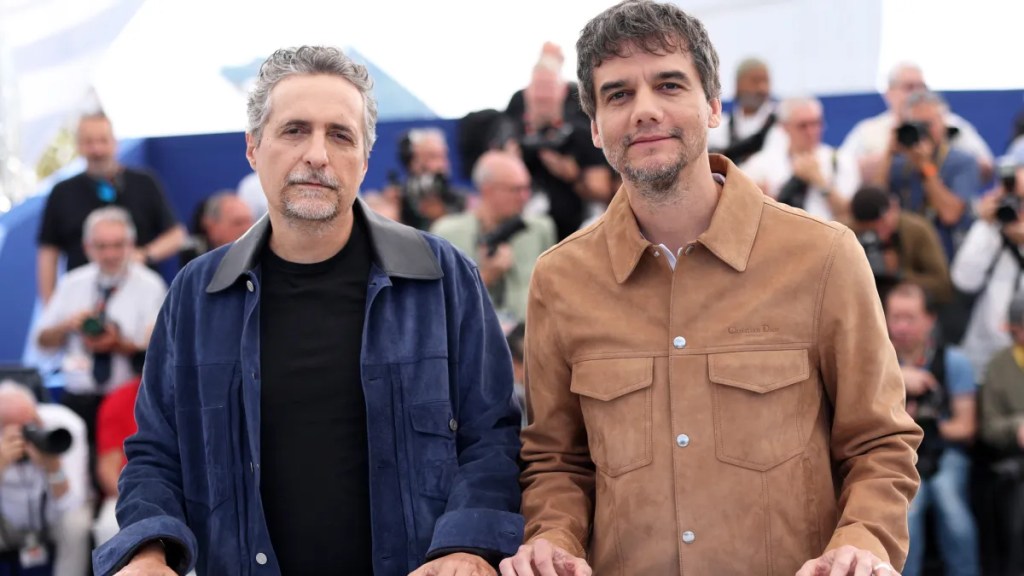
What’s remarkable, however, is the way in which Mendonça captures these issues. It isn’t through a macro lens wherein politicians and the issues themselves are the stars of the movies, much like a documentary might be. Rather, his stories follow the individuals; they are character-first narratives and the themes present themselves in a much more intimate fashion. This is further helped by Mendonça working with some tremendous actors, all of whom give top-tier performances.
The fact that Neighboring Sounds was Mendonça’s first film almost makes me mad. The same way how 12 Angry Men being Sydney Lumet’s first film made me mad the first time I watched it. Because they are so good and have no business being debut features. Obviously, Mendonça had a storied career as a documentarian prior to his shift to features, but documentaries are not features, and it’s impressive how seamlessly he was able to execute certain cinematic sensibilities with a mature subtlety.
In Neighboring Sounds, Mendonça isn’t afraid to take time, drip-feeding the audience with small, seemingly mundane moments of the everyday lives of these middle-class residents. Yet, every moment, every character interaction, and the way they’re shot, all have meaning. To give an example, in the beginning of the movie we have this shot of a young girl looking down from a high-rise building’s balcony. Below, she sees a young boy on the other side of the building’s fence playing with a football (not that football, the real football). The boy accidentally kicks the ball over the fence and into the building’s property. He calls for someone on the other side to throw the ball back, but no one does. Eventually, he gives up and goes back home. The girl, having seen all of this, feels bad and even tells her mother about the boy, but nothing comes of it. Now, when explaining this moment the way in which I’m doing, it’s fairly easy to understand the allegories taking place. What isn’t as easily discernible, however, is how impactful this moment is, thematically, to the wider story. This one shot, one moment, encapsulates the violent history and tensions of the narrative. One that the audience will only truly understand at the end.
Mendonça is, without question, one of the finest directors we have currently working in the business, and you owe it to yourself to go and watch all of his films. Especially Neighboring Sounds, which very well may be my favourite.


Leave a comment