
I don’t know how to begin this article. I don’t know what words to write because words feel insufficient. A sin for me to say as a writer, I understand, but it’s the truth. Because it’s not often that a piece of media or work of art leaves me feeling this way. It’s a feeling I have a hard time describing, but one I’ve been lucky to have felt a few times in my life. I felt it after watching Grave of the Fireflies, after reading James Baldwin’s Giovanni’s Room and Omar El Akkad’s One Day, Everyone Will Have Always Been Against This. I felt it after watching Satyajit Ray’s Pather Panchali and Agnes Varda’s Vagabond.
And here I am again, feeling that same feeling after having rolled credits on The Beginner’s Guide—a narrative-driven first-person video game from Davey Wreden, the creator of The Stanley Parable. A game that left me unable to describe the emotions that it had elicited. Because the feelings were all too much. It’s a game that struck me at the very core of my existence as a writer; my ego as an artist and storyteller, questioning my work and its purpose.
Now, before I move on, I need to ask you to stop. Stop reading this article and go play The Beginner’s Guide if you haven’t. Because it’s an experience you should have without any preconceived ideas of what this game is. I can’t guarantee it’ll affect you the same way it did me (as is the nature of art), but for the price of admission, I believe it is an experience well worth having. An experience that, from henceforth, I’ll be doing my best to describe to you in an attempt to understand and analyze its deeper meaning. As such, take this moment as a spoiler warning.
A Friend
The game starts with a fade into white, which already is an interesting choice. Traditionally, we’re used to seeing films and visual narratives like games begin and end with fades in and out of black, signifying a closure or a passage of time. White, in contrast, is more ambiguous—almost dreamlike and as if you’re stepping into something not entirely based on reality or truth. When I’d first played through this game, this choice didn’t mean much at the time. Now knowing the game’s ending, the choice stuck out to me, considering what I knew about Davey as a narrator. Speaking of which.
Davey Wreden introduces himself at the start. He thanks you for playing the game and tells you that The Beginner’s Guide isn’t one game, but rather a collection of smaller games. Games made by his friend, who goes by the handle “Coda.” Davey met Coda in 2009 and was instantly infatuated with their work. Davey describes Coda as somewhat of a recluse. Someone who was constantly making these games but seldom (if ever) shared them with other people. All of Coda’s games are made in the Source engine, and at first glance don’t have much going for them from a visual or mechanical standpoint. They are all these short, first-person thought experiments. Experiences bereft of any elaborate gameplay mechanics, though each with some quirk or interesting idea. Ideas that Davey, as he walks you through these games, concludes are in someway interconnected. Not with one another, necessarily, but with Coda’s mind.
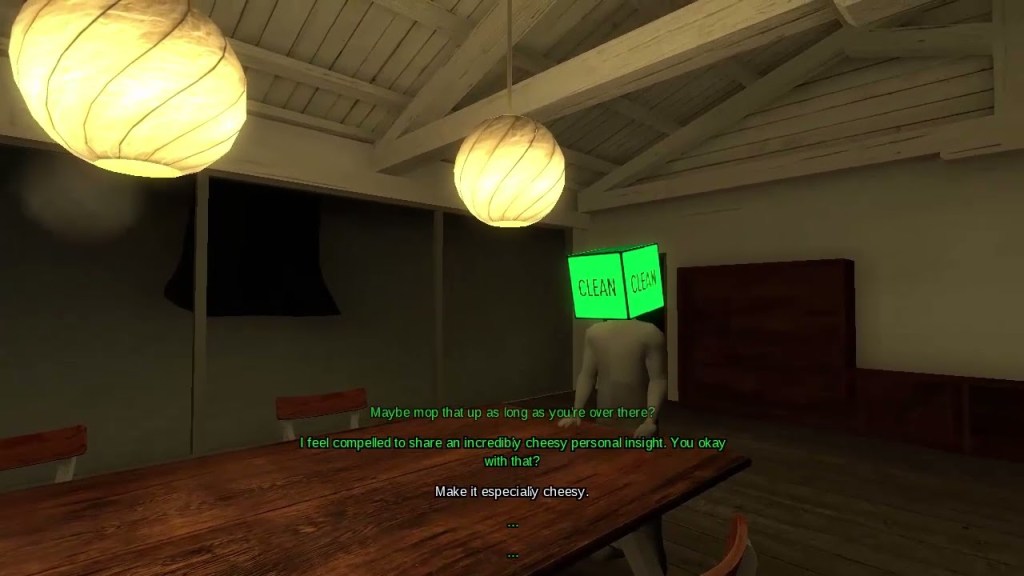
Davey struggled to understand some of Coda’s design choices. Like how in one game Coda creates this prison where they force the player to be stuck in it for an hour before unlocking the door. In another, the player is asked by an NPC to clean up a house. Once you finish, all of the chores reset and you have to do them again—and again, in an endless loop. Davey doesn’t force you to endure these mechanics, however, instead modifying the experience to be more enjoyable. But Coda, as Davey explains, questions whether games needed to be “enjoyable” — or even “playable” — or if their designs couldn’t go beyond those words to convey something deeper.
Davey disagrees with this philosophy and tells you how the two would often argue about it. However, the more Davey played Coda’s games, the more he began to understand this idea. Davey explains how he believes Coda used his games as a way to communicate with the world, without ever actually communicating with the world. With that theory in mind, as you progress through the chapters, you slowly start seeing Coda — the person, not the game developer — in their games. Davey tells you how he wished Coda would open up; how he wished they would share their work with the world; how he wished they’d talk to someone about their loneliness and struggles.
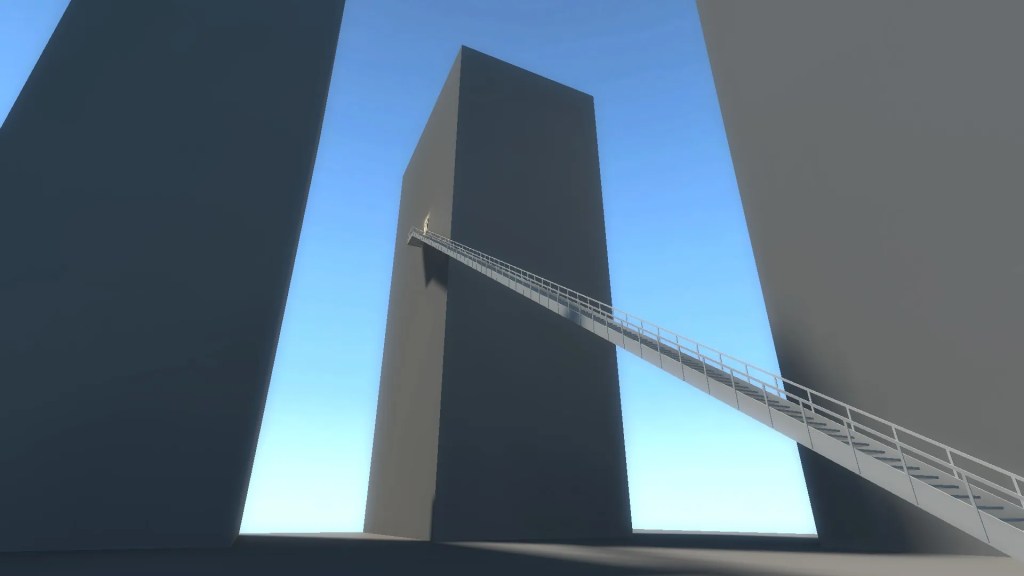
One of the earlier chapters has you go up a flight of stairs, at the end of which is a door that opens. However, as you approach the top, your pace slows to a crawl and you’re unable to make it to the door. Why would Coda make it so the door opens yet you’re unable to reach it? Who knows, but Davey modifies the game so that your pace reverts to normal so that you can enter the room behind the door at the top. What you see inside is quite chilling. A room filled with floating words; phrases that don’t entirely make sense at first, until you realize they are sentences describing ideas for games. “You are a gate;” “Stand on an ‘X’ staring at a bear for 3 hours;” “Read an enemy’s emails to learn how to beat them.” That last one sounds pretty dope, I won’t lie. But these ideas exist in this room. A room Coda never intended for you — or anyone — to see. That is, until Davey modified the game to allow you to do so.
A Friend (?)
Davey mentions in the beginning that Coda abruptly stopped developing games in 2011. He says that he’s not entirely sure why and hasn’t heard from them since. Someone who once produced a game every couple of months was, all of a sudden, nowhere to be found. And that affected Davey, because Coda was their friend and he was concerned for their well-being. He also missed Coda’s games. He didn’t want them to simply exist in the abyss. He needed to do something. That something is The Beginner’s Guide. A game which exists to maybe, hopefully, show Coda that their games mean something. That they resonate with people. And if Coda sees that, sees that people love The Beginner’s Guide, love their games, then maybe they’d come back to make more.
This wouldn’t be the first time Davey’s obsession with Coda’s games led him to do something questionable. Somewhere along the tail-end of their friendship, Davey thought it’d be a good idea to finally share a few of Coda’s games with some trusted mutual friends and colleagues. They loved what they played, and said as such to Coda. It would only be a short while after this that Coda would cut all ties with Davey and disappear.
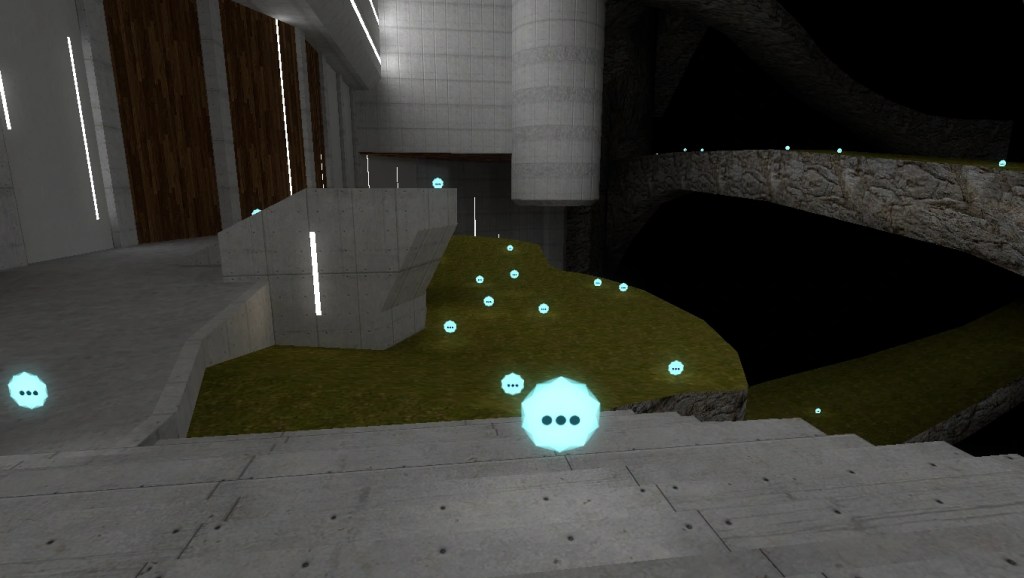
The further you progress, the more you begin questioning Davey as a narrator. He depicts Coda as this recluse; a lonely human struggling with their mental health and using game development as a means to cope with their depression. He asserts that it’d be so much healthier for Coda if they’d simply share their games with the world; to allow other people to see their creations. Davey doesn’t leave room for you to interpret these games, instead passionately analyzing each of their meanings — and, in turn, Coda’s psyche — as fact, though in a manner that’s approachable and seemingly from a genuinely empathetic place.
It isn’t until the very last level where the true story between Coda and Davey is revealed. This level is called “The Tower,” and to Davey’s knowledge it’s the last game that Coda ever made. From the moment it starts, things are quite different compared to Coda’s other games. You’re surrounded by empty, almost brutalist architecture with haunting sobs and screams of a woman echoing throughout the grey walls. The only thing in front of you is a jarring red portcullis. Davey describes this game as “cold” and “distant.”
When you walk past the red portcullis, you’re met with another one in the distance, a seemingly empty room between you and it. The room, however, is not empty, there’s an invisible maze you must get through in order to reach the entrance on the other side. A wrong step results in the screen flashing red followed with a shriek. It’s a jarring experience, and one that feels almost as a warning. Or, as Davey puts it, “The game goes beyond not being meant to be played, it actually seems to despise the player for trying to play it at all.” A curious description, but we’ll touch upon that in a bit. Davey modifies the game and builds an orange bridge over to the red portcullis.
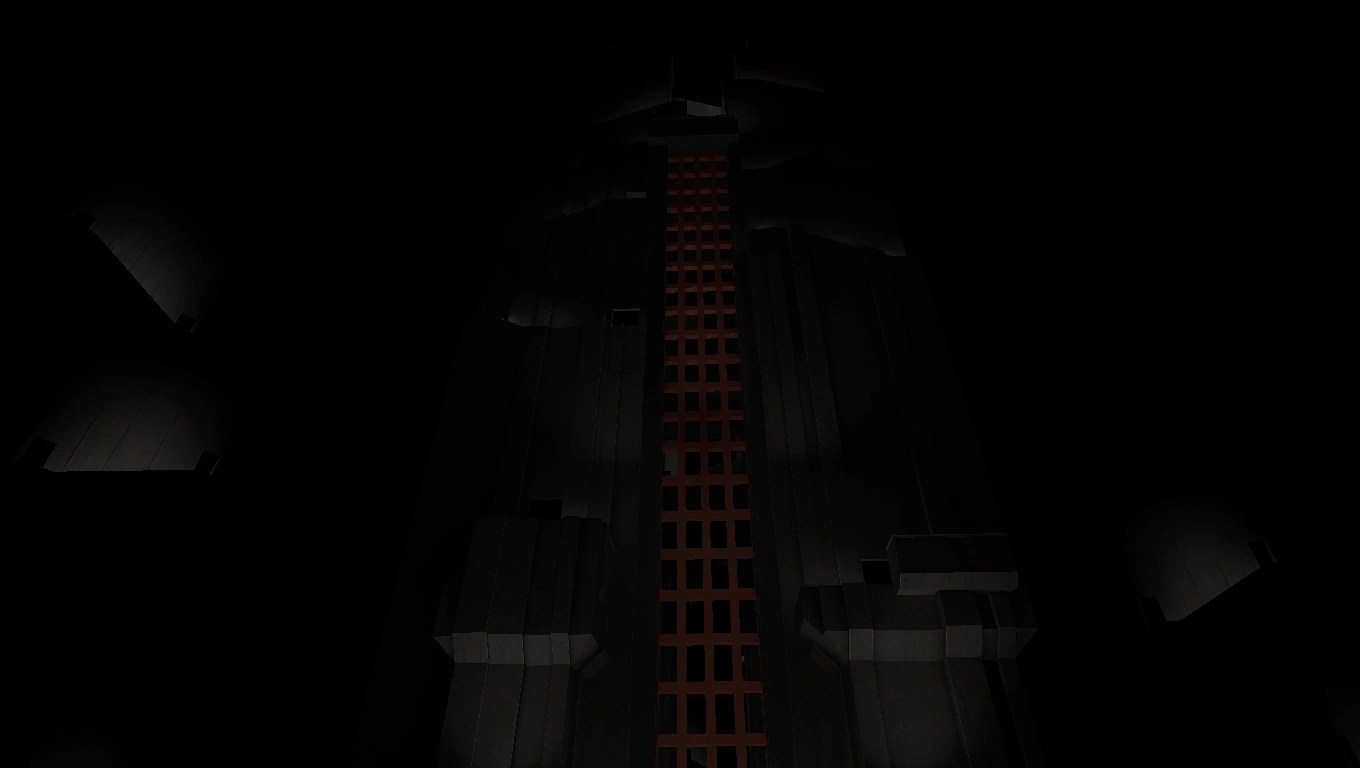
As you climb the stairs to reach the level’s end, Davey begins to question his actions and his relationship with Coda.
“I had come to so many conclusions from looking at his work up until this point, and then suddenly none of them…For years I was trying to get to know him, to understand who he actually was and what he stood for.”
“I asked him so many times to please just tell me what his games mean to him.”
“I just felt so strongly that if I could have connected with him, that I could have somehow made his work my own, that I would finally be once-and-for-all happy.”
“Where did I screw up?’
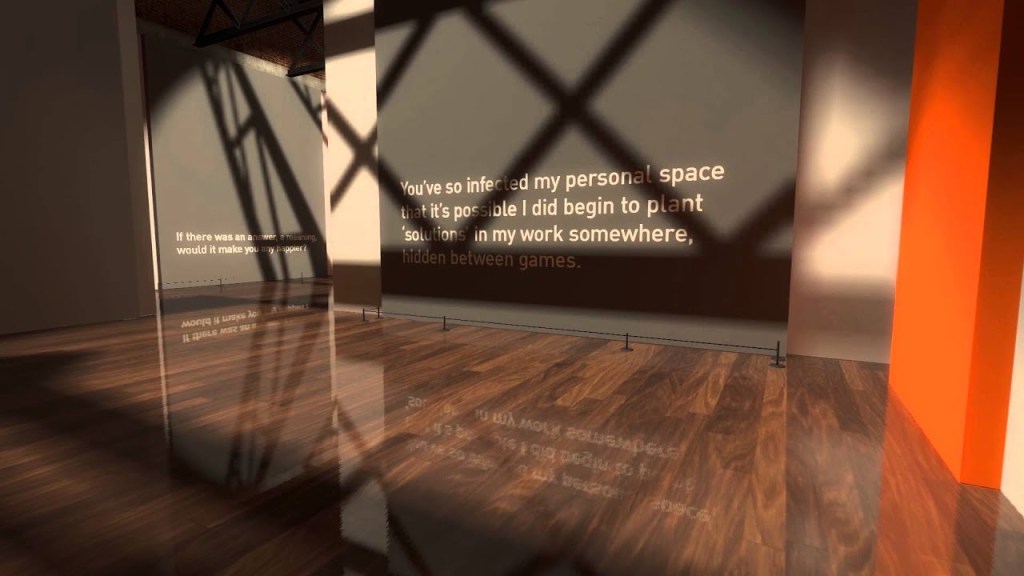
At the top of the tower, you enter a room whose walls — some of them orange — are filled with text. It’s an email. A few of its lines read:
“Dear Davey,
Thank you for your interest in my games. I need to ask you not to speak to me anymore. I wonder at times whether you think I am making these games for you”
“If there was an answer, a meaning, would it make you any happier? Would you stop taking my games and showing them to people against my wishes? Would you stop changing my games? Stop adding lampposts to them?”
“The fact that you think I am frustrated or broken says more about you than about me.”
“I know that this doesn’t makes sense to you just yet. But I do hope that one day it clicks, and that you make peace with this thing you are wrestling. And when you finally see what I am talking about: Don’t say anything.”
An Artist (?)
Davey did not not say anything. He made The Beginner’s Guide. This game that’s a compilation of Coda’s life’s work. Games by someone he called a friend. He shared Coda’s games to the world, even though Coda didn’t want them shared. And for what? For what reason? Why would Davey do this? Why was he insistent on sharing the intimate creations of a close friend?
Well, because Coda is an artist, and Davey is an artist’s ego. My interpretation of The Beginner’s Guide is that Coda is Davey’s alter ego. There’s some speculation amongst fans that Coda may indeed be a real person, possibly based on one of Davey’s real-life friends or even a girlfriend (as evidenced by some female models and voices scattered throughout the games, most significantly in the aforementioned “Tower” level). There’s a dedication during the credits that reads “For R,” which gives credence to this speculation. Nevertheless, for me, it’s quite clear that Davey and Coda are one in the same. That The Beginner’s Guide is a game about art, its purpose, and the constant battle an artist has between preserving the sanctity of their work and the ego that drives them to seek outside validation. It’s about an artist (Coda) wrestling with their ego (Davey) to preserve and protect their games. To protect that special thing that keeps their creations unsullied from the outside world.
For those that don’t know, I’ve spent over a decade as a creator. I’ve been a working actor on both the stage and film, written and sold screenplays, directed and produced a handful of short films, and am currently trying to sell my first manuscript for a science fiction novel while also dabbling in photography. If there was ever a diagnosis for “artist ADHD” I feel my symptoms would fit. As such, fighting with my own ego and this incessant need for validation is something I am all too familiar with. I mean, just take a look at the opening of this paragraph. I could have simply written “actor,” instead I needed to add “working” as a qualifier. I needed to tell you that I had written and sold screenplays. That I wasn’t just another floundering artist. That I had been compensated financially for my work. That I was seen. Please, see me. Please, I beg you, see me.
…
It’s tough for me to admit that, even though I want so bad to be like Coda, I am, unfortunately, much more like Davey. Maybe all artists are like this, I don’t know. Maybe all artists are constantly wrestling with their inner Codas and Daveys.
There’s a moment during the “Tower” level where Davey says that he can’t fathom making something just for the sake of making it. That he doesn’t understand the purpose of making games if it’s not meant to be shared with other people. Everything I have ever done as an artist was with the hope that other people would see it. Even if there wasn’t a financial gain, at the very least I wanted my work to resonate with someone, anyone. I wanted somebody out there to see my work and, in turn, see me. Just see me.
And I hate that. Because I love art. I love telling stories, and I wish that love was enough. That my work didn’t need validation or to be monetized. That I just did it for the love of the game. At the same time, I feel art is communal. If every artist just locked themselves in a room and made beautiful work (or even terrible work, for that matter) only for them, then we’d lose all art. And a world without art is not one I want to live in. I also want to be fair to myself. I do make art for the love of it. I make art, write stories, and make videos and articles like this because I can’t imagine not doing so. Not doing it would be akin to not living. I just wish doing it wasn’t immediately followed by this itch to have others see me doing it. I wish my art, I, could be seen and not seen at the same time.
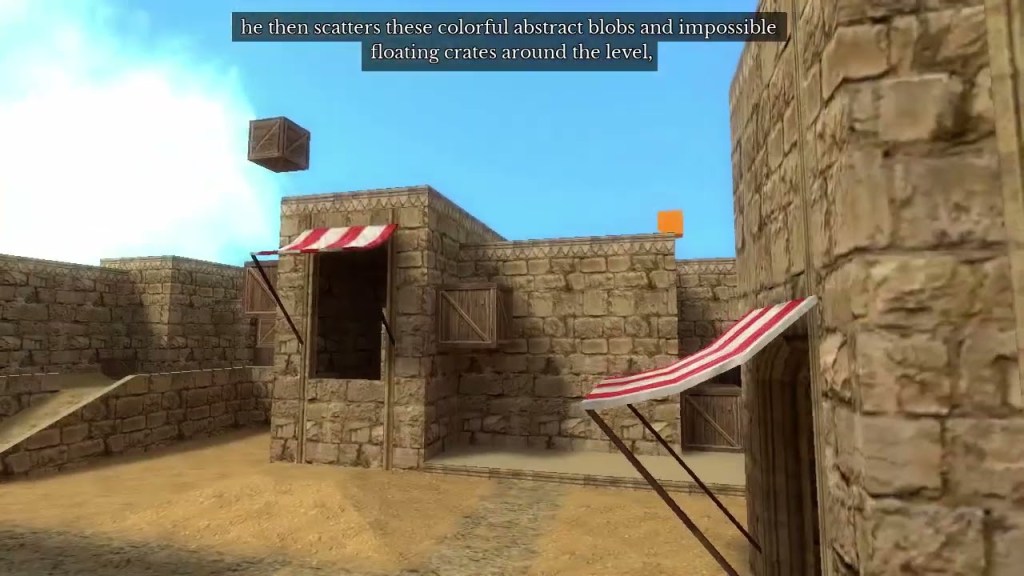
There are little hints littered throughout the levels of The Beginner’s Guide that signal these games, Coda’s games, have been tampered with by Davey. At the end, when Coda’s emails reveal that it was actually Davey putting lampposts in these games and not Coda, you start catching things during a second play-through. I mentioned earlier that the bridge Davey puts at the end of the “Tower” level to help you cross that invisible maze is coloured orange. On my second play-through, I noticed orange art assets were littered across multiple levels. In the very first one, an orange box curiously sticks out like a sore thumb amongst an otherwise standard Counter-Strike-esque map. There are orange walls and platforms that don’t quite fit. It signals this idea that Davey, the ego, had been encroaching upon Coda’s work for some time, tainting their work—as if preparing them for outside consumption.
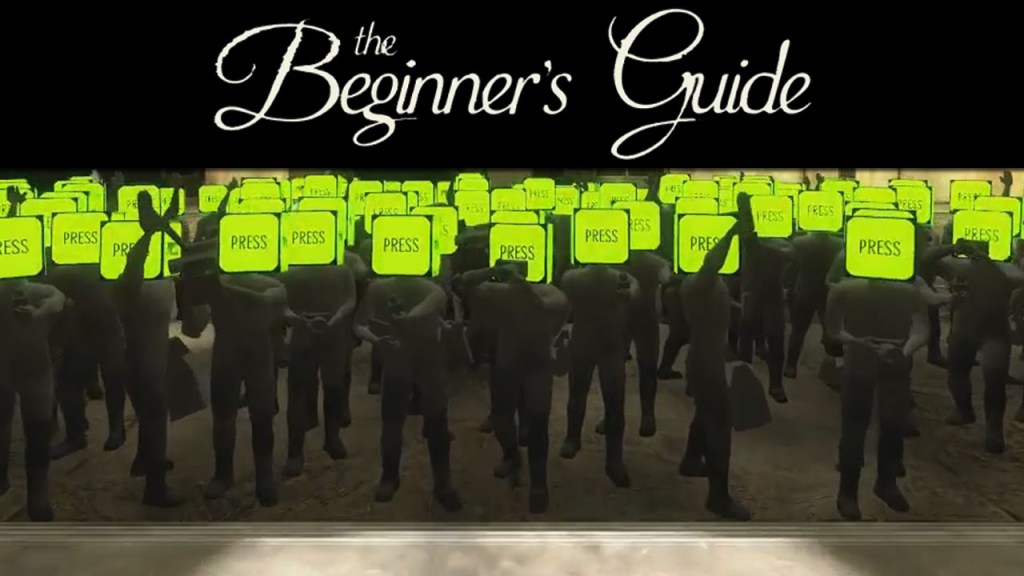
The more Davey encroaches upon Coda, the more people start having expectations for their work, the less Coda has a desire to create. This idea peaks during the penultimate chapter named “Machine.” In it, you walk through a crowd of NPCs with boxes for heads with the word “press” written on them. They take pictures of you and ask you questions like, “Will we get to see the machine?” and “What can you tell us?” When you reach the machine — a decrepit metallic box sitting in an empty room — you’re given dialogue options to tell it things like “You stopped” and “Those people out there, can you imagine what pain you’ve put them through?” The chapter ends with you, in the shoes of (I presume) Davey, going out to the crowd and telling them that the “machine” will not apologize, but that we — meaning the people of the outside — are stronger than it (Coda).
The following segment has you walk into to a theatre, machine gun in hand, and start shooting at the very fabric of this game’s world, destroying it. Because that’s what happens when your art goes into the world: People destroy it. Still, during this, Davey, as the narrator, spins the narrative to make you believe this is Coda still isolating themselves from the world. That the only way for Coda to overcome their loneliness is just to share their work with people.
The final “Tower” level, when understanding the cruelties of Davey, now has a different meaning. It isn’t Coda on the brink of doing something terrible to themselves. It’s a last ditch effort to stop Davey—to stop you. To stop you from tarnishing their games, changing their meanings, and sharing them with the world only to feed your ego. To allow the last remnants of creativity that Coda has left to survive.
On a second play-through, it’s very obvious that this story is a work of fiction; a meta-fiction about art, its intent versus its perception, and the ego of its creator. It’s clear that this story is about Davey Wreden and his journey as an artist and game developer, fighting with his own egos, insecurities, and those that view his work. Some may fault the game’s writing for this, for doubling down on the premise of Davey and Coda being real people, but doing so only added to the narrative themes for me. It made it real, which in itself is scary. The Beginner’s Guide is a brilliant piece of work that resonated with me on a level very few pieces of media ever have. I think its a game every artist needs to play, even if they don’t play video games.
 Pixel Swish
Leave a comment