

One of my fondest gaming memories as a kid was going over to a friend’s house whose older brother had an Xbox. Our parents were friends so I’d be over there often, and his older brother was responsible for taking care of us. To shut us up and keep us occupied, he’d let us play Halo 2. Being a couple of dumb seven-year-olds, we’d hop on split-screen multiplayer and blow each other up in rockets-only matches—laughing maniacally with each rag-doll animation.
One of my fondest gaming memories as a teenager was when I moved back to my home country and, while struggling to make friends, got invited to a sleepover by one of the popular kids. When I mentioned that I had a copy of Halo 3 that I could bring to the sleepover, all the boys freaked out. Because, you see, back in the mid-2000s, my home country didn’t have copies of all the latest and greatest games available on the market. My copy was the one I’d brought with me from Canada. All of us stayed up the entire night to play through the campaign in split-screen co-op—passing controllers back and forth as we each took turns being in the shoes of Chief.
And now, one of my fondest gaming memories as an adult will, no doubt, be playing through nearly each and every Halo campaign again via The Master Chief Collection with my buddy Rick, who hit me up a couple of months ago and told me that he’d never played any of these games before but wanted to see if I’d be interested to do so in co-op. A chance to revisit one of my favourite franchises, play each of their campaigns back-to-back, and see them through a modern lens? Yeah, I said “yes” in a heartbeat. It would also be an opportunity for me to play Halo 4 and ODST for the first time, as I’d never done so previously. As of writing, we’ve completed the MCC and are a little over halfway through Infinite. We decided to skip Halo 5 because, well, it’s Halo 5.
Now, before we began this journey, I had a fairly clear idea of my rankings for each of the Halo campaigns. I wasn’t expecting my thoughts or the order in which I’d rank them to change much with this new play-through—but boy, did they ever. So, allow me to tell you about my experience playing through each one of these campaigns in 2026, and my renewed rankings for each of them. A little heads up: Though I’ll do my best, it’s impossible to not delve into some spoiler territory as I touch upon each of these games, so take this as a minor spoiler warning for The MCC.
Halo: Combat Evolved
Halo: Combat Evolved revolutionized the first-person shooter genre on consoles. It revolutionized how FPS games felt to play on a controller, and many of the mechanics we’re used to today — like streamlined controller bindings and reticle snapping — are thanks to the ingenuity of the team at Bungie. It was also one of the first FPS games to tell a narrative with cinematic storytelling sensibilities. 25 years later, the game definitely shows its age, but certain elements still hold up. Although, it’s far from I would call a great experience.
Combat Evolved thrusts you into the midst of the story without much set-up. You’re introduced to Captain Keyes and the A.I. Cortana who are aboard the Pillar of Autumn, a UNSC cruiser that’s being attacked by Covenant forces. Soon enough, Keyes orders Cortana to release you, the Master Chief, and help the crew escape onto a newly discovered ring-world named Halo. On Halo, you and UNSC soldiers fend of hordes of Covenant while saving scattered survivors. You soon learn that Keyes has been captured, and so you must infiltrate a Covenant cruiser to save him. It’s not long before more mysteries begin unraveling and the truth of Halo is revealed.
When thinking about the story on paper, it all sounds interesting. Problem is, the way in which the game is structured doesn’t lend well to its storytelling. Firstly, the escape from the Pillar of Autumn felt like it was never going to end. Rick and I went through countless metallic corridors, all of which looked the same, only to be met with dead-ends. When on Halo, though the missions are linear, the objectives are scattered around this ring-world, and they’re all quite repetitive. This repetition is made worse when the environments all looks the same, often making it a bit confusing to traverse. Most of the story during all of this is done through either Cortana or UNSC soldiers blabbering in your ear while you’re trying to figure out where the f*ck to go, which isn’t the most impactful narrative experience.
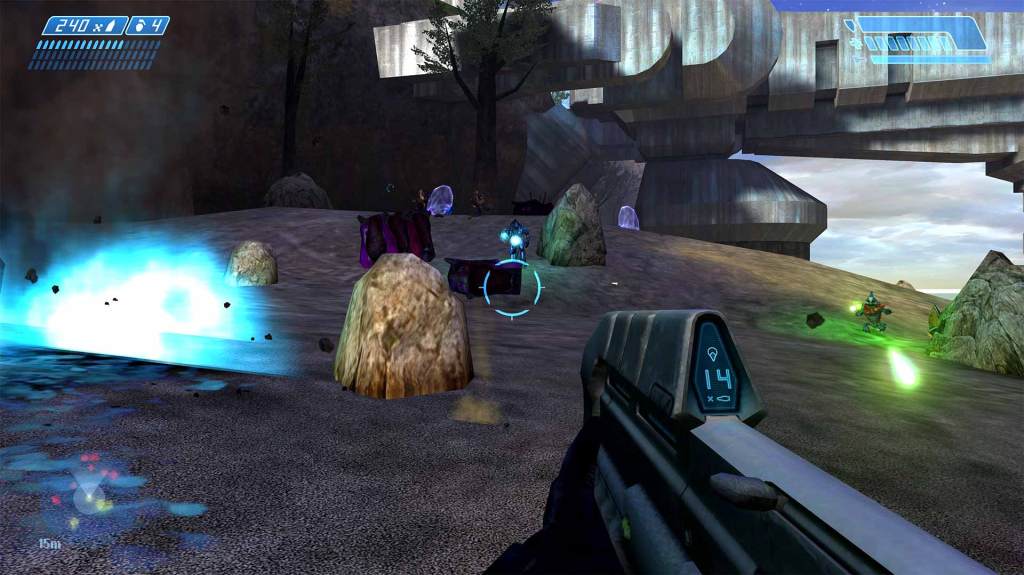
Now, a first-person shooter campaign is always going to be about “go here, kill enemies, interact with a doohickey, watch a cutscene,” but that formula becomes all the more tedious when the gameplay loop and environmental design doesn’t add much diversity. The Anniversary edition graphics don’t help with this, either, as the updated visuals shift the tone of the game for the worse and make for far too much visual noise.
Still, in terms of moment-to-moment combat, Halo is Halo. And Halo‘s gameplay is unlike anything else. Even though Combat Evolved doesn’t feel as good as some of the later entries, it’s still a solid experience. The enemies are iconic, their A.I. responds to your actions, and the guns are all fun to shoot, even if a couple of them lack the punch of their later iterations. Except the Pistol; the Pistol is wonderfully OP, and I love it. The vehicle sections do get a bit laborious, especially considering how charmingly awful they feel to control on console. Thankfully, on PC, the controls are far better. Which is why I was the designated driver in our play-through, while Rick, a controller peasant, was on the turret blasting through Grunts.
Overall, though Combat Evolved has its charm, and its gameplay is still solid, I don’t think it’s an experience that holds up in 2026. From its repetitive missions and environments to its shallow storytelling sensibilities, it’s definitely a game of its time. For as much I can appreciate how it pushed boundaries for the genre in 2001, especially on console, I was underwhelmed by the overall experience in 2026. Which is why I was very excited to play the recently released Campaign Evolved, thinking that a full remake would fix these woes from the original. Having just finished our play-through of it, Rick and I are of the same mind that Campaign Evolved, for all of its improvements, didn’t hit as hard as we would have hoped.
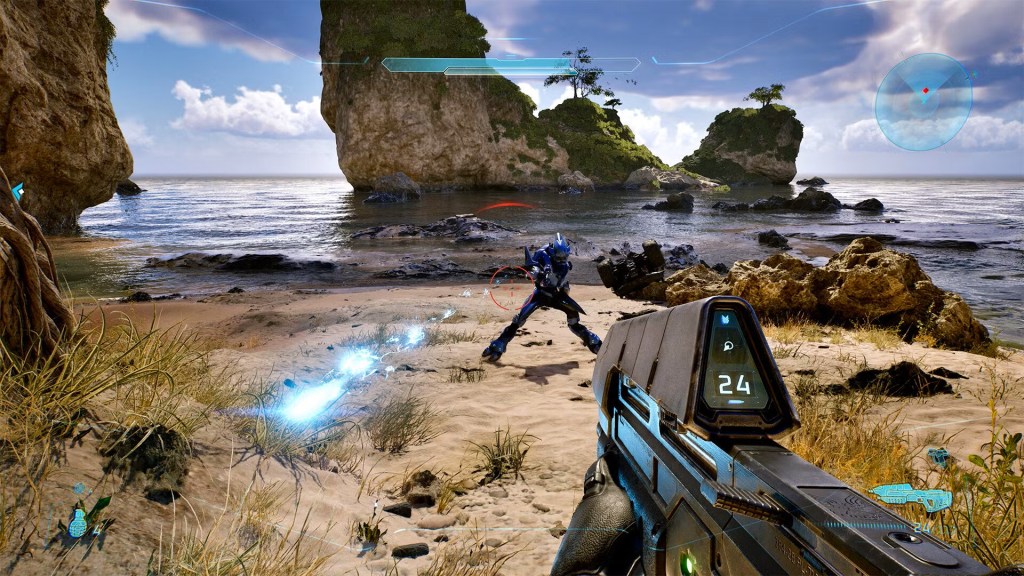
First of all, the move to Unreal Engine 5, though makes the game look graphically impressive on a technical front, now loses that special art-style that makes Halo look and feel like Halo. That being said, some of the exteriors are quite breathtaking, even though I know I’ve seen these UE5 trees before. The added guns and special abilities are a nice touch, and though 343-er–Halo Studios did cut some of the unnecessary fat from missions, they still suffer from the overall structure that’s intrinsic to the original’s design.
Furthermore, though the added cutscenes and dialogue add some more “oomph” and much needed fleshing out of the lore to the cinematic experience, there’s still something about the overall narrative quality that feels…flat. Which leads me to believe that this may just be a testament to Combat Evolved not being a great Halo game when it comes to its narrative experience. Also, people talking about the cringe-y dialogue of Campaign Evolved as if the original didn’t have some laughably corny lines. At least the explosions look nice in (even though they make my PC cry).
Halo 2
Alright, I’m going to keep this one short because I yapped more than expected with Combat Evolved. Simply put, Halo 2 may very well be one of the greatest sequels of all time. The Anniversary edition, in particular, is a tremendous achievement. 343 corrected their missteps from the atrocious visuals of Combat Evolved Anniversary and ensured the integrity of Halo 2‘s art-style was kept intact, while making certain assets and environments really pop the right way. Furthermore, the CGI cinematic cutscenes done by Blur Studios are absolutely phenomenal—seriously, even Campaign Evolved can’t reach the heights of the quality of work done by Blur.

The step up in audiovisuals, voice-acting, and overall production and cinematic quality really helps to provide a level of scale, urgency, and narrative finesse that was severely missing for me in the first game. Halo 2 fleshes out the Covenant, the Prophets, and the political conflicts between the two factions in interesting ways. Being able to step into the shoes of The Arbiter and see how they quelled Covenant rebellions while unraveling the lies of the Prophets was all very intriguing and got me invested into the wider story and deeper lore of Halo far more than the first game ever did. As mentioned, I’d played these games as a young’un, but this was the first time I truly understood what the heck was even going on in this universe. It even inspired me to go read some of the Halo books, and let me tell you, this sh*t goes deep. Also, Karen Traviss is the G.O.A.T. I loved her Gears of War novels, and I just started her Kilo-5 Halo trilogy, and it’s awesome. I know some of you fanboys will be mad that I said that, but I don’t care—go fight with a wall.
In terms of gameplay, Halo 2 has one of the greatest mechanics in the entire franchise: Dual-wielding. Being able to raze through enemies with a Needler and a Brute Carbine will never not be fun. It’s a shame the franchise didn’t continue with this mechanic (at least not to the extent 2 did) because it’s oodles of fun. Beyond that, the set-pieces, vehicle sections, and environments are all just bigger, better, and more robust this time around. Some criticized the story for ending on a cliffhanger, which, I can understand for when it came out. Now, however, with the MCC, it just makes the jump into 3 all the more exciting. For now, I’m putting Halo 2 well above Combat Evolved.

Halo 3
For the longest time, I’d considered Halo 3 to be one of my all-time favourite games—top 10, easily. As such, I was anxiously excited to jump into it after all these years, and had hyped it up quite a bit for Rick before we started. Unfortunately, friends, I have some bad news. Replaying this game in 2026 and seeing it through older and (somewhat) wiser eyes, and vicariously through fresh ones via Rick, I must say I was woefully underwhelmed by Halo 3. That scale, political intrigue, and storytelling finesse I lauded Halo 2 for having all took a major step-back in 3.
We no longer get to play as The Arbiter and see their point-of-view. Not only that, but for a character that got so much love and development in 2, was now relegated to being basically an irrelevant NPC. The entirety of Halo 3 felt like what should have been the final three missions for Halo 2, but stretched over an eight-hour campaign—but also stripped of spectacle, memorable set-pieces, and any cinematic vibrancy. Arby wasn’t the only character who got less love, either. Cortana, a beloved character who provided much needed levity and lore in previous games, in addition to being the heart for Chief, was now just a nuisance in 3. The Gravemind, one of the most interesting parts of the second game, ended up being a big nothing-burger in this one. Also, Sargent Johnson was done dirty.
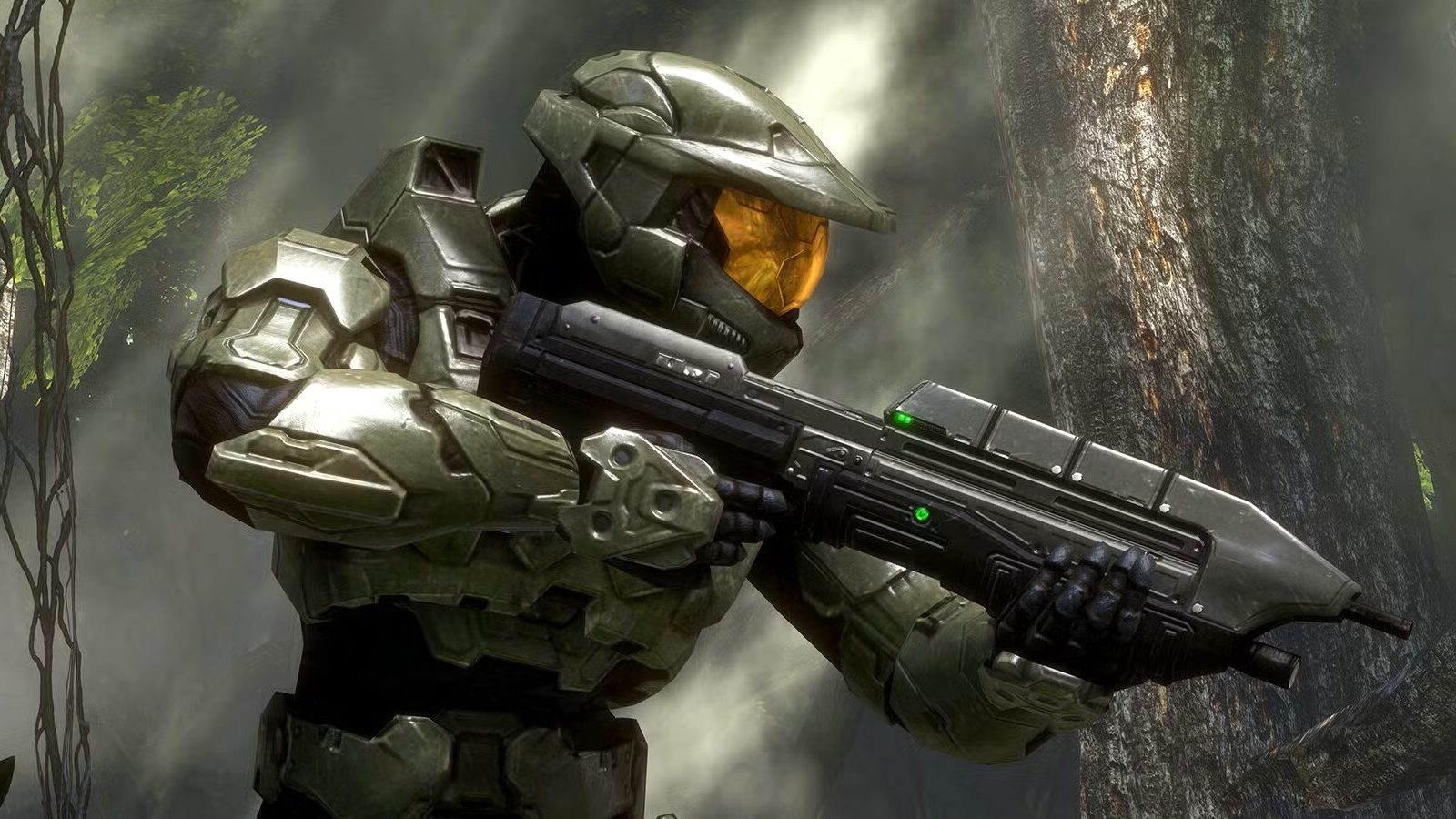
At least the gameplay is still solid. The addition of the Gravity Hammer alone makes this game worth it. The Bubble Shield is an interesting tool, too, which gives you and enemies some defensive variety. Fighting Scarabs and watching them blow up still leaves me in awe, even after all of these years. The vehicle sections were pretty great as well with some iconic additions like the Brute Chopper. I still think some of the guns in Halo 2 felt better, but overall, Halo 3 provided a solid moment-to-moment combat experience. I’ll put this one above Combat Evolved, but well below Halo 2.
Halo 3: ODST
Halo 3: ODST is different…very different. But different in the best way, because it turns the Halo formula on its head. You’re no longer playing as the Master Chief. You’re not even playing as a super-human, instead taking the role of a normal human; a Rookie ODST (Orbital Drop Shock Trooper). The game takes place during the events of Halo 2, in the fictional African city of New Mombasa, where a Covenant ship has occupied the city and other ODST soldiers have gone missing. It’s up to you, a lone soldier in a big city surrounded by Covenant, to find the other missing ODSTs.
As mentioned, this was the first time I’d ever played this game, and it was the first time where I’d felt true dread and despair in a Halo game. Tonally and atmospherically, ODST is a jarring departure from previous Halo games. It’s dark, eerie, and the Covenant feel, possibly for the first time, truly terrifying every time you encounter them. All of this is brought together by a quiet jazz-y soundtrack that just makes the mood *chef’s kiss.* Narratively, things are quite well-done. This is a far more intimate, character-driven story than the previous games. It isn’t about the Forerunners, or the Covenant, or Halo rings; it’s about you and your fellow ODSTs.

Gameplay-wise, things are a little on the shallower end of things, but honestly, I didn’t mind it given the nature of the setting and story, and it still manages to have some great vehicle stages and set-pieces. It’s also interesting that the game just drops you in New Mombasa and tells you to find your way. It’s not exactly open-world as we know of the term today, but it’s definitely far more open, with different paths open for you to explore around the city.
Overall, though it’s hard to compare it to the other games, ODST is definitely one of the more memorable games in the series. I’m easily putting it above 3 and CE, though below 2.
Halo: Reach
Considered by many as the best campaign in the series, Halo: Reach is effectively ODST on steroids. And it is, indeed, glorious. A prequel, Reach tells the story of Noble Team, a unit of Spartan soldiers dispatched to the planet Reach to investigate a malfunctioning communications relay. You play as Noble Six, and together with your band of brothers and sister, fend off Covenant forces while trying to rescue Doctor Halsey, the creator of the Spartan program.
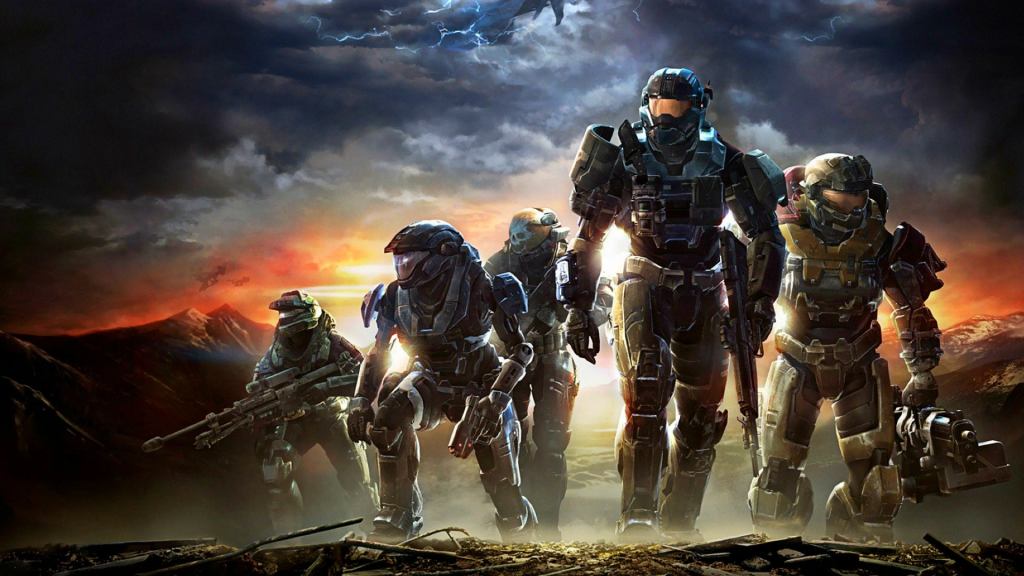
If you paid attention to the first line of dialogue in Combat Evolved, said by Captain Keyes, you’ll know what happened to Noble Team. Of all of the Halo campaigns, Reach is arguably the most heartbreaking, and that last sequence is still one of the most haunting last moments in video game history. The cutscene direction is very well done on a character level, which made the impact of the ending all the more devastating. And just like ODST before it, Reach does an immaculate job of establishing its mood and tone from the get-go. It’s not as darkly desperate as ODST, nor does it share that same level of dreariness, but it’s still incredibly atmospheric.
In terms of gameplay, Reach introduces sprint for the very first time (hallelujah!). It’s a special ability pick-up rather than a permanent ability, which makes all of the other special abilities moot because I never wanted to give up sprinting, but at least it’s finally here. Not many new weapons or vehicles are introduced this time around, though the Needle Rifle is dope and quickly became a favourite of mine. Structurally, the missions are what you’d expect from a traditional Halo game. Take out large Covenant encampments, disable their big doohickey’s, get on vehicles and traverse through the planet—you get the idea.
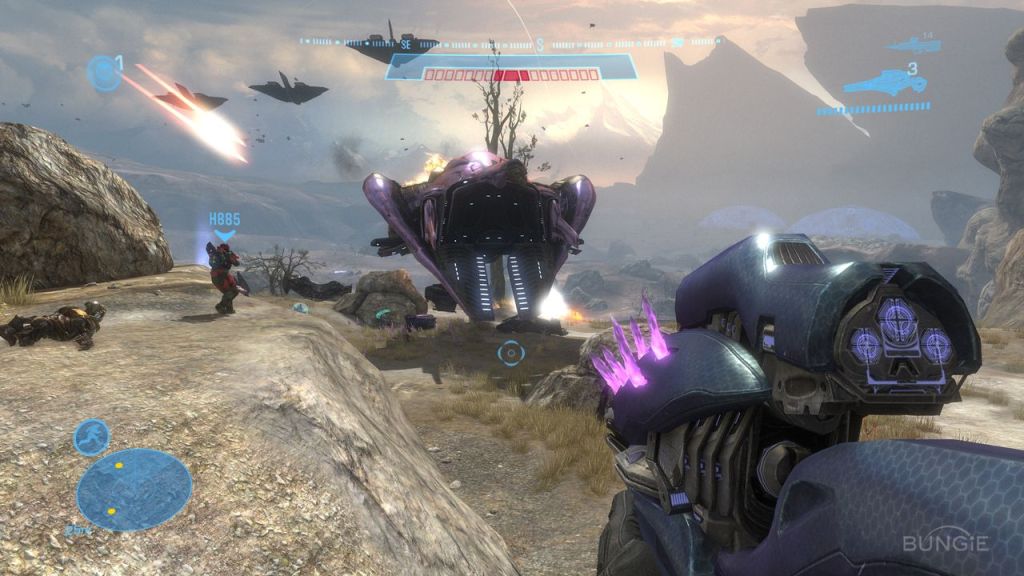
On a second play-through, none of the missions nor set-pieces particularly stood out, but none of it was by any means bad or underwhelming. All of these years later, though the ending remains peak, I did feel a tad underwhelmed by the overall story. The narrative is very much about Noble Team and less about the plot beats, which is fine, but exactly because of that I wish there was more for me to chew on with these characters and their personal stories and history. Maybe having short missions where we stepped into each of their shoes, like how we did in ODST, would have helped in connecting with their stories further. Still, Reach remains a great experience, and I wish the team who made it and ODST could have worked on more projects like them in the Halo universe. The overall campaign doesn’t reach the heights of Halo 2, but I’ll comfortably put it right below it, and just a smidge over ODST.
Halo 4
Oh boy, this is going to make a lot of you fanboys mad. But, screw it, I’m gonna say it: Halo 4 is the best Halo campaign. Yes, I’m serious. And, you know what? I’m not alone. Rick, a man who up until now had no prior experience with this series (and up until this game hadn’t really even cared about the story, if he’s being honest) agrees wholeheartedly with this opinion.
Halo 4 is the first game that made either of us genuinely care about Master Chief and Cortana. It’s the first game that got Rick interested in the wider lore of the Halo universe. The cutscenes, the dialogue, and the overall cinematic presentation are all some of the series’ best. Yes, the scale of the story is pulled back quite a bit compared to Halo 2 & Halo 3. And yes, the Didact, though an intriguing villain from a lore perspective, was underused and underdeveloped throughout the game, and it’s criminal that he wasn’t a proper boss fight at the end. Still, the story that is here, the lore that is presented via the Librarian, and the relationship that’s fleshed out between Chief and Cortana, is all really, really well done. Also, the performances by Steve Downes and Jen Taylor are peak. I expected to get misty-eyed at the end of Halo: Reach, I did not expect to f*cking sob at the end of Halo 4.
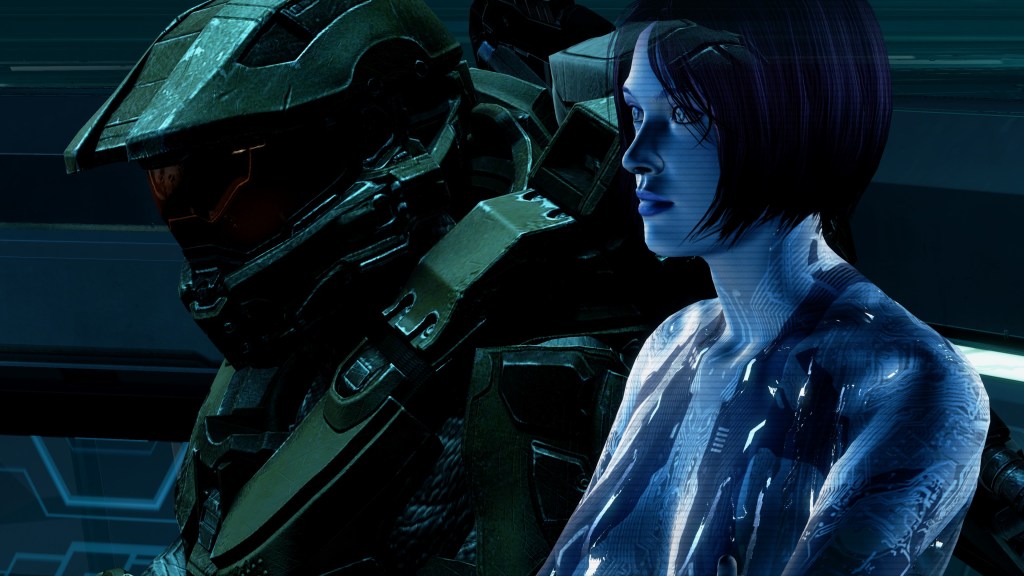
Visually, this game is stunning. From the environments to the particle effects to the lighting, Halo 4 is a beauty of a game, and one I’m frankly shocked is on the same platform as Halo 3. Yes, 343 took some liberties with the art-style, but they’re liberties I don’t mind. I like Chief’s more mechanical, sci-fi forward aesthetic. It’s a little busy, but felt more grounded within the more hard sci-fi environments and story-line. As for Cortana…yeah, let’s just say even my wife would be interested in some of that action. On a serious note, I do think her redesign was a little jarringly sexy, but I ain’t gonna complain.
On the audio front, things are fairly solid as well, except for one major wrinkle: the Grunts. For “lore reasons,” 343 replaced the iconic (and hilarious) Grunt chatter from the Bungie games with bog-standard (and annoyingly high-pitched) alien noises. Why? Well, apparently it’s because the Unggoy (a.k.a. “Grunts”) in Halo 4 are now speaking in their native tongue instead of the language of the Sangheli (a.k.a. “Elites”) due to the dissolution of the Covenant. Chief’s armour is able to directly translate Sangheli on the fly, but cannot do the same with the language of the Unggoy. And that’s…fine, but I want to hear the Grunt chatter, God damn it!
Gameplay-wise, it’s apparent from the first moment you fire that Assault Rifle that this game feels…different. Not bad, per se, but there’s definitely something a teensy bit different here than the Bungie games. I don’t know what it is, whether it’s the recoil of the guns, the sound design, or the movement, but there’s just an ever-so slight change in overall game-feel that takes some getting used to. Once you do get used to it, however, things are fine and the game plays great. Sprint is a mainstay now and we get introduced to a slew of new, very sci-fi forward guns thanks to the introduction of a new enemy type, the Promethean.
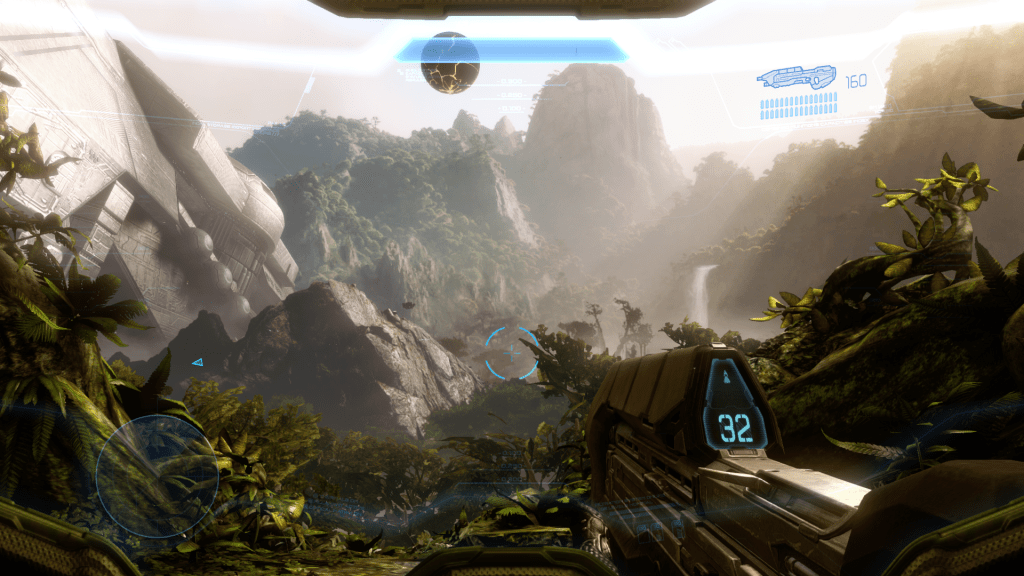
People don’t like the Promethean, and I can understand that, to an extent. They are very bland enemies bereft of any personality, with a few of their types being quite annoying to fight. But, like, have ya’ll fought the Flood? The Flood sections are some of the worst parts of the original trilogy. Give me the Promethean any day of the week. At least they pose a challenge with their combat tactics and aren’t just annoying fodder. Plus their sniper rifle is badass. Also, Halo 4 might have some of the best vehicle sections in the series, thanks in large part due to an amazing space combat section at the end.
Halo 4 is the only Halo game I want to go back and replay. Sure, I’m not looking forward to playing some of those Promethean sections again, but that story, visual design, and cinematic presentation coupled with a beautiful emotional core anchored by Chief and Cortana is well-worth revisiting. This was the first game 343 made after Microsoft split with Bungie, so impassioned fans at the time were going to have negative emotions towards the game, over-scrutinizing any and all changes the developers made to their beloved franchise. In 2026, however, playing it for the first time as a veteran fan of the series, I have no problem admitting this is my favourite Halo campaign. Unfortunately, 343’s first outing into the Halo universe would be their last, truly great one, as the company has floundered to get back to what made their first game great.
Halo Infinite
As mentioned, Rick and I didn’t play Halo 5. Because, from everything I’ve read and watched, Halo 5‘s campaign is atrocious. Though we know we should play the campaign one of these days to form our own opinions, we decided that day wasn’t today. And so, we decided to skip ahead to Halo Infinite.
As of writing, we are a little over halfway through our play-through of Infinite, but I’m pretty confident when I say that, in terms of gameplay, Halo Infinite is, far and away, the best game in the series. This second play-through has only cemented that opinion. Everything about this game is pure fun. From gun-feel to movement to enemy A.I., everything about Infinite just works. Also, the grapple-hook. Oh my God, the grapple-hook. A simple mechanic that completely transforms how Halo is played, for the better. It allows for so many different ways to engage with the terrain, adding a verticality never-before-seen in Halo. In conjunction with the explosive cylinders, blasting away Grunts has never been more fun. Also, Grunt chatter is back, baby! I don’t know if it makes sense with the lore, but I do not care in the slightest.
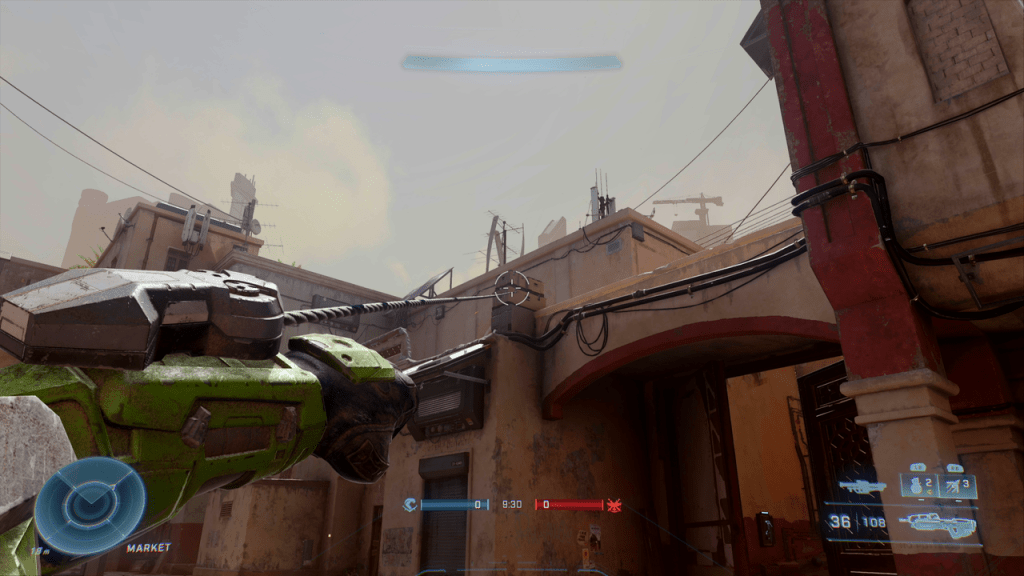
Unfortunately, my praise for Infinite ends there. Narratively, things are quite thin. The new baddies this time around are The Banished—a pirate gang primarily comprised of Brutes. Their leader is Escharum, a dude who loves to yap through holograms and talk a lot of sh*t. You are, once again, on a Halo ring, trying to figure out what The Banished are up to and unravel more Forerunner secrets. You also have a new A.I. companion who calls herself Weapon. She’s basically a more cheery, discounted Cortana. The drop in cinematic “oomph” compared to 343’s outing in Halo 4 is quite noticeable. There’s no story-boarding, no sense of direction or tone, or really anything that grounds this narrative in any meaningful way. It also doesn’t look amazing, neither on a technical level nor artistic level.
Frankly, the entire game reminds me of Combat Evolved. Being stuck on a Halo ring-world, except this time you have Ubisoft-esque open-world tasks and markers, which, though fine enough on a gameplay level, don’t do much to give you a sense of world-building because of how all of it is bereft of any kind of narrative or storytelling. Though Chief, Weapon, and Esparza are a nice trio, I wish there was more for me to glom onto in terms of their stories and relationships.
Infinite‘s campaign is held up by its gameplay. If it wasn’t so damn good, this would easily be fighting with Combat Evolved for last place on my list. But it is damn good. Also, for as harsh as I was about the story, it isn’t awful—just incredibly forgettable and blandly presented. It might be controversial, but I’ll go ahead and put this right above Halo 3, though just barely.
And there you have it. My re-ranking of the Halo campaigns in 2026, which looks like this:

Fight with me, tell me what your rankings look like, and let out all of your grievances with 343 in the comments below.


Leave a comment