
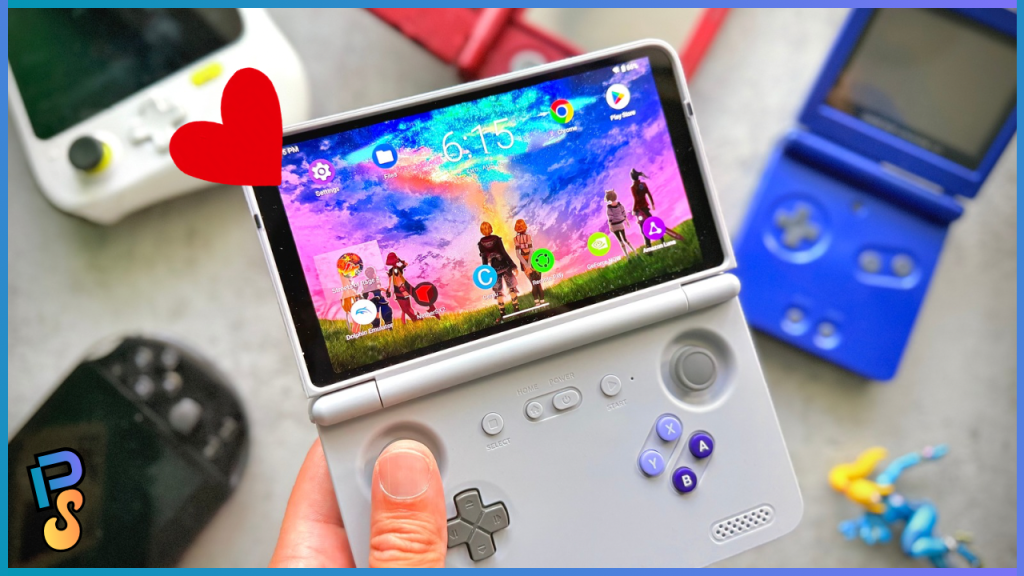
The Retroid Pocket Flip 2 is an Android-based gaming handheld with a clamshell form factor, a gorgeous AMOLED, and enough power to emulate games all the way up to, and including, the Wii U and even the Nintendo Switch. But, you probably already knew that. Because, the Retroid Pocket Flip 2 isn’t a new device. It’s been about a year since this handheld came out, and most of the reviews I’ve seen for it since have been very positive. It’s a device I’ve been eyeing for some time, mainly because of its form factor, but had held off spending the 200 bones (or 300 up here in Yvon-land) because, well, I got bills to pay and a backlog of games that somehow manages to keep getting bigger.
It wasn’t until my wife got me the Miyoo Mini Plus for my birthday earlier this year that I’d realized just how awesome it was to have a dedicated and super portable device just for emulation. Up until then, I’d only ever had either bigger, bulkier handhelds like the G Cloud or MSI Claw 8, or classic ones from my adolescence like the Vita and Game Boy Advance SP. As a lover of handhelds, and after spending a few months with the Miyoo Mini Plus, I knew it was only a matter of time before I bit the bullet and grabbed a new handheld. I knew I wanted something that had a larger, better screen; something that was powerful enough to do PS2, GameCube, and Wii U emulation with ease while still having good battery life, and came in a form factor that didn’t sacrifice portability. This, of course, as TechDweeb would say, meant I needed a “Flippy” King.
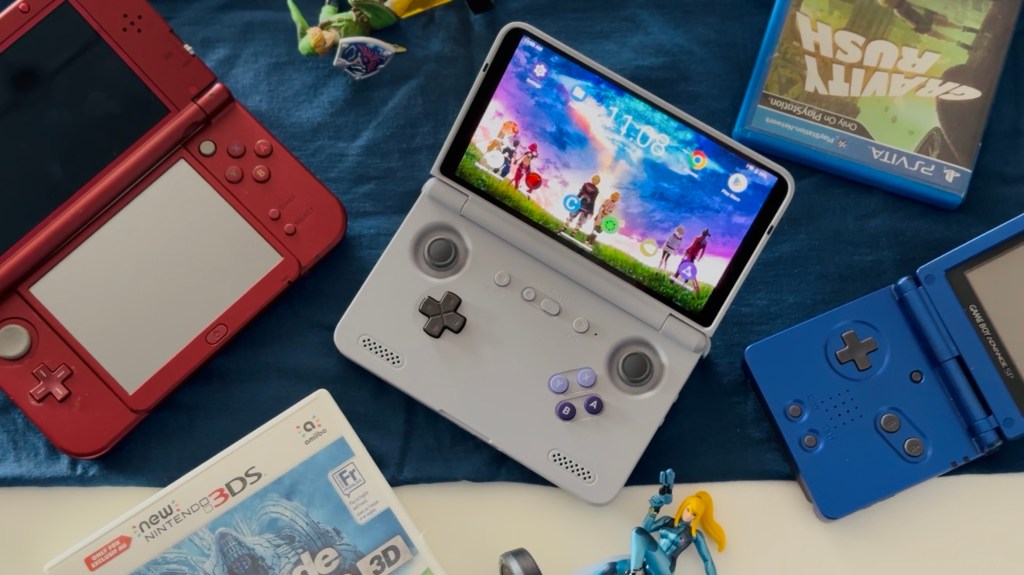
Well, friends, after spending a couple of weeks with the Retroid Pocket Flip 2, I am happy to report that, although it has one flaw that’s hard to ignore, I am very much in love with this “Flippy” handheld, and wanna share with you the experience of using it in 2026.
The Outside
When taking the Retroid Pocket Flip 2 out of its box, my first reaction was, “wow, this thing feel really nice and sturdy.” There’s a surprising rigidity to the chassis with zero flex around the buttons, sticks, or back, which, when combined with an even weight distribution, gives the device a great premium feel in the hands. The matte texture on my 16-bit retro colour-way is very nice, too. I saw some reviewers say that they didn’t like the accented logo on the lid, which, though I can understand as its radar-like design doesn’t feel entirely appropriate, doesn’t bother me all too much.
Let’s talk about the buttons and sticks. The face buttons have a matte texture instead of a glossy one, which, when combined with decent travel and practically zero wobble, make them great to press. They’re a little smaller than I’d like, but still very solid. Much of the same can be said about the D-Pad—it’s sturdy, clicky, and works great for side-scrollers and fighting games, but again, a little small. The analogue sticks are Hall-effect, which is always great to see and should provide long-term durability. They’re inset, obviously, to allow the handheld to close flush. This reduces their mobility somewhat, but nothing to fuss over. They’re also a little on the smaller end, but their textured grip and symmetrical design make the ergonomics as such that I hardly ever have issues while playing 3D games. As for the shoulder buttons, they are very Switch-like with how thin and clicky they are, which, though isn’t my favourite, their textured grips make up for it. The triggers are great, though, with decent travel and solid feel.
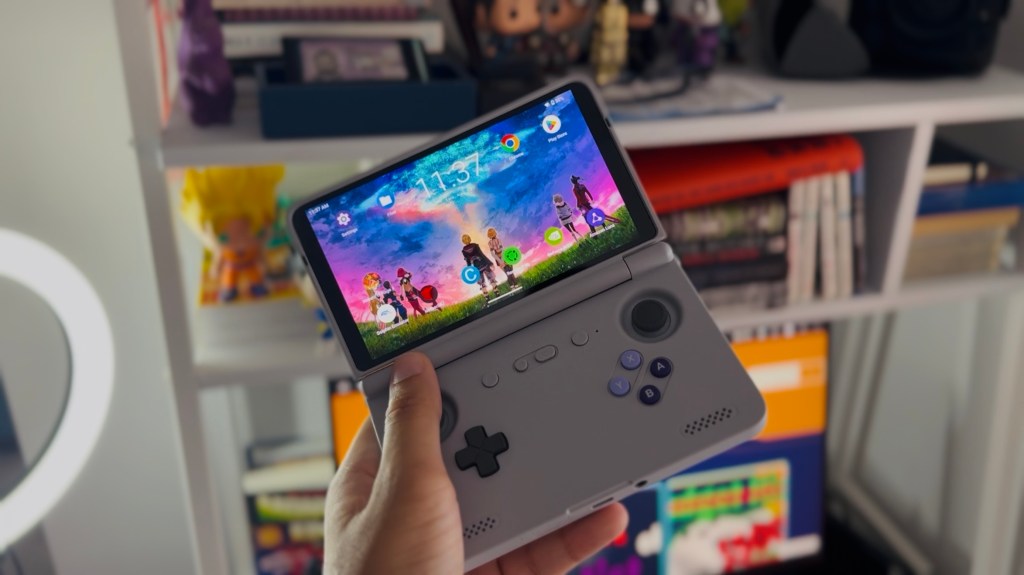
The highlight of the Pocket 2 in terms of its hardware is, no doubt, that gorgeous 5.5-inch AMOLED. Having only owned non-OLED handheld gaming devices, the difference is quite substantial. The colours on this display are vibrant with deep, crisp blacks. It’s a full 1080p display, which at this size is very sharp. Personally, having gotten used to 7-inch+ handhelds, I think 6-inches would have been the perfect size, but I’m not going to fuss over half an inch (there’s a dirty joke in there somewhere). The display is only 60fps instead of 120, but for 200 bucks that’s to be expected.
Now, let’s talk about the thing that either makes or breaks a “Flippy” handheld: The Hinge. Retroid advertises that the Pocket Flip 2 is, “Utilizing a newly enhanced hinge design to ensure long-term stability and reliability.” Though it’s only been a couple of weeks, I can say that the hinge on this guy has been…fine. It doesn’t feel as smooth and satisfying as something like the 3DS or even Game Boy Advance SP, but it also doesn’t feel cheap or that it’s going to come apart in a few months. There aren’t any creaks when opening or shutting the device, but I also don’t feel as carefree or secure compared to my classic Nintendo handhelds. Though this could change as time goes on—I do tend to baby my devices for quite a while.
My biggest issue with the hinge is actually my biggest issue with the device overall, which is how far it opens up and the degree at which Retroid have put the hinge stop. I don’t know about you, but for me, I like playing my clamshell handhelds open to as close to 180 degrees as it’ll let me. Whether I’m laying on my bed or sitting crouched over on the train, I enjoy having my handheld fully open to its maximum…openness. This feels the most natural for my wrists, and the most ergonomic for my neck and eyeline. The 3DS and GBA SP both have multiple natural hinge stops at various degrees, with both opening up to go past 180 degrees. The Retroid Pocket Flip 2, in comparison, has a natural stop at 150 degrees, and then another at 178 degrees. I feel 150 degrees is way too narrow to feel natural. I can’t imagine anybody playing their games this way, but that may just be me. As such, I play at the maximum 178 degrees.
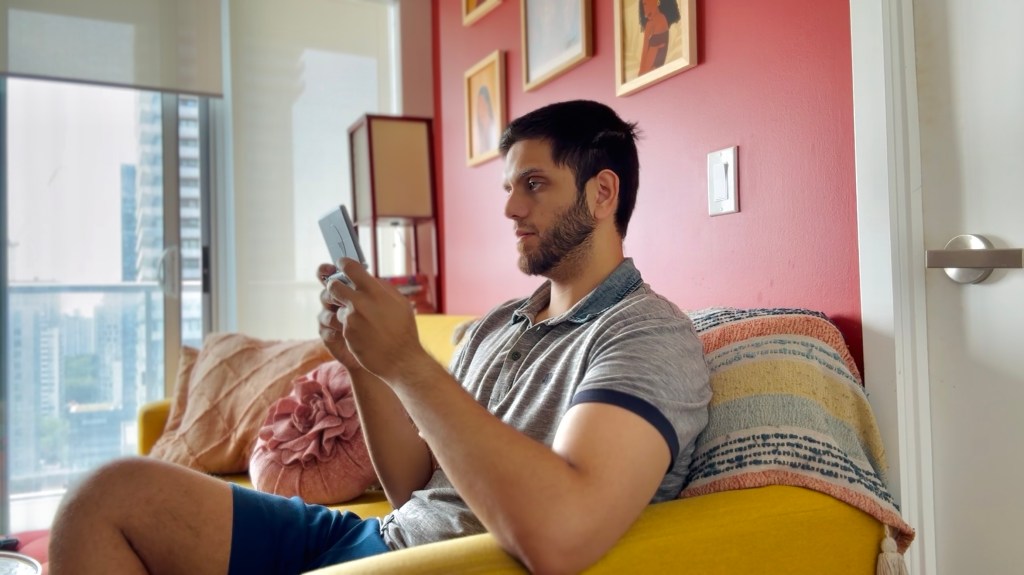
Problem is, the hinge doesn’t want to stay open at that maximum stop. It’s fine when you’re sitting crouched over and gravity is pushing down on the lid/screen. It’s even alright when you bring the handheld up a little and the lid is perpendicular to your face. However, as soon as you tilt that screen a little bit over closer to your face, the hinge quickly gives in and the lid reverts back to that 150 degree stop. This makes playing while laying down in bed nearly impossible. I don’t even need to be laying down, I could be in my chair, playing with the handheld perpendicular to my face, and with even a slight shake during a tense moment in a game, have the screen pop back. I’m not sure if this is an issue with just my unit, or if it’s something that’ll get better with time as I “break in” the hinge more, but for right now it’s been the most frustrating aspect during my time with this handheld I have otherwise been having a blast using to play some of my favourite games. Speaking of games.
The Inside
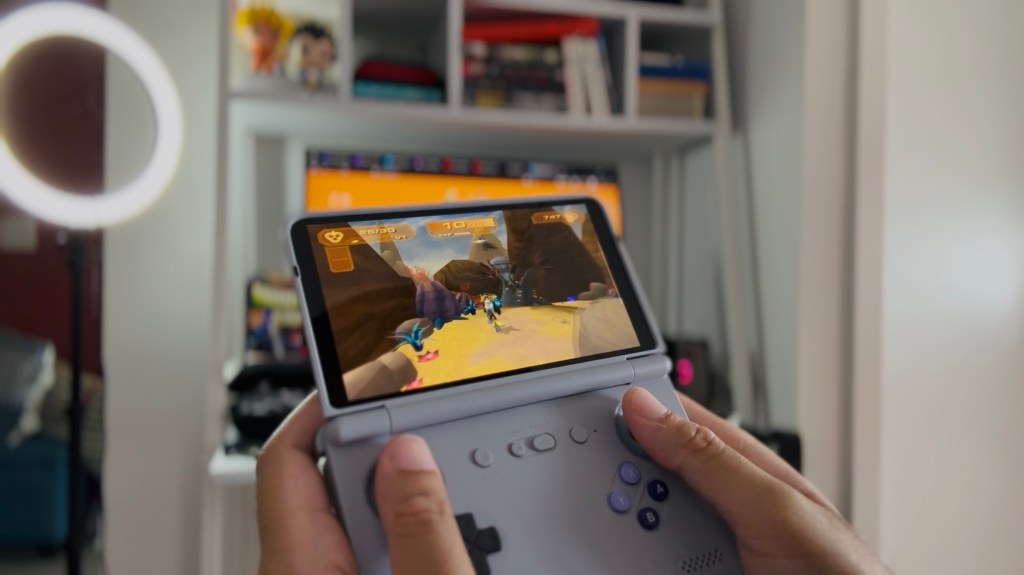
The Pocket Flip 2 is powered by the Snapdragon 865 and either 8 or 12 gigabytes of RAM. The 865 is a near-decade-old chip, but it still has enough power to play PS2 and GameCube games with relative ease. I can play something like Ratchet & Clank: Up Your Arsenal at 2x resolution without much issue, doing so at only the “Performance” preset, which is the second of the three performance toggles the Flip 2 offers. I was so impressed with the performance that I decided to see how much more I could push the handheld. Trying out some more demanding emulation like the Wii on Dolphin and Wii U on CEMU proved no problem, either, as the device handled games like Super Mario Galaxy and Twilight Princess like a champ, without me even needing to bump up to the “High Performance” toggle. This leads me to believe, then, that if you wanted to, you could potentially do some lighter Switch and maybe even PS3 emulation, though obviously your mileage will vary depending on the game. And, of course, this also means that most Android games on the Play Store are going to run perfectly fine.
As for battery life, the Pocket Flip 2 comes equipped with a 5,000 mAh battery, which is sizeable and should give you anywhere from 3-12 hours of battery life. That’s quite the range, but there’s also a big difference between playing Breath of the Wild and Custer’s Revenge, though I’m not sure if I’m only talking about graphics there. The best part of the Flip 2’s battery life has to do with its sleep function. I love being able to simply close the lid after a quick gaming session, have the device automatically go to sleep, and come back hours (even days) later to find the battery only having gone down by a few percent. This is such a massive difference compared to my Miyoo Mini Plus, which I have to shut down completely every time I end a session, otherwise the battery dies quicker than my hopes and dreams. The Flip 2 also supports fast-charging, which is a massive plus.
In terms of the OS and UI, this is pretty bog-standard Android 13. Retroid does have its own launcher, but I’ll be honest, it’s not great. It looks okay, I guess, but functionally there’s not much going on here and some of the UI is a little janky. I mainly just organize my apps on the home screen and just forget about it. There were some OS-related bugs when initially setting the device up, though that could be more on Google’s end.
The Experience & Verdict
I grew up on “Flippy” handhelds. I also grew up with the PS2 and Wii. Being able to now have a modern “Flippy” handheld that can play some of my favourite games from my childhood, while also having the functionality to use cloud-streaming services like Boosteroid to access and play my triple-A PC games, all in a beautiful, clamshell design with great battery life and an OLED, is a dream come true. I am truly smitten by the Retroid Pocket Flip 2. It’s become a part of my EDC, my near-one-stop-shop for all of my gaming needs, and I foresee it being the handheld I play the most in the months and years to come. Yes, it isn’t perfect. That hinge tilt issue is very annoying for someone like myself who enjoys playing while laying in bed. Still, considering how much I love everything else about this device, that’s an annoyance I will happily deal with.
Using the device on a day-to-day basis has been a joy. I’m team “Flippy” all day, every day, and have always felt it to be the superior handheld form factor. The design protects the screen and buttons, so you don’t really need a case, and paired with that sleep function and great battery life, it just makes getting in and out of your gaming sessions quick and fuss-free. Hopefully Retroid fix that glaring hinge issue with the Pocket Flip 3, which is rumored to be coming out later this year. Considering that, should you still buy the Flip 2 in 2026? Well, there’s always going to be a new shiny thing on the horizon. However, if you want what I think is a very solid, very capable clamshell handheld, one that now comes equipped with even more RAM, all the while not breaking the bank (especially if you grab it second-hand or on sale), then I don’t think you can do better than the Retroid Pocket Flip 2.
Check out our sponsor, ObserverCrew, for more gaming and film coverage created by other passionate journalists!


Leave a comment