

On paper, Rivage sounds like a game that I would love. A first-person, narrative-driven, science fiction adventure set aboard an abandoned space station wherein you must unravel its mysterious by solving mind-bending puzzles? Sign me up. Unfortunately — and it pains me to say this — developer Exnilo Studio have made some baffling design decisions with their debut title that makes for a tedious, frustrating, and an eventual mind-bending-ly boring gameplay experience that desperately needed further play-testing.
I really wanted to love Rivage. I really wanted to tell you to go out and support this indie developer, especially seeing as they’re my fellow neighbors from Montreal. But, I don’t, and I cannot. That’s not to say there isn’t some good stuff here; there is. However, whenever that good tries to peek through, it’s quickly smashed to pieces by the blunt force of tedium. And that tedium is caused, primarily, by one mechanic. A mechanic we’ve seen in plenty of games of this ilk, but its implementation here feels forced and completely unnecessary.
But I’m getting ahead of myself. Let’s start, as usual, from the beginning. This is my review of Exnilo Studio’s Rivage.
The Heart
Set in the 25th century, Rivage puts you in the shoes of Miranda, who awakens alone aboard the space station A.R.E.S. She, alongside her crew of scientists, were tasked to study an Earth-like planet named VESTA to see if it could be habitable for humanity. However, after a strange phenomena, Miranda now finds herself stuck in a loop, with her crew suddenly missing. Alone, she must wake up each day and unravel the mysteries of this phenomena, while learning more about the truth of her missing crewmates in the process.
Narratively, Rivage starts off strong. Waking up in this abandoned space station, slowly learning about your player-character Miranda and her crewmates through emails and environmental storytelling, is captivating. However, once I got over that initial wonder and curiosity, it wasn’t long before my interest began to dissipate. The more audio logs I listened to and journal entries I read, the less I was pulled in by this story. None of these characters were very interesting. Frankly, aside from Miranda, who is quite vanilla, they were all somewhat annoying and very one-dimensional.
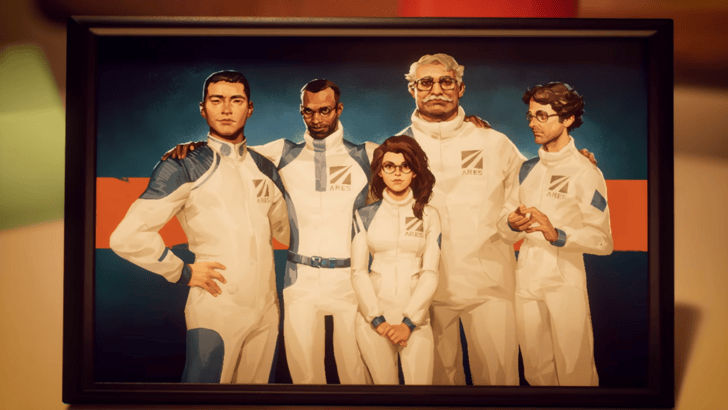
Some of that is on the voice-acting, which I’ll touch upon in a bit, but a lot of it is in the mediocre writing. Most of the writing, be they audio logs, journal entries, or emails, make these characters sound like immature, angsty teenagers rather than smart scientists making ground-breaking discoveries. Seriously, one of the main plotlines is about how the entire crew — who are supposedly adults, by the way — make fun of, and bully, the older crew member who’s fat and diabetic. Now, I know adults can be dumb (I mean, have you seen Earth lately?), but the way in which some of these character moments are written is quite puerile, feeling at odds with the overall tone and aesthetic of the game, which presents itself to be much deeper and intriguing.
Beyond that, the story didn’t keep me engaged as I continued to play. With all of the frustrations I had with the gameplay, I was at least hoping that the narrative and mysteries would go in directions that would keep my interest—but they didn’t. Audio logs, emails, and texts were either there to facilitate in solving a puzzle, or retread same old character dynamics. Like, I get it, Jonny is a tyrannical a*shole, and he hates fat people, can the man say something else? Sure, there were a couple of audio logs towards the end that added a little more colour to these characters and their development, but by that point I was so ready for the game to end that I didn’t care at all.
The Eyes & Ears
In terms of visuals and overall art-direction, Rivage should look great. I say “should” because its art-direction, though great in terms of asset designs, colour-work, and lighting, falls apart due to Unreal Engine 5’s love of graininess. So, I played this game on the Steam Machine, which, though isn’t a $5,000 super-computer (although, in today’s market, that’s probably the price of a budget rig), but has more than enough power to play this game at 1080p and “Epic” settings, without the use of any upscaling. And even so, the amount of noise, flickering, and overall softness in image quality was genuinely distracting and quite ugly to look at. No matter how much I tried tinkering with the settings, Lord Grain never went away. And it’s not just me, Steam Reviews are already complaining about this exact same issue.
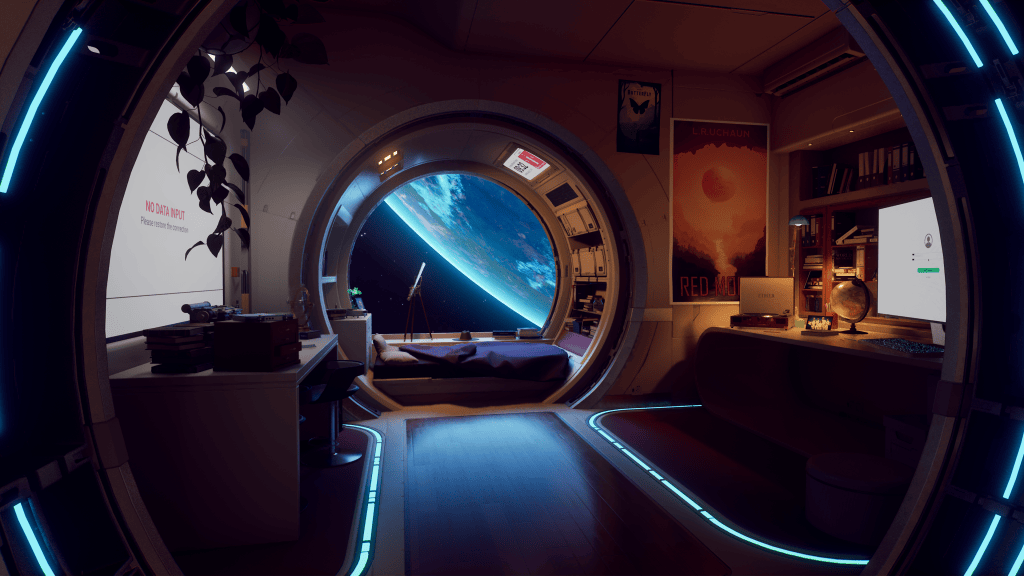
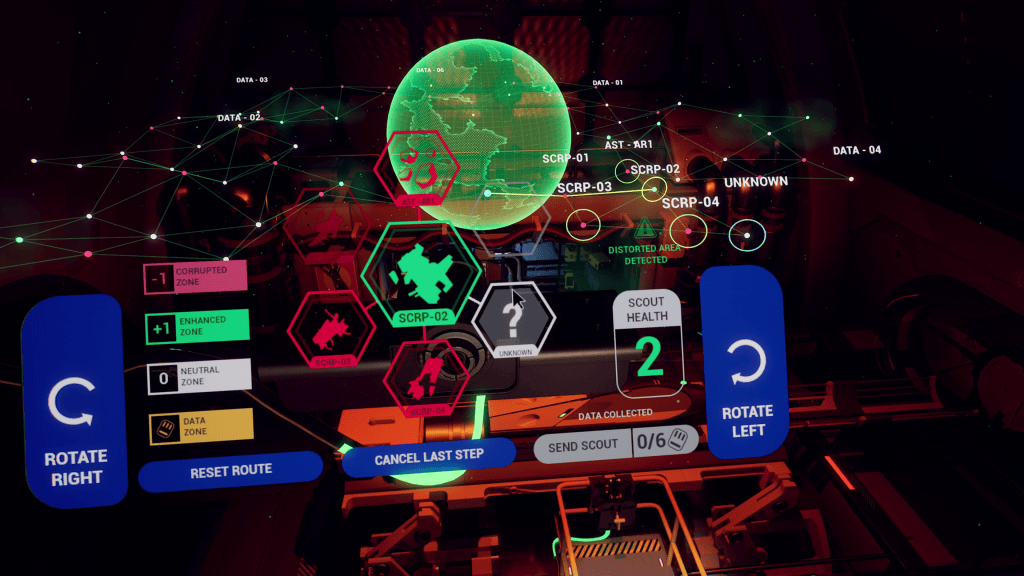
Which is unfortunate, because the visuals are quite good if you take them for what they are behind the noise. Every room looks and feels distinct; the bedrooms of crewmates feel lived in with personal knick-knacks, documents, and baubles; the station itself is well-designed and feels grounded in its hard sci-fi aesthetic. The UI looks unique, too, feeling like an actual piece of augmented reality tech instead of just your average “select” menu journal. There was some genuine thought and hard work put into this science fiction world; hard work and thought that has been unjustly tarnished by UE5. Now, Exnilo Studio are aware of this issue and have released a public beta, which I’ve tried, but the issue, unfortunately, continues to persist.
As for the audio, things are a bit of a mixed bag. There wasn’t a specific music track throughout my play-through that jumped out, either positively or negatively. Still, some of the incidental and ambient music that underscores your exploration do well to establish the atmosphere and are aptly sci-fi. The sound design is decent, too, with the clicks of buttons, clacks of tools, whirs of doors, and hums of futuristic technology all coming together to make for a space station that feels like a real place.
What isn’t decent, unfortunately, is the voice acting. Aside from Miranda’s VO artist, who is fine, the rest of the cast sounded more like caricatures than real people. Which is tough for me to say as a former actor because I never want to knock someone’s performance, but, man, some of the line deliveries can be quite grating. Some of that is less on the actors and more on the the dialogue writing and VO direction. Still, a good actor can manage to make less-than-stellar writing compelling—that was definitely not the case here.
The Controller
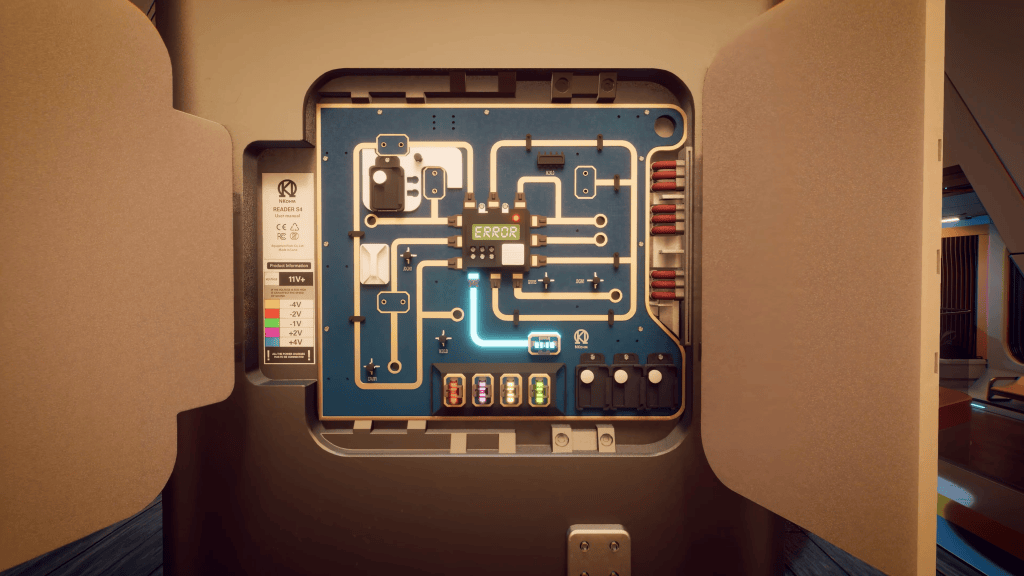
Alright, let’s get into my biggest issue with Rivage: gameplay. Actually, my issue is not with the gameplay as a whole; I enjoyed most of the moment-to-moment elements Exnilo Studio have implemented here. Exploring A.R.E.S., looking through documents, reading emails, listening to audio logs (irrespective of the grating VO), and solving puzzles were all, for the most part, good from a gameplay perspective. I love games like Gone Home, What Remains of Edith Finch, and Firewatch; games wherein you have to walk around and unravel the story and its mysteries by exploring your environment and solving puzzles are my jam. And most of the puzzles here in Rivage are well executed. They’re challenging, mostly satisfying to solve, mechanically diverse and push you to think outside the box, and fit well within the world. Are their solutions at times a bit too obtuse and narratively incoherent? Sure, but I’m fine suspending my disbelief if it serves the game.
Do you know what doesn’t serve a game? Implementing a ham-fisted time-loop mechanic whose only point is to artificially lengthen a game. Okay, let’s get this out of the way: I don’t love loop mechanics in games. Be they Rogue-likes or something like Blue Prince, which Rivage takes a lot of inspiration from. That being said, I can understand their merit from a design perspective. I understand the ludo-narrative significance of the loop mechanic in Outer Wilds. I understand the satisfaction one may get by slowly upgrading their character’s build and understanding level layouts to get a little farther in their next run in games like Dead Cells and Hades. The mechanic may not be my thing, but I get it.
Exnilo Studio’s implementation of the loop mechanic in Rivage is, frankly, atrocious, and nearly made me quit the game multiple times. Narratively, the loop exists to explain this strange phenomena that Miranda is stuck in, with her having to relive the same day until she (you) figures out a way to escape. Upon awakening, you see that the space station is severely low in power. You have four power nodes each loop, and you must be careful with how you use each to explore the station. Because, for whatever reason, the thing that takes the most power on this station is…opening doors. Once you run out of nodes, the station runs out of power and you have to enter a storage room and interact with an arcade machine to reset the loop. Why an arcade machine? Don’t ask me.
The issue isn’t that the loop mechanic is tied to the station’s power, it’s that you spend a power node each time you open a damn door. This, in turn, stifles exploration—it stifles momentum. It leads to moments where, let’s say, I would use three nodes to access a certain room that has a puzzle, and as I’m solving it I excitedly realize that the solution is actually something I saw in another room, but oh wait, I can’t go there now because I don’t have enough power nodes. Well, time to loop, I guess. And this happens over, and over, and over again. It’s not fun, it’s boring; it’s not challenging, it’s tedious. It gets especially egregious towards the end when you have to duplicate certain objects but the duplication only works after you loop. By the end, every time the power cut out, I had an almost visceral reaction—I started hating that damn arcade machine. Seriously, if I don’t see another arcade machine for the rest of my life, I think I’ll be okay.
At least the game gives you some tools to help keep track of all of the hints and data you collect. The “K9” system, which acts as the games HUD, keeps track of key items and passwords, while also allowing you to take a screenshot of anything in your view (here’s a tip for both this game and life: take a screenshot of literally everything). However, it’s strange that certain things get saved while others do not, which leads to you needing to redo some small puzzles. For the most part, it works as you’d expect, but there were times where I had to redo a puzzle that I felt my “K9” should have saved.
The Verdict
Exnilo Studio could have done away with the entire loop mechanic and have Rivage be a very solid five-hour experience. It would still have its quirks like the poor voice acting, writing, visual hiccups, and some not-so-great puzzle designs. But, it would be a tightly-wrapped, sci-fi puzzle-adventure game I wouldn’t have a problem recommending. Unfortunately, the awful way in which the time loop mechanic is implemented makes for an excruciatingly tedious experience. One that stifles any sense of momentum and criminally undercuts that “eureka” moment of finding a puzzle’s solution once you realize you have to, for the umpteenth time, revisit that damn arcade machine.
Shaz played Rivage on PC with a code he received from the publisher.


Leave a comment