
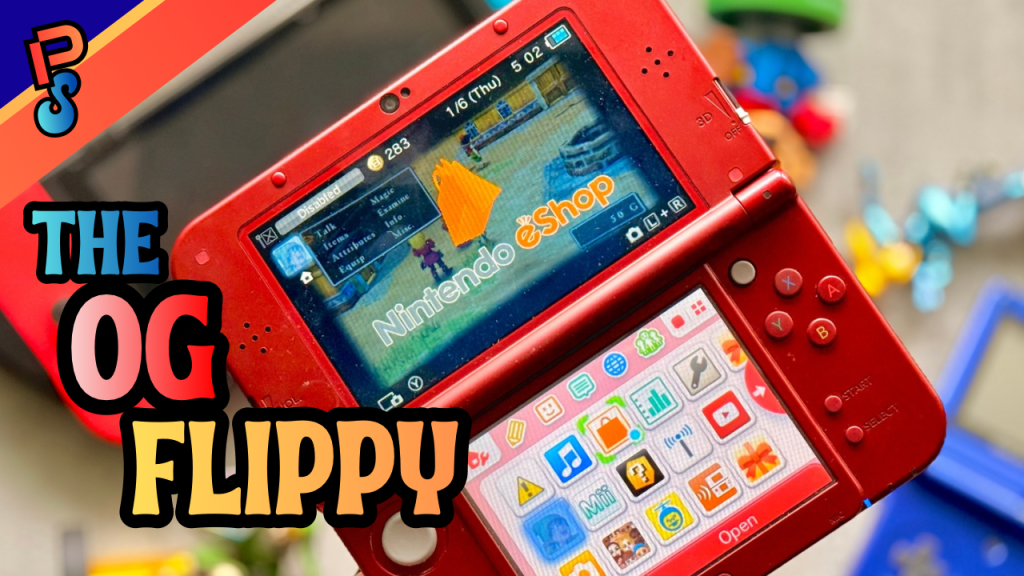
Do I have a powerful, current generation home console to play modern triple-A games? Yes. Do I have a modern handheld gaming PC to take some of those triple-A games on-the-go? Yes. Do I have a modern retro gaming handheld to play some of the greatest classics from my childhood? Yup; two, actually. Did I also spend 1500 Canadian Bordens on a Steam Machine to prove my faith to Lord Gaben? Absolutely. I am a blessed man with an abundance of modern options when it comes to choosing how I get to access my favourite games. And yet, for reasons beyond my understanding, I decided to wade through all of those wonderful modern options and start playing the Nintendo 3DS in 2026. What is wrong with me, ya’ll?
So, here’s what happened. I was dusting my PS5 — something I often do because the poor thing hasn’t been turned on in almost two years — when I accidentally knocked over one of my 3DS games from behind my media cabinet. The game? An unwrapped copy of Dragon Quest VII. Now, I know for a fact that I bought this game at least seven or eight years ago, and can’t believe I never took it out of its plastic wrap, let alone played it. I was never a huge Dragon Quest fan, but also never gave the series a proper chance; hence, I’m assuming, my purchasing of this game back in the day. I took the accident as a sign. A sign that I needed to set off on a new adventure—backlog be damned. And so, I took out my 3DS, scrounged the storage room to find its charger, and started playing Nintendo’s now two-generation-old handheld for the first time in years, and the experience has been…good-ish. This is my 2026 review of the Nintendo 3DS.
The Outside
The 3DS variant that I have is the “New” 3DS XL that released in 2015 here in North America. It has some notable differences, but things are more-or-less the same on the outside. The first thing I said when picking up this handheld for the first time in years was the same thing I said a decade ago when I unboxed it: “Wow, this thing feels solid.” There’s a heft and rigidity to this chassis that feels very premium. To the point where I don’t feel as comfortable being lax with it compared to my other handhelds. Not because I don’t think it wouldn’t be durable, but because I think it feels too nice to simply toss around. The glossy finish may be a fingerprint magnet, but it looks quite nice. And that crimson colourway is just *chef’s kiss.*
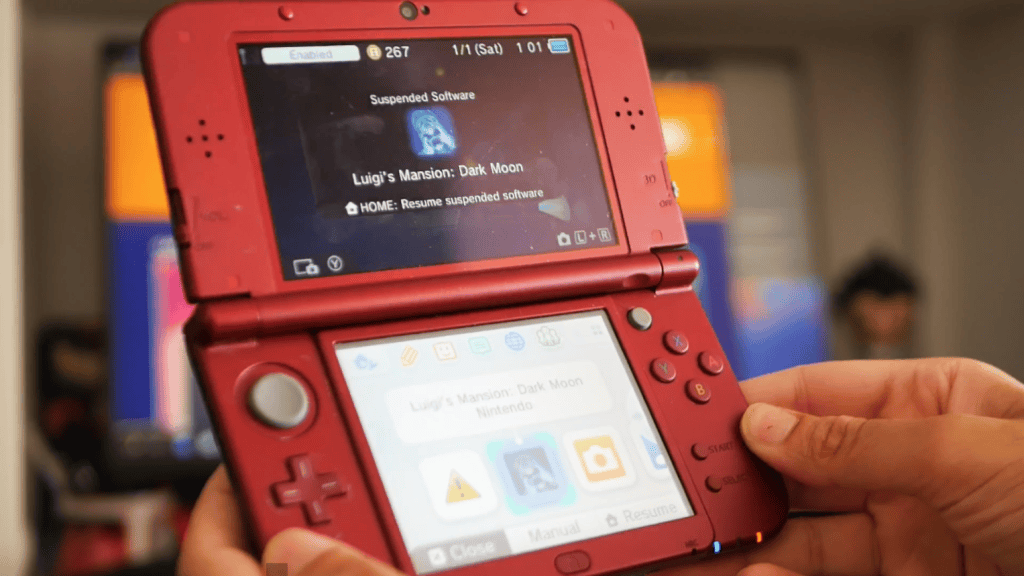
Opening up the clamshell and I was surprised at how well this hinge has held up. It’s still smooth and satisfying, while holding its place in the three different hinge-stops. There’s a little wobble, but not enough to where the hinge gives in (*ahem,* Retroid). The placement of the stops is perfect, too, with the second one being how I usually play, but the last coming in handy for whenever I’m laying in bed. The sound of the click when you reach each of the stops is a little sharp and grating to my ears, but that’s a personal nitpick. Though I don’t think the hinge feels as satisfying compared to Nintendo’s older Game Boy Advance SP, it’s still very solid.
As for the buttons, things are as you remember. The Nintendo ABXY are placed evenly and have a nice matte finish. They have a soft click when pressed instead of a harsh one, which my wife is thankful for, and though they don’t have the longest travel, they’re perfectly satisfying. The D-Pad is fine as well, though a little smaller than I’d like. It’s a little wobblier than I remember, too, though that may be due to age. The shoulder buttons are nice and clicky as well, and the ZR and ZL buttons are a nice addition to the XL, though games rarely use them. Now, let’s talk about the analogue stick situation. The Circle-Pad is…meh. It does the job, I guess, but it’s nowhere near as accurate compared to sticks on modern clamshell handhelds or even the PS Vita, whose sticks are far superior. And don’t get me started on the “nubbin” Nintendo added to this upgraded XL variant. It’s hilariously dumb. It’s not terrible; using it to move the camera in games like Xenoblade Chronicles works fine enough, but it in no way feels satisfying or accurate. Still, I can’t discount that, in terms of durability, it’s held up very well.
The screen on this “New” XL got a nice upgrade, though mainly in terms of the 3D technology where it does a far better job of tracking your eyes so that you don’t lose the 3D effect when you move your head around a little. The screen itself is still pretty low resolution, coming in at a paltry 240p. As you might imagine, this makes for a pretty pixelated visual experience, especially when you turn on the 3D, which adds further noise to the image. This screen was already outdated when it released back in the day, and time hasn’t been any kinder to it. Still, on a four-and-a-half-inch screen the PPI is good enough to where I’d say it doesn’t take away from the experience altogether, especially if you’re playing Nintendo games or other titles with similarly animated art-styles.
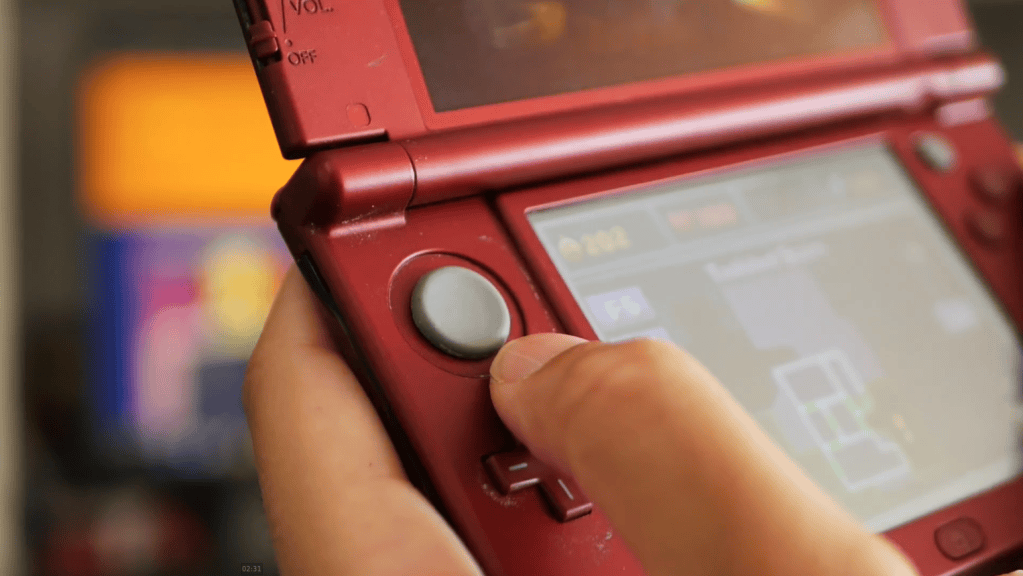
Speaking of screen size, I will say these bezels are quite dated as well. Modern retro handhelds are fitting 7-inch screens into smaller form-factors. I get that the speakers are located up top, but I would’ve preferred if Nintendo moved them to the bottom and gave us an inch-or-so more in screen real estate. Both the bezels and low resolution are quite jarring in 2026, but again, not enough to fully sully the experience.
Oh, and there’s also the second screen, which has resistive-touch functionality, and the stylus. I have nothing to say about either because I rarely use the stylus and the second screen simply acts as a map for when I play my RPGs. As such, the low resolution screen doesn’t bother me as much and the touch sensitivity is fine, I guess. Seriously, I think Kid Icarus was the only game I used either, extensively, and I remember having a good time with it, so I guess both are serviceable for when you need to use them.
The Inside
The “New” 3DS XL is powered by a slightly boosted ARM11 processor. This boost allowed the handheld to support a few more demanding exclusives, namely Xenoblade Chronicles and Fire Emblem Warriors. I played the former for the first time on this device, and though I loved the game, it definitely was pushing this handheld to its limit—Shulk did not look great on this thing.
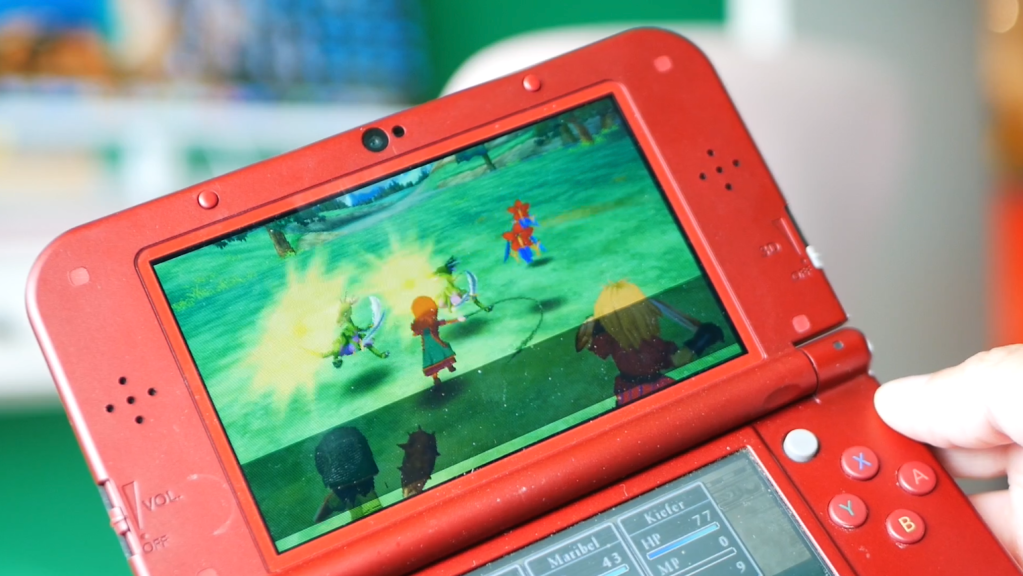
As for battery life, things are…kinda mediocre. The 1,750 mAh battery is quite a bit smaller than that of its competitor, the PS Vita, which is fitted with a 2,200 one. The difference in battery life is noticeable between the two, especially on standby. That’s not to say the battery life is terrible on the 3DS; I can get about 3 hours on one charge while playing Dragon Quest VII, which is fine for two play sessions. However, the handheld eats away at the battery a little too quickly while on standby, leading to me having to search for the charger midway through that second play session.
I’ve always enjoyed Nintendo’s UIs. From the Wii to the Switch, Nintendo’s UIs are always charming and simple, and the 3DS is no different. The tile customization on the bottom is a nice touch, allowing you to view all of your apps at once. On that front, though, I will say, there are a couple of extra apps pre-installed that feel a little like bloat—like, what the heck even is Face Raiders?
The Experience
What makes the 3DS so special, even all of these years later, is its library of games. From most of Nintendo’s mascots making an appearance in tremendous fashion to countless JRPG classics to amazing indies, the 3DS library is impressive on its own. But, when you add the fact that its backwards compatible with most DS titles, the result is a library that may well be one of the greatest of all-time.
The library alone makes the 3DS a very worthy pickup in 2026. It’s why I have yet to sunset this device and keep coming back to it; there’s always some game or another that I want to play on it. And the playing experience still holds up quite well. Sure, the low resolution screen, quirky analogue stick, and mediocre battery life are a little disappointing, but none of those elements come close to mar the overall experience of playing this classic clamshell—a clamshell that I think modern manufacturers could still learn a thing or two from.
Check out our sponsor, ObserverCrew, for more gaming and film coverage created by other passionate journalists! They’ve just launched their new site, RetroObserver, where you can read awesome nostalgic pieces like this.


Leave a comment